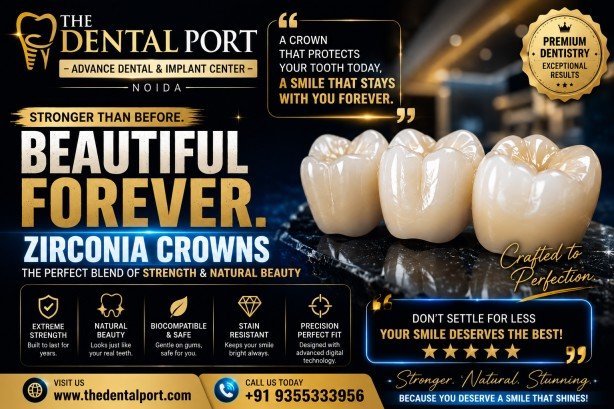
A damaged, heavily filled, fractured, discoloured, or root canal treated tooth may look like a small dental problem, but leaving a weakened tooth unprotected can increase the risk of further damage. A properly planned dental crown can restore the tooth’s shape, chewing function, appearance, and protection.
Among modern crown materials, zirconia crowns have become a popular choice because they combine high strength with a tooth-coloured appearance. However, zirconia is not automatically the best crown for every tooth. The right material depends on the location of the tooth, bite forces, remaining tooth structure, aesthetic requirements, gum condition, and the dentist’s treatment plan.
If you are searching for zirconia crowns in Noida, zirconia dental crowns near me, or wondering about the zirconia crown cost in Noida, this guide explains what actually matters before choosing a crown.
What Is a Zirconia Crown?
A zirconia crown is a tooth-coloured dental restoration made primarily from zirconium dioxide, a strong ceramic material used in restorative dentistry.
The crown is custom-designed to cover and protect a prepared tooth. Depending on the clinical situation, zirconia may be used for posterior teeth, anterior teeth, implant-supported crowns, or other restorative applications.
A well-designed zirconia crown can help restore:
- Tooth strength
- Chewing function
- Tooth shape and proportions
- Smile aesthetics
- Protection of weakened tooth structure
- Proper contact with neighbouring teeth
The important point is that the material alone does not determine the success of a crown. Tooth preparation, occlusion, digital design, laboratory quality, cementation, and long-term oral hygiene all matter.
Why Are Zirconia Crowns Popular in Noida?
Patients choosing a dental crown today often want two things at the same time: strength and a natural appearance.
Traditional metal crowns are strong but are not tooth coloured. Porcelain-fused-to-metal crowns can provide good aesthetics, but the underlying metal may sometimes affect the appearance around the gum margin.
Modern zirconia restorations provide another option.
Depending on the zirconia formulation and design, they can offer:
- High fracture resistance
- Good functional durability
- Tooth-coloured aesthetics
- Metal-free construction
- Good tissue compatibility
- Digital CAD/CAM fabrication
- Customised shape and shade
- Predictable fit when properly designed and fabricated
This makes zirconia particularly useful when a tooth requires substantial protection without compromising appearance.
7 Major Benefits of Zirconia Crowns
1. High Strength for Heavily Loaded Teeth
One of the biggest reasons dentists choose zirconia is its mechanical strength.
Posterior teeth are exposed to substantial chewing forces. For patients who require strong restorations on molars or premolars, appropriately selected zirconia can be an excellent option.
Some high-strength zirconia materials have flexural strength values exceeding 1,000 MPa, although the exact strength varies considerably between zirconia generations and products.
This is why it is better to ask your dentist which type of zirconia is being used, rather than simply asking whether a crown is “zirconia.”
2. Natural-Looking Appearance
Modern zirconia is very different from the extremely opaque zirconia used in some early restorations.
Newer multilayer and more translucent zirconia materials can provide improved light transmission and shade gradation.
A good crown should not simply be white. It should reproduce the:
- Shade
- Shape
- Contour
- Surface texture
- Translucency
- Proportions
of the surrounding teeth.
For visible front teeth, aesthetic planning becomes especially important.
3. Metal-Free Restoration
Zirconia crowns contain no conventional metal substructure.
For patients who prefer metal-free restorations, zirconia provides a ceramic alternative to metal or porcelain-fused-to-metal crowns.
However, “metal-free” should not be confused with “automatically superior.” The clinical indication and quality of the restoration remain more important than the marketing label.
4. Good Biocompatibility
Zirconia is generally considered highly biocompatible and is widely used in dentistry.
A well-fitting crown with properly finished margins can support healthy surrounding tissues when combined with good oral hygiene.
It is important to remember that gum health depends on more than crown material. Over-contoured crowns, poor margins, plaque accumulation, and inadequate cleaning can contribute to gum problems regardless of whether the crown is zirconia, PFM, or another material.
5. Excellent Resistance to Staining
The zirconia ceramic itself is highly resistant to staining.
However, patients should understand an important distinction: the crown material does not change colour like natural enamel, but the surrounding teeth and external glazing or surface characteristics can still affect the overall appearance of the smile.
Good oral hygiene and professional dental maintenance remain important.
6. Digital Precision with CAD/CAM Dentistry
Modern zirconia crowns can be designed using digital workflows.
A typical workflow may involve:
Digital scan → virtual crown design → CAD/CAM milling → sintering → finishing and characterisation → clinical try-in → cementation
Digital dentistry can improve consistency and allow the dentist and dental laboratory to communicate the intended anatomy more accurately.
The final result still depends on the clinical and laboratory team.
7. Suitable for Many Different Clinical Situations
Zirconia can be considered for several restorative situations, including:
- Root canal treated teeth
- Heavily restored posterior teeth
- Fractured teeth
- Severely worn teeth
- Teeth with significant structural loss
- Selected anterior teeth requiring high aesthetics
- Implant-supported crowns
The choice should always follow an examination and appropriate diagnostic assessment.
Are Zirconia Crowns Really the Best Crowns?
This is where patients should be careful with online dental marketing.
There is no single crown material that is best for every patient and every tooth.
Zirconia may be an excellent choice for one tooth, while lithium disilicate or another ceramic restoration may be more appropriate for another.
For example:
Posterior tooth + high bite forces:
High-strength zirconia may be strongly considered.
Highly aesthetic anterior tooth:
A more translucent ceramic may sometimes provide superior optical characteristics.
Severely damaged tooth:
The priority may be tooth preservation, ferrule, core build-up, periodontal condition, and occlusal protection rather than simply selecting a crown material.
The better question is not:
“Which crown is the best?”
It is:
“Which crown material is best suited to my tooth, bite, aesthetic requirements, and long-term prognosis?”
That is the question a good restorative dentist should answer.
Zirconia vs PFM vs E-max vs Metal Crowns
| Feature | Zirconia | PFM | E-max / Lithium Disilicate | Metal |
|---|---|---|---|---|
| Strength | Very high depending on type | High | High | Very high |
| Aesthetics | Excellent with modern zirconia | Good | Excellent | Poor |
| Metal-free | Yes | No | Yes | No |
| Anterior aesthetics | Very good to excellent depending on material | Good | Excellent | Poor |
| Posterior use | Excellent for selected cases | Excellent | Suitable in selected cases | Excellent |
| Translucency | Varies by zirconia type | Moderate | Excellent | None |
| Stain resistance | Excellent | Good | Excellent | Excellent |
| Digital fabrication | Yes | Yes | Yes | Yes |
The table is a general clinical comparison. The suitability of a particular material depends on the individual tooth and the specific product used.
Zirconia Crowns After Root Canal Treatment
A root canal treated tooth may have lost substantial tooth structure because of decay, previous restorations, fracture, or the treatment itself.
However, not every root canal treated tooth automatically requires a crown.
The decision depends on:
- Amount of remaining tooth structure
- Tooth position
- Occlusal forces
- Existing restoration
- Risk of fracture
- Presence of cracks
- Ferrule effect
- Functional requirements
For many posterior teeth with significant structural loss, full-coverage restoration can provide important protection.
If your dentist recommends a zirconia crown after root canal treatment, the goal should be to protect the remaining tooth structure while restoring normal function and appearance.
Are Zirconia Crowns Good for Front Teeth?
Yes, modern zirconia can be used for anterior teeth.
But anterior dentistry places greater demands on optical properties.
For a front tooth, the dentist may need to evaluate:
- Natural tooth shade
- Translucency
- Adjacent teeth
- Gum position
- Smile line
- Facial symmetry
- Tooth proportions
- Surface texture
- Incisal characteristics
Highly translucent zirconia can produce excellent aesthetic results in selected cases. However, other ceramics may sometimes offer superior optical behaviour depending on the clinical situation.
This is why “zirconia for every tooth” is not a scientifically sound treatment philosophy.
Types of Zirconia Used in Dentistry
Not all zirconia is the same.
High-Strength Zirconia
These materials prioritise mechanical strength and are commonly considered for areas exposed to substantial chewing forces.
Translucent Zirconia
Translucent zirconia improves optical properties while maintaining useful mechanical performance.
Multilayer Zirconia
Multilayer blocks contain gradients in shade and translucency designed to create a more natural appearance.
Monolithic Zirconia
A monolithic crown is milled primarily from zirconia rather than relying on a thick external porcelain layer.
This can reduce the risk of porcelain chipping in appropriate cases.
Your dentist should select the zirconia formulation based on the clinical requirement rather than choosing purely by brand name or price.
How Much Does a Zirconia Crown Cost in Noida?
The zirconia crown cost in Noida can vary significantly.
The price may depend on:
- Type and quality of zirconia
- Crown design
- Digital scanning and CAD/CAM workflow
- Dental laboratory
- Dentist’s expertise
- Tooth location
- Complexity of tooth preparation
- Additional procedures required
- Temporary crown
- Core build-up
- Root canal treatment
- Gum treatment
- Occlusal correction
- Whether the crown is tooth-supported or implant-supported
Therefore, a very low online price should not be compared directly with a premium restorative crown without understanding what is included.
At The Dental Port, Advance Dental & Implant Center, Noida, patients can undergo a clinical assessment to determine whether zirconia, E-max, PFM, or another restoration is appropriate for their specific tooth.
For current pricing, the most accurate approach is to evaluate the tooth first and then provide a treatment plan based on the required restoration.
Zirconia Crown Procedure: What Happens?
A typical zirconia crown treatment may involve several stages.
Step 1: Dental Examination
The dentist evaluates the tooth, gums, bite, existing restoration, and remaining tooth structure.
An X-ray may be recommended when clinically indicated.
Step 2: Treatment Planning
The dentist determines whether the tooth can be restored and whether additional treatment is required.
This may include:
- Root canal treatment
- Core build-up
- Gum treatment
- Replacement of an old restoration
- Management of cracks
- Bite evaluation
Step 3: Tooth Preparation
The tooth is carefully prepared to create sufficient space for the planned crown while preserving as much healthy tooth structure as possible.
Step 4: Digital Scan
An intraoral scanner may be used to capture the prepared tooth and surrounding structures.
Digital scanning can eliminate the need for conventional impression material in suitable cases.
Step 5: CAD Design
The crown is digitally designed according to the patient’s tooth anatomy, occlusion, contacts, and aesthetic requirements.
Step 6: Zirconia Milling and Sintering
The digital design is transferred to a milling system. The zirconia restoration is then sintered according to the manufacturer’s protocol.
Step 7: Try-In and Occlusal Adjustment
The dentist checks:
- Marginal fit
- Contacts
- Bite
- Shape
- Shade
- Patient comfort
Step 8: Final Cementation
Once the restoration is clinically satisfactory, it is permanently cemented using an appropriate luting protocol.
How Long Do Zirconia Crowns Last?
A zirconia crown does not have a guaranteed expiration date.
Clinical longevity depends on:
- Crown design
- Material
- Tooth preparation
- Cementation
- Bite forces
- Bruxism
- Oral hygiene
- Gum health
- Diet and habits
- Regular dental examinations
Many dental crowns can function for 10 years or longer, but individual outcomes vary.
A crown can remain structurally intact while the tooth underneath develops decay, gum disease, fracture, or another problem. Therefore, regular dental examinations remain important even when the crown looks perfectly normal.
Can Zirconia Crowns Break?
Zirconia is highly fracture-resistant, but no dental restoration is indestructible.
Failure can occur because of:
- Excessive bite forces
- Severe grinding or clenching
- Trauma
- Poor crown design
- Inadequate tooth preparation
- Cementation problems
- Material-related factors
- Underlying tooth fracture
A properly planned restoration combined with management of excessive bite forces can improve long-term performance.
Patients who grind their teeth may benefit from an individually assessed night guard.
Zirconia Crown vs Tooth Extraction and Dental Implant
A crown and an implant solve different problems.
A zirconia crown restores a tooth that is still considered restorable.
A dental implant replaces a missing tooth after extraction or tooth loss.
Therefore, extraction should not be recommended simply because a tooth needs a crown.
If a natural tooth has a reasonable long-term prognosis, preserving it is generally preferable to removing it unnecessarily.
When a tooth is non-restorable, however, an implant-supported restoration may become part of the treatment discussion.
What Makes a Zirconia Crown Look Natural?
The most natural-looking crown is not necessarily the brightest or whitest crown.
Aesthetic success depends on:
Shade + translucency + anatomy + surface texture + proportions + contacts + gum relationship + occlusion
The dentist and laboratory technician should consider the neighbouring teeth rather than designing the crown in isolation.
For front teeth, photographs and digital planning can also help improve communication between the clinical and laboratory teams.
How to Choose the Best Dental Clinic for Zirconia Crowns in Noida
When comparing clinics, do not choose purely on crown price.
Ask:
- Who will examine and plan the case?
- Which zirconia material is being used?
- Is the crown designed digitally?
- Is an intraoral scanner available?
- Which dental laboratory fabricates the restoration?
- How is the bite evaluated?
- What happens if the crown needs adjustment?
- Is the underlying tooth healthy enough for restoration?
- Is a root canal or core build-up required?
- Does the dentist explain alternative crown materials?
These questions are much more useful than simply asking, “What is the cheapest zirconia crown?”
Why Choose The Dental Port for Zirconia Crowns in Noida?
At The Dental Port, Advance Dental & Implant Center, Noida, zirconia crown treatment is planned around the individual tooth rather than using a one-material-fits-all approach.
The clinical assessment may include:
- Tooth and gum evaluation
- Digital scanning where appropriate
- Occlusal assessment
- Shade and aesthetic planning
- Digital crown design
- Laboratory coordination
- Try-in and bite verification
- Final cementation and follow-up
The objective is simple: preserve the natural tooth whenever possible and provide a restoration that functions comfortably and looks appropriate for the patient’s smile.
If you are looking for zirconia crowns in Noida, particularly around Sector 168, Sector 137, Sector 142, Sector 143, Sector 150 and the Noida-Greater Noida Expressway, a proper clinical assessment is the best starting point.
Frequently Asked Questions About Zirconia Crowns
What is a zirconia crown?
A zirconia crown is a tooth-coloured ceramic restoration made from zirconium dioxide. It covers and protects a damaged or weakened tooth while restoring its shape, function, and appearance.
Are zirconia crowns better than PFM crowns?
Not in every situation. Zirconia generally offers excellent strength and aesthetics, while PFM remains a proven restorative option. The best choice depends on the tooth, bite, aesthetic requirements, remaining tooth structure, and clinical indication.
Are zirconia crowns better than E-max crowns?
Both can provide excellent results. Zirconia is particularly attractive when high strength is important, while lithium disilicate such as E-max is often valued for its optical properties. The correct material depends on the individual case.
How long does a zirconia crown last?
Many crowns can last 10 years or longer, but longevity varies. Oral hygiene, bite forces, crown design, cementation, tooth condition, and regular dental care all influence the outcome.
Are zirconia crowns safe?
Zirconia is widely used in dentistry and is generally considered highly biocompatible. Proper crown design, fit, finishing, cementation, and oral hygiene are important for maintaining healthy surrounding tissues.
Can zirconia crowns be used after root canal treatment?
Yes. Zirconia can be used to restore selected root canal treated teeth, particularly when substantial tooth structure has been lost. However, not every root canal treated tooth necessarily requires a crown.
Are zirconia crowns suitable for front teeth?
Yes. Modern translucent zirconia can provide highly aesthetic results in selected anterior cases. The dentist should choose the material according to the required optical and functional characteristics.
Do zirconia crowns look artificial?
A properly designed modern zirconia crown can look very natural. The final appearance depends on the zirconia type, shade, translucency, tooth anatomy, surface characterisation, and quality of clinical and laboratory work.
Can zirconia crowns stain?
Zirconia itself is highly resistant to staining. However, the surrounding natural teeth can change colour over time, which may affect the overall appearance of the smile.
Can zirconia crowns chip?
Zirconia itself has high fracture resistance, although damage can still occur under excessive forces, trauma, severe bruxism, or unfavourable design. The behaviour also depends on the specific zirconia material and restoration design.
How many visits are required for a zirconia crown?
Many conventional cases can be completed in two main appointments, although the number varies according to the condition of the tooth and whether additional procedures are required.
Is a zirconia crown painful?
The tooth is generally treated under local anaesthesia during preparation. Some patients may experience temporary sensitivity or gum tenderness afterwards. Persistent pain should be evaluated by the dentist.
Can a zirconia crown be placed over a root canal treated tooth?
Yes, when the tooth has adequate remaining structure and a suitable prognosis. The dentist must first assess the root canal, remaining tooth structure, periodontal health, and bite.
What is the zirconia crown price in Noida?
The price varies according to zirconia type, laboratory quality, digital workflow, dentist expertise, tooth condition, and additional treatment requirements. A consultation is needed for an accurate treatment estimate.
Where can I get zirconia crowns near me in Noida?
Patients searching for zirconia crowns near me in Noida can consider a clinic that provides comprehensive examination, digital planning, restorative dentistry, and laboratory-supported crown fabrication. The Dental Port, Advance Dental & Implant Center in Sector 168, Noida, provides restorative and cosmetic dental care following individual treatment planning.
Final Takeaway
Zirconia crowns are among the strongest and most versatile tooth-coloured crown options available today, but the material is only one part of successful treatment.
A long-lasting crown depends on the condition of the tooth, accurate diagnosis, conservative preparation, appropriate material selection, precise digital or conventional fabrication, correct bite, excellent margins, proper cementation, and good oral hygiene.
If you have a broken, heavily filled, discoloured, weakened, or root canal treated tooth, do not choose a crown solely because it is advertised as the “best.”
Choose the restoration that is best suited to your tooth.
If you are considering a zirconia crown in Noida, schedule a dental evaluation at The Dental Port, Advance Dental & Implant Center, Sector 168, Noida to understand whether zirconia is the right option for your tooth and what alternatives may be available.
Book a consultation: +91 93553 33956
Disclaimer: This article is for general educational purposes and does not replace an individual dental examination, diagnosis, or treatment plan. Crown material, treatment sequence, prognosis, and cost vary from patient to patient.

Pingback: Is It Normal to Have Pain After a Dental Crown? A Dentist Explains What’s Normal and What Needs Attention - The Dental Port
Pingback: Pain After a Dental Crown? When to See a Dentist | Noida