If you have been told that you do not have enough bone for a dental implant, do not assume that dental implants are no longer an option.
Bone loss after tooth extraction, gum disease, trauma or long-term missing teeth can reduce the height or width of the jawbone needed to support an implant. In such cases, bone grafting for dental implants can rebuild the deficient area and create a more suitable foundation for implant placement.
At THE DENTAL PORT, Advance Dental & Implant Center, Noida, bone augmentation is planned according to the individual patient’s bone volume, implant requirements, gum condition, medical history and long-term restorative goals.
This guide explains bone grafting for dental implants in Noida, including the cost factors, types of bone grafting, procedure, healing time, sinus lift, implant timing and the questions you should ask before undergoing treatment.
What Is Bone Grafting for Dental Implants?
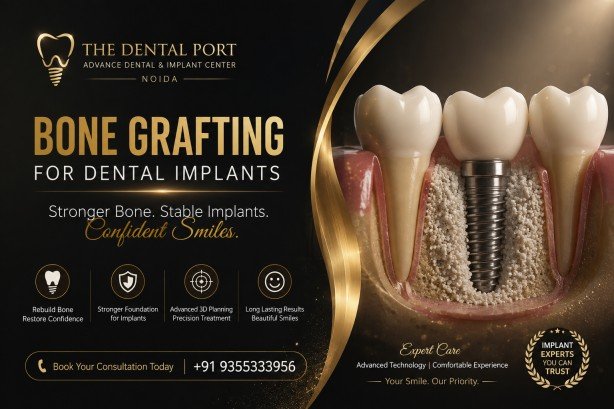
Dental bone grafting is a procedure used to rebuild or augment areas of the jaw where there is insufficient bone to support a dental implant.
A dental implant requires adequate bone volume for stability and long-term integration. When bone has been lost, an implant may not have sufficient support or may need to be positioned in a compromised location.
A bone graft can help increase:
- Bone width
- Bone height
- Bone volume
- Support around a future implant
- The available foundation for implant placement
However, not every patient with bone loss automatically needs a bone graft.
The decision should be based on clinical examination and appropriate imaging, usually including a CBCT scan, rather than on an X-ray alone.
Why Do Patients Need Bone Grafting Before Dental Implants?
The most common reason is bone loss following tooth extraction or prolonged tooth loss.
Once a tooth is removed, the surrounding jawbone no longer receives the same functional stimulation. Over time, the ridge can become narrower and shorter.
Other causes include:
1. Long-Term Missing Teeth
The longer a tooth remains missing, the greater the possibility of progressive ridge resorption.
2. Advanced Gum Disease
Periodontitis can destroy the bone supporting natural teeth. Even after the diseased tooth is removed, the remaining bone may be insufficient for implant placement.
3. Previous Infection
A severe dental infection can cause destruction of the surrounding bone.
4. Dental Trauma
Injury to the teeth or jaw may result in localized bone defects.
5. Failed Previous Dental Treatment
Some patients present after extraction, previous implant treatment or other surgical procedures with inadequate bone volume.
6. Naturally Thin Jawbone
Some areas of the jaw, particularly certain regions of the upper front jaw, may naturally have limited bone thickness.
7. Pneumatized Maxillary Sinus
In the posterior upper jaw, the maxillary sinus may occupy a large portion of the available bone. A sinus lift or sinus augmentation may therefore be required before implants can be placed.
How Much Does Bone Grafting Cost for Dental Implants in Noida?
The cost of bone grafting in Noida is not a single fixed amount because different patients have very different bone defects.
The final treatment fee can depend on:
- Size and location of the defect
- Amount of bone augmentation required
- Type of grafting procedure
- Graft material selected
- Membranes or additional regenerative materials required
- Whether a sinus lift is necessary
- Number of teeth or implants involved
- Complexity of the surgery
- CBCT and other diagnostic requirements
- Whether grafting and implant placement are performed together or separately
At THE DENTAL PORT, Noida, the recommended procedure should be determined after clinical examination and 3D imaging.
A practical point about bone grafting cost
Be cautious of comparing clinics only on the quoted graft price.
A lower initial quote may not include the graft material, membrane, imaging, surgical procedure, medications or follow-up care. Similarly, a higher quote may reflect a more extensive reconstruction.
The better question is:
“What exactly is included in my bone grafting treatment plan?”
This gives you a more meaningful comparison than price alone.
Types of Bone Grafting Used for Dental Implants
Different bone defects require different approaches. There is no single bone graft procedure that is suitable for everyone.
1. Socket Preservation
Socket preservation is performed around the time of tooth extraction.
When a tooth is removed, the socket can be filled with an appropriate grafting material to help reduce the loss of bone volume during healing.
It may be considered when a future dental implant is planned.
Best suited for:
Patients undergoing extraction who want to preserve the site for possible future implant placement.
2. Ridge Augmentation
Ridge augmentation is used when the jaw ridge has become too narrow or deficient for predictable implant placement.
The graft is placed in the deficient region to increase the available bone volume.
Best suited for:
Horizontal or vertical ridge deficiencies that prevent ideal implant positioning.
3. Sinus Lift or Sinus Augmentation
A sinus lift for dental implants is generally considered for selected patients who have insufficient bone height in the posterior upper jaw.
The sinus membrane is carefully elevated and grafting material is placed beneath it to increase the available bone height.
There are different techniques, and the appropriate method depends on the remaining bone height, sinus anatomy and implant plan.
Best suited for:
Certain patients requiring implants in the upper back teeth region.
4. Block Bone Grafting
A block graft may be considered for larger or more complex bone deficiencies.
A block of bone is secured to the deficient area and allowed to heal before or as part of implant rehabilitation, depending on the clinical situation.
Best suited for:
Selected patients with significant localized bone deficiencies.
5. Guided Bone Regeneration
Guided bone regeneration, or GBR, uses grafting material and a barrier membrane to encourage bone formation in a deficient area.
It is widely used in implant dentistry when additional bone volume is required for implant placement or around an implant site.
The technique chosen depends on the shape and size of the defect.
Do You Always Need Bone Grafting Before a Dental Implant?
No.
This is one of the most important points patients should understand.
Bone grafting should not be recommended simply because a patient is receiving a dental implant.
If there is adequate bone volume and the implant can be positioned safely and restoratively, additional grafting may not be necessary.
On the other hand, attempting to place an implant where there is inadequate bone can compromise implant stability, positioning, soft tissue support and long-term treatment predictability.
The goal should be the least invasive procedure that provides an appropriate foundation for the planned restoration.
At THE DENTAL PORT, treatment planning should begin with assessment of the actual defect rather than automatically adding a graft to every implant treatment.
Can a Dental Implant Be Placed at the Same Time as Bone Grafting?
Sometimes, yes.
Whether simultaneous implant placement and bone grafting is possible depends on:
- Remaining bone volume
- Primary implant stability
- Size and configuration of the defect
- Location of the implant
- Infection or inflammation
- Soft tissue condition
- Overall treatment plan
In selected cases, bone grafting and implant placement can be performed during the same surgical appointment.
In other cases, the bone needs to heal first before the implant can be placed.
This distinction is important because the fastest treatment is not necessarily the most appropriate treatment.
How Long Does Bone Grafting Take to Heal?
Bone graft healing is not instantaneous.
The soft tissues may feel substantially better within the first couple of weeks, but biological bone maturation takes considerably longer.
The timeline varies according to the type and size of graft, location, patient’s healing response and whether an implant was placed simultaneously.
A general treatment sequence may look like this:
Consultation → CBCT evaluation → Treatment planning → Bone grafting → Healing → Reassessment → Implant placement → Osseointegration → Final crown
Some patients may require several months between grafting and implant placement.
Your dentist should therefore provide a personalized timeline rather than promising that every graft will heal within a fixed number of weeks.
What Happens During a Bone Grafting Procedure?
Although the exact technique varies, the procedure generally involves several stages.
Step 1: Clinical Assessment
The dentist evaluates the missing tooth region, gums, bite, adjacent teeth and overall oral condition.
Step 2: 3D Imaging
A CBCT scan for dental implants can provide three-dimensional information about bone height, width and anatomical structures.
Step 3: Treatment Planning
The clinician determines whether grafting is actually required and selects the appropriate technique.
Step 4: Graft Placement
The deficient area is prepared and the selected graft material is placed according to the surgical plan.
Step 5: Membrane or Stabilization
Where indicated, a membrane or other method may be used to protect and stabilize the graft.
Step 6: Suturing
The surgical site is closed and postoperative instructions are provided.
Step 7: Healing and Review
Follow-up appointments are used to monitor soft tissue healing and the development of adequate bone for the next stage.
What Bone Graft Materials Are Used?
Bone graft materials can come from different sources and may include:
- Autogenous bone
- Allograft material
- Xenograft material
- Synthetic or alloplastic graft materials
The choice depends on the clinical situation, surgical objective, availability, clinician preference and patient-specific factors.
There is no universal “best bone graft material” for every patient.
A good treatment plan should explain why a particular material or combination of materials is being recommended for your case.
Is Bone Grafting Painful?
Bone grafting is performed using local anesthesia, so the surgical procedure itself should not be painful.
After surgery, patients can experience:
- Mild to moderate discomfort
- Swelling
- Tenderness
- Minor bleeding
- Temporary difficulty chewing around the treated area
Postoperative symptoms vary according to the size and location of the procedure.
Following the prescribed medication and postoperative instructions can help make recovery more comfortable.
If pain or swelling becomes severe, continues to worsen or is associated with other concerning symptoms, the treating dentist should be contacted promptly.
Bone Grafting and Dental Implants: What Comes First?
There are several possible treatment pathways.
Option 1: Extraction + Socket Preservation
Tooth removal is followed by grafting to preserve the extraction site.
Option 2: Bone Grafting First, Implant Later
The bone is rebuilt and allowed to heal before implant placement.
Option 3: Bone Grafting + Implant Placement
In carefully selected cases, both procedures can be performed during the same treatment phase.
Option 4: Sinus Lift + Implant Placement
Depending on the remaining bone height and clinical circumstances, a sinus augmentation and implant may be performed together or in separate stages.
The correct sequence depends on your anatomy, not simply on a standard treatment protocol.
What Happens If You Skip Bone Grafting When It Is Recommended?
If there is genuinely inadequate bone and an implant is placed without addressing the deficiency, several problems may arise.
These can include:
- Poor implant positioning
- Inadequate primary stability
- Exposure of the implant surface
- Compromised esthetics
- Difficulty achieving appropriate soft tissue contours
- Increased risk of complications
However, it is equally important not to assume that every bone defect requires extensive grafting.
The objective is not maximum grafting. The objective is adequate biology and appropriate implant positioning.
Bone Grafting for Dental Implants in Noida: Why 3D Planning Matters
A conventional dental X-ray provides a two-dimensional view.
A CBCT scan can provide three-dimensional information that helps the implant dentist assess:
- Bone height
- Bone width
- Bone morphology
- Sinus anatomy
- Inferior alveolar nerve location
- Adjacent anatomical structures
- Implant positioning possibilities
This information can be particularly valuable when planning complex dental implants, full-mouth rehabilitation, multiple implants or severe bone loss.
Can Bone Grafting Help With Severe Jawbone Loss?
In many cases, bone augmentation can make implant treatment possible even when substantial bone loss has occurred.
However, severe bone loss requires more detailed planning.
Depending on the anatomy, treatment may involve:
- Ridge augmentation
- Guided bone regeneration
- Sinus augmentation
- Block grafting
- Staged implant placement
- Specialized implant solutions in selected cases
For patients with severe upper-jaw bone loss, conventional implants may not always be the only consideration. Advanced treatment options such as zygomatic implants may be evaluated in appropriately selected cases.
These procedures require specialist assessment and should not be presented as a universal alternative to conventional bone grafting.
How to Prepare for Bone Grafting
Before your procedure, inform your dentist about:
- Existing medical conditions
- Current medications
- Previous dental surgeries
- Allergies
- Smoking or tobacco use
- Previous implant complications
- Any history of gum disease
Good oral hygiene and control of active dental infection are important before regenerative procedures.
Smoking can negatively affect healing, so patients who smoke should discuss cessation or reduction with their dental surgeon.
Follow the specific preoperative instructions provided by your treating team.
After Bone Grafting: Important Care Instructions
Your dentist will provide instructions specific to your procedure, but postoperative care commonly includes:
- Avoid disturbing the surgical site
- Follow prescribed medications
- Maintain appropriate oral hygiene as instructed
- Avoid smoking during healing
- Follow dietary restrictions recommended by your dentist
- Avoid unnecessary pressure on the grafted area
- Attend scheduled follow-ups
- Contact your dentist if unusual symptoms develop
Do not compare your healing with someone else’s experience. A small socket preservation procedure and a major ridge augmentation do not heal in exactly the same way.
When Should You See a Dental Implant Specialist in Noida?
Consider an implant-focused evaluation if you have:
- Missing teeth with significant bone loss
- Been told you cannot receive implants because of insufficient bone
- Been advised to undergo a sinus lift
- Had teeth missing for many years
- Experienced severe gum disease
- Previously failed an implant
- Been advised to undergo extensive bone grafting
- Been offered multiple treatment options and are unsure which is appropriate
A second opinion can be particularly useful when the proposed treatment is complex or involves several surgical stages.
Bone Grafting for Dental Implants in Noida: Why Choose THE DENTAL PORT?
At THE DENTAL PORT, Advance Dental & Implant Center, Noida, implant treatment is planned around the patient’s individual anatomy and restorative requirements.
Our approach focuses on:
- Detailed clinical evaluation
- 3D imaging where indicated
- Individualized implant planning
- Assessment of bone quality and quantity
- Appropriate selection of grafting techniques
- Comprehensive implant rehabilitation
- Clear discussion of treatment alternatives
- Structured follow-up throughout treatment
Located in Noida Sector 168, THE DENTAL PORT serves patients from the Greater Noida Expressway corridor and nearby areas including Sector 137, Sector 142, Sector 143, Sector 150, Sector 104, Sector 110, Sector 118, Sector 120, Sector 122, Sector 128, Sector 132 and Sector 144.
The right treatment is not necessarily the most expensive or the most extensive. It is the treatment that addresses the actual clinical problem while maintaining a sound biological and restorative foundation.
Frequently Asked Questions About Bone Grafting for Dental Implants
Is bone grafting necessary for every dental implant?
No. Bone grafting is recommended when the available bone is insufficient for the planned implant position or when preservation or augmentation of the implant site is clinically indicated.
How much does dental bone grafting cost in Noida?
The cost varies according to the type and extent of grafting, graft material, surgical complexity, imaging and whether additional procedures such as sinus augmentation are required. A personalized examination and CBCT assessment are needed for an accurate estimate.
Can I get an implant immediately after bone grafting?
Sometimes. In selected cases, the implant can be placed together with the graft. In other cases, the graft needs to heal before implant placement.
How long after bone grafting can I get a dental implant?
The timing varies with the grafting technique, size of the defect and healing response. Some cases can proceed relatively quickly, while larger grafts may require several months of healing before implant placement.
Is bone grafting safe?
Bone grafting is a commonly used procedure in implant dentistry, but like any surgical procedure it has potential risks. Your dentist should explain the expected benefits, limitations and risks before treatment.
Does bone grafting hurt?
The procedure is performed under anesthesia. Some postoperative swelling, tenderness or discomfort can occur during healing, depending on the extent of surgery.
Can bone grafting save me from losing the option of dental implants?
Bone augmentation can make implant treatment possible in many patients who have inadequate bone. However, the appropriate approach depends on the location and severity of bone loss and the patient’s overall oral condition.
Is a sinus lift the same as a bone graft?
A sinus lift is a specific type of bone augmentation procedure used in selected cases involving the posterior upper jaw. Bone graft material is often placed during the procedure to increase the available bone height.
Can bone grafting be done after many years of missing teeth?
Yes, in many cases. However, the amount and pattern of bone loss can increase with time, which may make treatment more complex.
What if I have diabetes or another medical condition?
Certain medical conditions can influence surgical healing and implant treatment. Your dentist should review your medical history and medications before recommending bone grafting or implants.
Should I get a second opinion before bone grafting?
For complex or extensive grafting, a second opinion can be reasonable, particularly when several treatment options are available. Ask each clinician to explain the diagnosis, alternatives, expected timeline and total treatment requirements.
The Bottom Line
Bone loss does not automatically mean you cannot have dental implants.
Modern implant dentistry offers several methods of rebuilding deficient jawbone, including socket preservation, ridge augmentation, guided bone regeneration, sinus lift and selected block grafting procedures.
But bone grafting should never be treated as a routine add-on simply to increase the treatment bill.
The important questions are:
Do you actually need a graft?
What type of bone deficiency do you have?
Can the implant be placed predictably with or without augmentation?
Which treatment provides the best long-term foundation for your final tooth?
A detailed clinical examination and appropriate 3D imaging can help answer these questions.
If you have been told that you have insufficient bone for dental implants, you can consult the implant team at THE DENTAL PORT, Advance Dental & Implant Center, Noida for an individualized assessment and treatment plan.
Looking for bone grafting or dental implants in Noida? Book a consultation to understand your bone condition, treatment options, expected timeline and estimated cost before making a decision.
THE DENTAL PORT, Advance Dental & Implant Center, Noida
Sector 168, Noida
Call: +91 9355333956