A cracked tooth, a large filling, or a tooth weakened after root canal treatment can make eating uncomfortable and leave you worried about losing the tooth. A dental crown may help protect and restore it, but one important question usually comes first: How much does a dental crown cost in Noida, and which material is right for your tooth?
At The Dental Port – Advance Dental & Implant Center, Sector 168, Noida, dental crown treatment is planned according to the tooth’s condition, remaining healthy structure, biting forces, and appearance requirements. The right crown is not necessarily the most expensive one. It is the one that suits your clinical needs and can be maintained properly.
The cost of a dental crown depends on the material, laboratory fabrication, tooth location, and any additional treatment required before placement. Understanding these factors helps you compare treatment options more confidently.
Quick Answer: How Much Does a Dental Crown Cost in Noida?
The cost of a dental crown in Noida varies according to the material used and the complexity of the case. Metal, porcelain-fused-to-metal (PFM), zirconia, and all-ceramic crowns have different properties and price points.
For an accurate estimate, ask your dentist for a material-wise quotation that clearly distinguishes the crown itself from root canal treatment, core build-up, temporary crowns, and other procedures.
At The Dental Port in Sector 168, Noida, the recommended crown and total treatment cost can be discussed after a clinical examination. Contact the clinic for current prices and availability.
Table of Contents
- What is a dental crown?
- When do you need a dental crown?
- What affects dental crown cost in Noida?
- Types of dental crowns and their differences
- Does the position of the tooth affect the crown?
- Is a crown necessary after root canal treatment?
- What is included in dental crown treatment?
- How long does dental crown treatment take?
- How do you choose the right dental crown?
- How can you avoid unexpected dental crown costs?
- Frequently asked questions
- Dental crown treatment at The Dental Port, Noida
1. What Is a Dental Crown?
A dental crown is a custom-made restoration that covers the visible portion of a tooth to restore its shape, strength, function, and appearance.
Unlike a filling, which repairs a smaller damaged area, a crown covers a larger portion of the tooth. It may be recommended when a tooth has extensive decay, a large existing filling, a fracture, or significant structural weakness.
Crowns can also be used to restore teeth after root canal treatment when additional protection is clinically appropriate. They may form part of a dental implant restoration, where a crown is attached to an implant-supported component to replace a missing tooth.
The material and design are selected according to the condition of the tooth and the forces it must withstand.
2. When Do You Need a Dental Crown?
Your dentist may recommend a dental crown when a filling alone cannot adequately restore or protect the remaining tooth structure.
Common reasons include:
- A cracked or broken tooth: A crown may protect a tooth when the damage is restorable.
- Extensive tooth decay: A crown may be required after the decay has been removed and the remaining tooth needs additional coverage.
- A large filling: Teeth with extensive restorations may need protection against further structural damage.
- After root canal treatment: A crown may be recommended when the remaining tooth structure and location make cuspal coverage appropriate.
- Severe wear: A crown may help restore shape and function in selected cases.
- Appearance concerns: A crown may improve the shape, colour, or contour of a tooth when other options are unsuitable.
- Dental implant restoration: A custom crown can replace the visible portion of a missing tooth supported by a dental implant.
Not every damaged tooth needs a crown. Depending on the extent of the damage, a filling, onlay, or another conservative restoration may be more appropriate. Your dentist should assess how much healthy tooth structure remains before recommending treatment.
3. What Affects Dental Crown Cost in Noida?
There is no single price that applies to every dental crown. Several factors determine the final cost.
Crown material
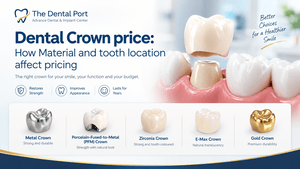
Zirconia, E-Max, PFM, and metal crowns differ in appearance, strength, fabrication requirements, and suitability for different teeth. The selected material is one of the main cost factors.
Position of the tooth
A front tooth may require careful shade matching and attention to translucency. A molar must withstand substantial chewing forces. These different requirements can influence the choice of crown and its fabrication.
Condition of the existing tooth
A tooth with adequate remaining structure may need straightforward preparation. A severely damaged tooth may require a core build-up or other restorative treatment before a crown can be placed.
Root canal treatment
If the tooth has an infected or irreversibly damaged pulp, root canal treatment may be necessary. This is generally a separate treatment component and should be identified clearly in the estimate.
Laboratory and fabrication requirements
The crown’s design, material, laboratory process, and quality of fit can affect its cost. The dentist also needs to check the crown’s margins, contact with neighbouring teeth, bite, and appearance before final placement.
Temporary crown and follow-up care
Some cases require a temporary crown while the permanent restoration is being made. Ask whether the temporary restoration, fitting appointments, and any adjustments are included in the quoted price.
Practical tip: When comparing dental crown prices in Noida, compare the same material and the same treatment components. A low advertised price may not represent the complete cost of restoring the tooth.
4. Types of Dental Crowns and Their Differences
The best crown depends on the tooth’s location, remaining structure, appearance requirements, and functional demands. Here are the commonly used options.
Zirconia Crown
A zirconia crown is made from a strong ceramic material. It is available in different formulations and designs, allowing the dentist to consider strength and appearance when planning the restoration.
Potential advantages:
- Tooth-coloured appearance
- Good strength for many clinical applications
- Metal-free construction
- Suitable for selected front and back teeth
Zirconia may be considered for molars that experience high chewing forces, as well as for other teeth when the chosen design suits the case.
The result depends on proper case selection, preparation, crown design, and bite adjustment. Zirconia is not automatically the best option for every patient.
E-Max Crown
E-Max is a lithium disilicate glass-ceramic material used for aesthetic dental restorations.
Potential advantages:
- Natural-looking translucency
- Good colour matching for visible teeth
- Metal-free appearance
- Suitable for selected crowns and other ceramic restorations
E-Max may be considered when appearance is a priority, particularly for some front teeth and premolars. Its suitability depends on the available tooth structure, bite, and restoration design.
Porcelain-Fused-to-Metal Crown (PFM)
A PFM crown combines a metal substructure with a porcelain outer layer.
Potential advantages:
- Established restorative option
- Tooth-coloured outer surface
- Metal support beneath the porcelain
- May suit selected front or back teeth
A PFM crown can be appropriate when its structural and aesthetic characteristics meet the clinical requirements. The porcelain layer may chip in some circumstances, and the metal beneath it can affect the appearance near the gum line in certain cases.
All-Metal Crown
An all-metal crown is made from a dental alloy. Its metallic appearance makes it less suitable when matching the natural colour of a visible tooth is a priority.
Potential advantages:
- Can withstand substantial chewing forces
- May require less removal of tooth structure in selected situations
- Often considered for teeth where appearance is less important
The exact properties depend on the alloy used. Metal crowns may be appropriate in selected cases, depending on patient preference and clinical requirements.
Gold Alloy Crown
Gold alloy crowns are a type of metal restoration. Their cost depends on the alloy composition, amount of material used, laboratory work, and clinic pricing.
They can offer useful mechanical properties in selected cases, but their metallic colour means they are not usually chosen when a tooth-coloured result is essential.
Which Crown Material Is Best?
| Crown type | Main consideration | Common clinical consideration |
|---|---|---|
| Zirconia | Strength and tooth-coloured appearance | Selected front and back teeth |
| E-Max | Translucency and aesthetics | Selected visible teeth and premolars |
| PFM | Porcelain appearance with a metal substructure | Selected front and back teeth |
| All-metal | Mechanical performance | Selected back teeth |
| Gold alloy | Material properties and durability | Selected cases based on clinical needs |
This table is a general guide, not a substitute for an examination. Your dentist should explain why a particular material is suitable for your tooth.
5. Does the Position of the Tooth Affect the Crown?
Yes. The position of the tooth influences the material selection, crown design, and aesthetic requirements.
Dental crown for a front tooth
Front teeth are visible when you speak and smile. Colour, shape, translucency, and the relationship with neighbouring teeth are important considerations.
E-Max, other suitable ceramics, or zirconia may be considered depending on the clinical situation. A good result requires more than selecting a tooth-coloured material. Shade selection, preparation, gum health, and the design of the final crown also matter.
Dental crown for a premolar
Premolars contribute to both appearance and chewing. They may experience different forces depending on the bite and their position.
The dentist considers the available tooth structure, aesthetic requirements, and bite when selecting the crown material.
Dental crown for a molar
Molars handle substantial chewing forces. The crown must be designed to withstand these forces while maintaining an appropriate bite and contact with neighbouring teeth.
Zirconia, PFM, and selected metal restorations may be considered, depending on the individual case.
A front tooth crown and a molar crown can therefore differ in material and fabrication requirements even when both are needed for structural restoration.
6. Is a Crown Necessary After Root Canal Treatment?
Not every root canal-treated tooth automatically requires a crown. The decision depends on the tooth’s location, the amount of healthy structure remaining, the size of any existing restoration, and the risk of fracture.
Back teeth often need cuspal coverage when substantial tooth structure has been lost. In some situations, a suitable bonded restoration may be sufficient, particularly when the remaining structure is favourable.
A root canal treats the diseased or damaged pulp inside the tooth. The final restoration serves a different purpose by sealing and restoring the tooth and, where appropriate, protecting it against fracture.
If you are considering root canal treatment and a dental crown in Noida, ask for a treatment plan that explains:
- Whether root canal treatment is necessary
- How much healthy tooth structure remains
- Whether a core build-up is required
- Why a crown or another restoration is recommended
- The cost of each treatment component
The aim is to preserve the natural tooth whenever it is predictably restorable, not to add procedures that are unnecessary.
7. What Is Included in Dental Crown Treatment?
A typical dental crown procedure may involve the following steps.
Step 1: Dental examination
The dentist examines the tooth, gums, existing restorations, and bite. X-rays may be required to assess the roots, surrounding bone, and extent of the problem.
Step 2: Treatment planning
The dentist determines whether the tooth can be restored and discusses suitable crown materials. If decay, infection, or structural damage needs treatment first, this is included in the plan.
Step 3: Tooth preparation
The tooth is shaped as needed to create space for the crown. The amount of preparation depends on the tooth, material, and restoration design.
Step 4: Impression or digital scan
An impression or digital record captures the prepared tooth and surrounding teeth. This information is used to fabricate the crown.
Step 5: Temporary crown, when needed
A temporary restoration may protect the prepared tooth while the permanent crown is being made. Whether this is required and included in the estimate depends on the case and treatment arrangement.
Step 6: Crown fitting
The dentist checks the crown’s fit, contacts, shade where relevant, and bite. Once the necessary checks are satisfactory, the crown is secured.
Step 7: Follow-up and maintenance
You may need a review if the bite feels uneven, the crown feels uncomfortable, or other concerns develop. Regular dental examinations help monitor the crown and surrounding gums.
The exact sequence and number of visits depend on the tooth’s condition and the type of restoration.
8. How Long Does Dental Crown Treatment Take?
Dental crown treatment commonly involves a preparation appointment followed by another appointment to fit the permanent crown. The interval depends on laboratory fabrication, the material selected, and the clinic’s workflow.
Treatment may take longer if the tooth first needs root canal treatment, gum treatment, or a core build-up.
Some clinics offer digital workflows or same-day crown services for selected cases. Availability depends on the equipment, material, and clinical suitability. Ask your dentist about the expected timeline before treatment begins.
9. How Do You Choose the Right Dental Crown?
Choosing a crown should involve more than comparing prices or selecting the material with the most attractive name.
Discuss the following with your dentist:
- Remaining tooth structure: Can the tooth support a crown predictably?
- Bite and chewing forces: Does the tooth experience heavy loading or grinding?
- Appearance: How important are shade, translucency, and the relationship with adjacent teeth?
- Gum health: Are the gums healthy enough to support a maintainable restoration?
- Material suitability: Which materials are appropriate for this particular tooth?
- Total cost: What procedures, laboratory work, and temporary restorations are included?
- Maintenance: What daily care and follow-up will help protect the restoration?
A well-planned crown should restore function while preserving as much healthy tooth structure as reasonably possible.
10. How Can You Avoid Unexpected Dental Crown Costs?
Before beginning treatment, request an itemised estimate rather than asking only for the price of a dental cap.
Confirm whether the quotation includes:
- Dental examination and diagnostic X-rays, where required
- Crown preparation
- The selected crown material
- Dental laboratory or fabrication charges
- Temporary crown, when required
- Core build-up or additional restorative work
- Root canal treatment, if indicated
- Final fitting and bite adjustments
- Follow-up visits and any applicable warranty terms
Also ask whether the quoted price is for the crown alone or a combined treatment package.
These questions help you understand the complete cost before committing to treatment and make it easier to compare options between dental clinics in Noida.
11. Frequently Asked Questions About Dental Crown Cost in Noida
How much does a dental crown cost in Noida?
Dental crown prices vary according to material, tooth location, laboratory fabrication, and the condition of the tooth. Contact The Dental Port for current material-wise pricing and an estimate based on your treatment needs.
What is the price of a zirconia crown in Noida?
The price depends on the zirconia system, crown design, laboratory requirements, and the clinic’s treatment charges. Ask for a current quotation and confirm whether any additional procedures are included.
Which is better, a zirconia crown or an E-Max crown?
Neither is universally better. E-Max may be considered when translucency and aesthetics are priorities, while zirconia may be suitable when strength and the demands of the bite are important. The correct choice depends on the tooth and restoration design.
Is a PFM crown a good option?
A PFM crown can be a suitable restoration in selected cases. It combines a metal substructure with a porcelain outer layer. Your dentist can explain its advantages and limitations compared with zirconia or other ceramics.
Is a dental crown painful?
Tooth preparation is generally performed under local anaesthesia when needed. Some sensitivity or gum soreness can occur afterwards. Persistent pain, a high bite, swelling, or a crown that feels loose should be assessed by a dentist.
Can a dental crown be placed on a broken tooth?
Sometimes. A crown may restore a broken tooth if enough healthy structure remains and the damage does not make the tooth unrestorable. Deep fractures, root damage, or extensive infection may require a different treatment plan.
Do I need a crown after every root canal?
No. The need depends on the tooth’s location, remaining structure, and fracture risk. Many back teeth benefit from appropriate cuspal coverage, but some teeth may be restored adequately with other options.
How long does a dental crown last?
A crown’s lifespan varies with its material, fit, bite, oral hygiene, and maintenance. No crown lasts forever, and complications can occur. Regular dental reviews and good oral hygiene help identify problems early.
Can a dental crown look like a natural tooth?
Tooth-coloured materials such as zirconia and E-Max can produce natural-looking results in suitable cases. The final appearance also depends on shade selection, crown shape, gum health, and the surrounding teeth.
What should I do if my crown feels loose?
Arrange a dental examination promptly. A loose crown may result from loss of cement, damage to the underlying tooth, or another problem. Avoid chewing hard foods on that side and do not try to glue the crown back yourself.
12. Dental Crown Treatment at The Dental Port, Sector 168, Noida
If you have a cracked tooth, a large filling, a damaged molar, or a tooth that needs restoration after root canal treatment, a dental assessment can help you understand your options.
At The Dental Port – Advance Dental & Implant Center, H-003, Nimbus The Golden Palm, Sector 168, Noida, treatment planning focuses on the condition of the tooth, suitable restorative materials, function, and appearance.
The clinic is located near the Noida Expressway and Advant Navis Business Park, making it accessible for patients living or working in the Sector 168 area.
Before choosing a crown, ask for a clear explanation of the recommended material, the reason for choosing it, the complete treatment cost, and the expected timeline.
Book a dental consultation to discuss your crown options and current pricing.
Website: https://www.thedentalport.com
Phone: +91 9355333956
Final Takeaway
The cost of a dental crown in Noida depends on more than the material alone. The condition of the tooth, its position, the restoration required, and any additional treatment all influence the final estimate.
A suitable crown should restore function, fit properly, and be maintainable with good oral hygiene and regular dental care. A clinical examination is the most reliable way to determine which option is appropriate for your tooth.
Article reviewed by Dr. Purnima Sharma, Cosmetic and Aesthetic Dentist, The Dental Port – Advance Dental & Implant Center, Noida.
This article provides general dental information and does not replace an individual clinical examination or treatment plan.