Zirconia crown or E-max crown? If you are planning a dental crown, you have probably come across both names.
Patients often ask:
“Which crown is stronger?”
“Which crown looks more natural?”
“Is E-max better for front teeth?”
“Is zirconia better for molars?”
“What should I choose for an implant crown?”
The honest answer is that there is no single crown material that is best for every tooth.
Zirconia and E-max are both advanced ceramic materials, but they behave differently. The right choice depends on the position of the tooth, remaining tooth structure, bite forces, smile line, aesthetic expectations, whether the crown is tooth-supported or implant-supported, and whether you grind or clench your teeth.
At The Dental Port, Advance Dental & Implant Center, Sector 168, Noida, we evaluate these factors before recommending a crown rather than choosing a material simply because it is more expensive or more commonly advertised.
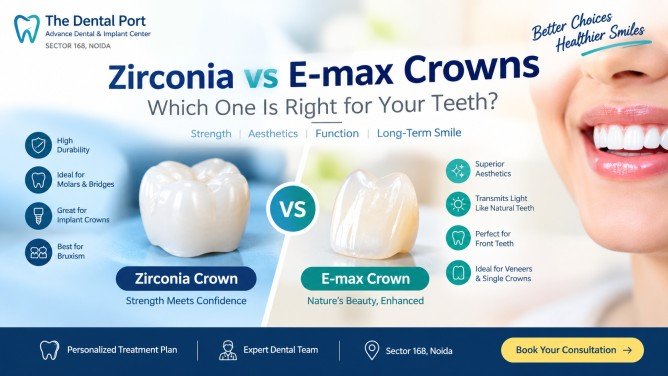
Quick Answer: Zirconia vs E-max
| Feature | Zirconia Crown | E-max Crown |
|---|---|---|
| Material | Zirconium dioxide ceramic | Lithium disilicate glass ceramic |
| Main advantage | Strength and fracture resistance | Excellent optical aesthetics |
| Appearance | Very natural with modern translucent zirconia | Highly natural and enamel-like |
| Front teeth | Excellent in selected cases | Often preferred for highly aesthetic single teeth |
| Premolars | Frequently suitable | Can be suitable depending on bite |
| Molars | Commonly selected | Suitable in selected cases |
| Bridges | Commonly used depending on design | More limited depending on span and indication |
| Implant crowns | Frequently used | Also possible in selected cases |
| Bruxism | Often considered when strength is important | Requires careful case selection |
| Veneers | Not usually the first choice | Lithium disilicate is commonly used |
| Best for | Strength-demanding restorations | Highly aesthetic restorations |
Important: The numbers often quoted online for ceramic strength are not interchangeable across every product. Zirconia itself comes in different formulations, and higher translucency can be associated with lower strength. The American Dental Association notes that zirconia products can have very high flexural strength, while lithium disilicate generally falls in a lower strength range but offers greater translucency.
What Is an E-max Crown?
E-max is commonly used to describe restorations made from lithium disilicate ceramic.
Its major advantage is its optical behaviour.
Natural teeth are not simply white. They interact with light. Enamel allows light to pass through and scatter, creating depth and vitality.
Lithium disilicate has excellent translucency, which is one reason it is widely used for highly aesthetic restorations.
E-max may be considered for:
- Front tooth crowns
- Single aesthetic crowns
- Selected premolar crowns
- Dental veneers
- Inlays and onlays
- Selected implant-supported restorations
- Smile makeover cases
Lithium disilicate is not just a cosmetic material. It has good mechanical properties and can be used for a range of anterior and selected posterior restorations.
The biggest advantage of E-max
Natural-looking light transmission.
For a single front tooth next to healthy natural teeth, matching colour, translucency, surface texture and tooth shape can be more important than simply choosing the strongest material.
What Is a Zirconia Crown?
Zirconia is a ceramic material based on zirconium dioxide.
It became popular in restorative dentistry because of its high strength and fracture resistance.
But there is an important detail patients often miss:
Not all zirconia is the same.
Modern zirconia comes in different formulations and translucency levels.
Traditional high-strength zirconia was relatively opaque. Newer translucent and multilayer zirconia can produce significantly more natural-looking restorations.
The ADA notes that increasing translucency in zirconia is generally associated with changes in its mechanical properties, meaning material selection should match the clinical situation rather than simply choosing the most translucent or strongest option.
Zirconia may be considered for:
- Molars
- Premolars
- Dental bridges
- Implant-supported crowns
- Multiple-unit restorations
- Patients with high chewing forces
- Selected anterior crowns
- Certain full-mouth rehabilitation cases
E-max vs Zirconia: The Real Difference
Think of the decision this way:
E-max
Optical performance + aesthetics + good strength
Zirconia
Strength + fracture resistance + modern aesthetics
But this does not mean:
E-max = weak
Zirconia = unattractive
That is an oversimplification.
Modern restorative dentistry has moved beyond the old idea that every front tooth needs one material and every back tooth needs another.
The material should be selected according to the specific tooth and the forces acting on it.
Which Crown Is Better for Front Teeth?
This is one of the most important questions.
For a highly visible front tooth, aesthetics are often a major consideration.
E-max may be preferred when:
- You need a single anterior crown
- The adjacent teeth are natural
- Excellent translucency is important
- The tooth has suitable structural conditions
- The bite is favourable
Translucent zirconia may be considered when:
- Greater strength is desirable
- Several teeth are being restored
- The case requires a different ceramic design
- The patient’s bite places greater demands on the restoration
Modern translucent zirconia has substantially expanded its use in aesthetic dentistry. However, lithium disilicate remains particularly valuable where maximum optical translucency is important.
What About Back Teeth and Molars?
Your molars experience substantial chewing forces.
This changes the material decision.
For posterior teeth, strength, occlusion, available tooth structure and restoration design become particularly important.
Zirconia is commonly used for posterior crowns and bridges because of its mechanical properties. In an ADA survey, posterior crowns and bridges were among the most common clinical applications reported for zirconia.
But that does not mean every molar automatically needs zirconia.
A properly designed lithium disilicate crown may also be appropriate in selected posterior situations.
The final decision should come after examining:
Tooth position + remaining tooth structure + bite + restoration thickness + opposing teeth + parafunctional habits.
What If You Grind or Clench Your Teeth?
Bruxism changes the conversation.
If you regularly:
- Grind your teeth while sleeping
- Clench your jaw
- Wake with jaw tightness
- Frequently chip teeth
- Have worn-down biting surfaces
your dentist needs to consider the additional forces placed on the restoration.
In these situations, a stronger material such as zirconia may be considered depending on the tooth and restoration design.
But simply putting a strong crown on a tooth does not solve the underlying problem.
A night guard or other protective strategy may also be recommended after assessing your bite.
Which Is Better for an Implant Crown?
An implant crown has a different clinical situation from a natural tooth.
The restoration must work with:
Implant position + abutment design + available space + bite + aesthetics + gum contour + opposing teeth.
Both zirconia and lithium disilicate can have roles in implant-supported restorations, depending on the design and clinical circumstances.
For highly aesthetic implant cases, especially in the smile zone, the dentist may consider the optical properties of the crown as well as the underlying implant components.
So the question should not simply be:
“Zirconia implant crown or E-max implant crown?”
The better question is:
“Which restorative design gives this particular implant the required strength, appearance and long-term function?”
Zirconia vs E-max for Dental Bridges
A bridge is different from a single crown because the restoration has to withstand forces across multiple teeth.
The length of the bridge, connector design, supporting teeth, location in the mouth and bite all matter.
Zirconia is widely used for fixed dental prostheses because of its mechanical properties.
Lithium disilicate can also be used for certain fixed prostheses, but its indications depend on the specific material, design and clinical situation.
Simple rule:
Single aesthetic tooth: E-max may be considered.
Multiple-unit restoration: zirconia may be considered depending on design and clinical requirements.
This is not a universal rule, but it is a useful starting point.
What About Dental Veneers?
This is where many patients get confused.
A crown is not the same as a veneer.
A dental crown covers a substantial portion of the tooth.
A veneer is a much thinner restoration designed primarily for the visible surface of the tooth.
Lithium disilicate is commonly used in aesthetic veneer treatment because of its optical properties and bonding characteristics.
But veneers are not suitable for every tooth.
If a tooth is:
- Severely weakened
- Heavily broken down
- Structurally compromised
- Previously heavily restored
a crown may be more appropriate than a veneer.
If the tooth is relatively healthy and the primary concern is shape, colour or minor cosmetic changes, a more conservative treatment may be possible.
The correct treatment depends on how much healthy tooth structure can safely be preserved.
Is Zirconia More Expensive Than E-max?
There is no universal price difference.
The final cost of a dental crown depends on several factors:
- Type and quality of ceramic
- Laboratory or CAD/CAM workflow
- Complexity of the case
- Tooth preparation
- Digital scanning
- Temporary crown
- Bite correction
- Existing dental work
- Whether additional treatment is required
- Whether the crown is tooth-supported or implant-supported
This is why comparing two crown prices without comparing what is included can be misleading.
At The Dental Port in Sector 168, Noida, the appropriate restoration is planned after examining the tooth rather than recommending a crown material based only on price.
Can You Have Zirconia and E-max in the Same Mouth?
Absolutely.
This is something patients often overlook.
Your mouth does not have to use the same material for every tooth.
For example:
Front single crown → E-max
Posterior molar → Zirconia
Implant crown → Zirconia or lithium disilicate depending on the case
Aesthetic veneers → Lithium disilicate
The goal is not to make every restoration identical.
The goal is to select the restoration according to the function and aesthetic demands of each tooth.
Why the “Strongest Crown” Is Not Always the Best Crown
Choosing a crown purely because it has the highest strength number can be a mistake.
A dental restoration has to do more than survive chewing.
It also has to:
- Fit accurately
- Look natural
- Work with your bite
- Protect the remaining tooth
- Maintain healthy gum contours
- Match adjacent teeth
- Be appropriate for the available space
- Work with the opposing teeth
Dental ceramics are classified according to intended clinical use and mechanical requirements, which reinforces an important point: material selection is linked to indication, not simply a strength contest.
Infographic: Which Crown May Suit Which Situation?
                 YOUR DENTAL CROWN DECISION
                           │
                           ▼
                 Which tooth needs treatment?
                           │
          ┌────────────────┴────────────────┐
          ▼                                 ▼
     FRONT TOOTH                       BACK TOOTH
          │                                 │
          ▼                                 ▼
  Is maximum aesthetics             High chewing load?
       important?                    Bite pressure?
          │                                 │
      ┌───┴───┐                         ┌───┴───┐
      ▼       ▼                         ▼       ▼
     YES      NO                       YES      NO
      │       │                         │       │
      ▼       ▼                         ▼       ▼
   E-max   Translucent              Zirconia   E-max or
            Zirconia                 often     zirconia
Remember: this is a patient education guide, not a substitute for a clinical examination.
Zirconia vs E-max: What Patients Should Actually Compare
Instead of asking:
❌ “Which one is the best?”
Ask:
1. Which tooth is being restored?
Front and back teeth have different functional and aesthetic requirements.
2. How much healthy tooth remains?
A crown cannot compensate for every structural problem.
3. How strong is your bite?
Bruxism and heavy occlusal forces can change material selection.
4. What does the tooth next to it look like?
For a single front tooth, optical matching becomes extremely important.
5. Is this a natural tooth or an implant?
The restoration design can be different.
6. Is this a single crown or a bridge?
The number of connected units changes the mechanical requirements.
7. How much space is available?
Material thickness and preparation design matter.
8. What does your smile show?
A tooth hidden behind the smile line has different aesthetic requirements from a central incisor.
Zirconia vs E-max: The Bottom Line
There is no universal winner.
E-max is particularly valuable when aesthetics and natural light transmission are major priorities.
Zirconia is particularly valuable when strength and fracture resistance are major considerations.
Modern translucent zirconia has also become considerably more aesthetic, so the old idea that zirconia is always opaque or unnatural is outdated.
The best crown is the one that matches your tooth, your bite, your smile and your clinical needs.
At The Dental Port, Advance Dental & Implant Center, Sector 168, Noida, crown planning can include clinical examination, digital assessment and evaluation of your bite and smile before selecting the restorative material.
Whether you are looking for a zirconia crown in Noida, E-max crown in Noida, dental crown after root canal, implant crown, cosmetic crown or smile makeover, the material should be selected after understanding the tooth rather than simply choosing the most heavily marketed option.
Frequently Asked Questions
Is E-max stronger than zirconia?
Generally, zirconia has higher flexural strength than lithium disilicate. However, strength alone does not determine which restoration is appropriate. Different zirconia formulations also have different strength and translucency profiles.
Is E-max better for front teeth?
E-max can be an excellent option for selected front teeth because lithium disilicate offers very good translucency and aesthetic properties. Translucent zirconia can also be suitable in selected anterior cases.
Is zirconia good for molars?
Yes. Zirconia is commonly used for posterior crowns because of its mechanical properties and resistance to fracture.
Which looks more natural, E-max or zirconia?
Both can look highly natural when properly selected and designed. Lithium disilicate generally has greater translucency, while newer zirconia formulations offer improved aesthetics compared with older opaque zirconia.
Can zirconia be used for front teeth?
Yes. Modern translucent and multilayer zirconia can be used for selected anterior restorations.
Which is better for an implant crown?
Both materials may be appropriate depending on implant position, available space, aesthetics, bite and restoration design. A clinical assessment is necessary before deciding.
Which crown is best for people who grind their teeth?
Patients with bruxism need careful evaluation of their bite and restoration design. Zirconia may be considered where greater strength is required, and a night guard may also be recommended.
Is an E-max crown the same as a veneer?
No. E-max describes a lithium disilicate ceramic material. It can be used to make both crowns and veneers, but a crown and veneer are different types of restorations.
How long does a zirconia or E-max crown last?
There is no guaranteed lifespan for any crown. Longevity depends on oral hygiene, bite forces, material, preparation, fit, cementation, diet, habits and regular dental care. Clinical studies show favourable medium-term outcomes for both zirconia and lithium disilicate restorations, but individual results vary.
Looking for Zirconia or E-max Crowns in Noida?
If you are comparing zirconia vs E-max crowns in Noida, don’t choose solely from a price list.
First determine:
Which tooth needs a crown?
How much tooth structure remains?
How strong is your bite?
Do you grind your teeth?
Is aesthetics or strength the primary concern?
Is it a natural tooth or implant?
At The Dental Port, Advance Dental & Implant Center, Sector 168, Noida, our team can assess your tooth and explain which restorative options are appropriate for your particular case.
Serving patients from Sector 168, Noida Expressway, Sector 137, Sector 142, Sector 143, Sector 150, Sector 135, Sector 128, Sector 104, Sector 120 and surrounding Noida areas.
Book a Crown Consultation
The Dental Port
Advance Dental & Implant Center
Sector 168, Noida
Phone: +91 9355333956