Medically Reviewed by Dr Suresh Kumar, Implantologist
The Dental Port – Advance Dental & Implant Center, Sector 168, Noida
Last Updated: November 2026
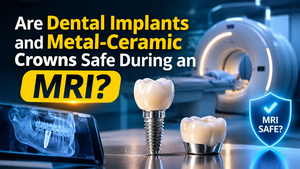
Have you received dental implants or metal-ceramic crowns and now need to undergo an MRI scan? You may be wondering whether the metal inside your mouth can move, heat up, become loose, or interfere with the MRI machine.
The good news is that most modern dental implants, particularly those made from medical-grade titanium, and many metal-ceramic dental crowns are generally compatible with MRI examinations. However, MRI safety must always be confirmed by the radiology team after checking the exact implant system, restorative materials and scanner conditions.
Having dental implants does not automatically mean you cannot undergo an MRI.
At The Dental Port – Advance Dental & Implant Center, Sector 168, Noida, we believe patients should understand the materials used in their dental treatment and how they relate to their long-term health and medical requirements.
In this guide, we explain MRI safety for dental implants, titanium implants, metal-ceramic crowns, zirconia crowns and other dental restorations, including precautions to take before your scan.
Quick Answer: Can You Have an MRI with Dental Implants?
Yes, most patients with modern titanium dental implants can undergo MRI examinations, subject to implant-specific safety clearance by the MRI team.
Here is a quick overview:
| Dental restoration | MRI considerations |
|---|---|
| Titanium dental implants | Generally MRI compatible under specified conditions |
| Zirconia dental crowns | Generally non-metallic and MRI compatible |
| Metal-ceramic (PFM) crowns | Usually acceptable after material and safety screening |
| Dental bridges | Depends on the supporting materials |
| Dental braces | May produce image distortion; screening is essential |
| Removable metal dentures | Usually need to be removed before entering the scanner room |
| Implant-supported dentures | Fixed and removable components must be evaluated separately |
Important: MRI compatibility is not a blanket guarantee for every dental implant or restoration. Always disclose your dental history during MRI screening.
1. Do Dental Implants Affect an MRI Scan?
Dental implants are commonly manufactured using commercially pure titanium or titanium alloys.
Titanium is widely used in implant dentistry because it offers excellent biocompatibility, corrosion resistance and the ability to integrate with the surrounding jawbone through a process called osseointegration.
It is also non-ferromagnetic, meaning it is not strongly attracted to the magnetic field used in MRI scanners.
This is why modern titanium dental implants are generally considered suitable for MRI examinations under the manufacturer’s specified conditions.
Can a dental implant move during an MRI?
A properly integrated titanium dental implant is not expected to move or become dislodged simply because a patient undergoes an MRI.
However, the MRI team must verify the implant system and its labelling before the examination.
Can dental implants become hot during an MRI?
MRI scanners use strong magnetic fields and radiofrequency energy. Depending on the material, geometry and scan conditions, some conductive components may experience radiofrequency-induced heating.
Modern dental implant systems are generally designed and evaluated for MRI conditions, but patients should not assume that every implant component is automatically safe under every scanner setting.
The manufacturer’s MRI safety instructions should guide the examination.
Can dental implants affect MRI image quality?
Yes. This is one of the more relevant considerations.
Titanium implants can produce localised image artefacts, which may appear as distortion, signal loss or dark areas in MRI images.
The effect is generally more relevant when scanning:
- The jawbone and surrounding tissues.
- The mouth and oral cavity.
- The face and facial structures.
- The head and neck region.
If the MRI is being performed on the knee, spine, abdomen or pelvis, dental implant-related artefacts are generally unlikely to affect the area being examined.
2. Are Metal-Ceramic Crowns (PFM Crowns) Safe During MRI?
Metal-ceramic crowns, also known as porcelain-fused-to-metal (PFM) crowns, are widely used dental restorations.
They consist of two main components:
- An internal metal framework that provides structural support.
- An external ceramic layer that provides the tooth-like appearance.
The metal framework can be manufactured from different dental alloys, including cobalt-chromium, nickel-chromium and noble-metal alloys.
Their magnetic properties vary according to their composition.
Most permanently cemented dental crowns are not expected to move during an MRI. Nevertheless, the MRI team should be informed about the presence of metal-ceramic restorations.
Can PFM crowns interfere with an MRI?
They can sometimes create localised image artefacts, particularly when the MRI focuses on the head, jaw or neck.
The extent of interference depends on:
- The type of metal alloy.
- The quantity and configuration of the metal.
- The MRI scanner strength.
- The imaging sequence being used.
- The anatomical region being examined.
Therefore, it is important to tell your radiologist about any metal-ceramic crowns before the examination.
3. Titanium Implants vs Zirconia Crowns: Which Is Better for MRI?
Patients sometimes confuse dental implant materials with crown materials. They are different components and should be evaluated separately.
Titanium is commonly used for the implant fixture placed inside the jawbone, whereas zirconia and metal-ceramic materials are used for crowns and bridges.
Zirconia is a ceramic material and does not contain a conventional metallic framework.
| Feature | Titanium implant | Zirconia crown | PFM crown |
|---|---|---|---|
| Material | Titanium or titanium alloy | Zirconia ceramic | Metal with ceramic coating |
| Biocompatibility | Excellent | Excellent | Depends on alloy and patient factors |
| MRI considerations | Generally compatible under specified conditions | Generally MRI compatible | Alloy-specific screening |
| Image artefacts | Possible | Generally minimal | Possible |
| Common application | Tooth replacement | Dental restoration | Dental restoration |
The choice between titanium, zirconia and metal-ceramic restorations should be based on clinical suitability, bite forces, aesthetic requirements, bone conditions and long-term treatment goals, not MRI considerations alone.
4. Should You Inform Your Radiologist About Dental Implants?
Absolutely.
Even when your dental implants are expected to be MRI compatible, you should disclose them during the MRI safety screening.
Inform the radiology team if you have:
- Single or multiple dental implants.
- Full-mouth dental implants.
- All-on-4 or All-on-6 implant-supported teeth.
- Metal-ceramic crowns or bridges.
- Zirconia crowns.
- Orthodontic braces.
- Implant-supported removable or fixed dentures.
- Any other metallic dental restorations.
This information allows the radiology team to assess potential safety concerns and minimise image distortion where necessary.
What information should you provide?
If possible, carry the following:
- Dental implant manufacturer and brand.
- Implant model or product identification.
- Implant placement date.
- Details of any implant-supported prosthesis.
- Information about metal crowns, bridges or removable appliances.
An implant passport or implant card can be helpful.
If you do not have one, contact your dentist for available treatment records.
5. Are Dental Implants Safe in a 3-Tesla MRI Scanner?
A 3-Tesla MRI scanner uses a stronger magnetic field than a conventional 1.5-Tesla scanner.
Many modern dental implant systems have manufacturer-specified MRI conditions that cover particular scanner strengths, but this must not be assumed for every implant.
MRI suitability depends on several factors:
- Implant manufacturer and model.
- Implant material and dimensions.
- Associated prosthetic components.
- Static magnetic field strength.
- Spatial gradient and radiofrequency exposure.
- Manufacturer-defined scanning conditions.
A dental implant being suitable for a 1.5T MRI does not automatically establish that it is suitable for every 3T MRI protocol.
The MRI department should verify the implant’s MR labelling and applicable conditions before proceeding.
6. Should You Remove Dental Implants Before an MRI?
No. Fixed dental implants are surgically integrated into the jawbone and are not routinely removed for an MRI examination.
Similarly, permanently cemented dental crowns are not routinely removed simply because an MRI has been advised.
However, removable dental appliances containing metal may need to be taken out before entering the MRI scanner room.
Always follow the instructions provided by the MRI department.
7. Can You Undergo an MRI Soon After Dental Implant Surgery?
An MRI may be possible after dental implant surgery, but the timing and safety conditions should be confirmed by the treating dentist and radiology team.
The MRI team needs to know:
- When the implant surgery was performed.
- Which implant system was used.
- Whether any additional metallic components were placed.
- What body region needs to be scanned.
- Whether the examination is urgent.
Do not postpone a medically necessary MRI without discussing the situation with your treating doctor and radiologist.
8. Does Having Dental Implants Mean You Should Avoid Future Medical Scans?
Not at all.
Modern dental implant treatment is designed to provide long-term tooth replacement, and MRI examinations are possible for most patients with commonly used titanium implant systems.
Patients with dental implants routinely undergo medical investigations when clinically indicated.
The important thing is to maintain accurate dental treatment records and inform healthcare professionals about your implants and restorations.
At The Dental Port, we encourage patients to understand their implant system, retain their implant documentation and discuss any medical imaging requirements with their dental and medical teams.
Frequently Asked Questions About Dental Implants and MRI Safety
1. Do I need to tell the MRI technician if I have dental implants?
Yes. Always disclose dental implants during MRI screening. The MRI team may need the implant brand, model and manufacturer safety information.
2. Can titanium dental implants move during an MRI?
Modern titanium dental implants are non-ferromagnetic and are not expected to move because of the MRI magnetic field when used within their specified safety conditions.
3. Are metal-ceramic crowns safe during an MRI?
Most fixed metal-ceramic crowns can undergo MRI examinations after appropriate screening. The metal alloy and scan conditions should be evaluated by the radiology team.
4. Can dental implants affect a brain MRI?
Yes, titanium implants and other dental materials may cause localised artefacts around the mouth and jaw. Depending on their location and the imaging technique, these may affect parts of a head or brain MRI.
5. Are dental implants safe in a 1.5-Tesla MRI?
Many modern titanium implant systems are labelled for use under specified 1.5T MRI conditions. The exact implant manufacturer’s instructions must be checked.
6. Are dental implants safe in a 3-Tesla MRI?
Some implant systems have specified 3T MRI conditions. Never assume universal compatibility. The MRI team should verify the exact system and scanner conditions.
7. Can I have an MRI with full-mouth dental implants?
Many patients with full-mouth implant-supported restorations can undergo MRI examinations. However, the complete implant and prosthesis configuration should be disclosed and evaluated.
8. Should I remove my zirconia crown before an MRI?
No. Zirconia crowns are ceramic restorations and are not routinely removed for MRI examinations.
9. Should I remove my dentures before an MRI?
Removable dentures, particularly those containing metal, generally need to be removed before entering the MRI scanner room. Follow the radiology department’s instructions.
10. Can I get dental implants if I may need MRI scans in the future?
Yes. A future possibility of MRI examinations is not, by itself, a reason to avoid dental implants. Discuss your medical history and treatment requirements with your implantologist before choosing the implant system.
Considering Dental Implants? Choose the Right Implant System for Your Long-Term Needs
Dental implant treatment is not just about replacing a missing tooth. It involves selecting an appropriate implant system, evaluating bone quality, planning the final restoration and considering the patient’s long-term oral health.
At The Dental Port – Advance Dental & Implant Center, Sector 168, Noida, implant treatment planning focuses on individual clinical requirements.
Our implant dentistry services include:
- Single-tooth dental implants.
- Multiple dental implants.
- Full-mouth dental implant rehabilitation.
- All-on-4 and All-on-6 implant solutions.
- Advanced implant planning and CBCT assessment.
- Implant-supported crowns and bridges.
- Bone grafting and advanced implant procedures, when indicated.
Dr Suresh Kumar, Implantologist, provides implant treatment planning based on individual clinical assessment, bone availability, restorative requirements and patient expectations.
Looking for Dental Implants in Noida?
If you are considering dental implants or want to understand which implant system and restoration may be suitable for you, schedule a consultation at The Dental Port.
The Dental Port – Advance Dental & Implant Center
H-003, Nimbus The Golden Palm, Sector 168, Noida, Uttar Pradesh 201305.
Near Noida Expressway and opposite Advant Navis Business Park.
Call / WhatsApp: +91 93553 33956
Website: https://www.thedentalport.com
Book your dental implant consultation and discuss your treatment options with our implant dentistry team.
Medical Review
Reviewed by Dr Suresh Kumar, Implantologist, The Dental Port – Advance Dental & Implant Center, Sector 168, Noida.
This article is intended for general patient education and does not replace individual assessment by an MRI safety team or treating clinician.
