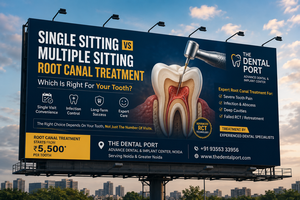
Can a root canal really be completed in one sitting? Is a multiple-visit RCT better for an infected tooth? And does taking more appointments mean higher treatment costs?
These are some of the most common questions patients ask before starting root canal treatment in Noida.
The truth is simple: single-sitting root canal treatment is not automatically better, and multiple-visit RCT is not automatically more advanced.
The right approach depends on the condition of your tooth, the level of infection, the anatomy of the root canals, previous dental treatment and how effectively the canals can be cleaned, disinfected and sealed.
At THE DENTAL PORT, Advance Dental & Implant Center, Noida, root canal treatment is planned around the individual tooth rather than forcing every patient into the same treatment schedule.
Single Sitting vs Multiple Sitting RCT: The Quick Answer
| Feature | Single-Sitting RCT | Multiple-Sitting RCT |
|---|---|---|
| Appointments | Usually one | Usually two or more |
| Treatment time | Longer single appointment | Divided between appointments |
| Convenience | Higher | Requires additional visits |
| Infection control | Completed during the treatment visit | May include medication between visits |
| Best suited for | Carefully selected cases | Cases requiring additional disinfection or management |
| Long-term outcome | Can be excellent | Can be excellent |
| Is one universally better? | No | No |
The number of visits does not determine the quality of a root canal. The quality of diagnosis, cleaning, disinfection, sealing and restoration matters far more.
What Is a Single-Sitting Root Canal?
A single-sitting root canal treatment, also called single-visit RCT, involves completing the major stages of treatment during one appointment.
Depending on the tooth and clinical situation, the dentist removes the infected or inflamed pulp, identifies the root canals, cleans and shapes them, disinfects the canal system and seals the canals.
Modern endodontic techniques can make single-visit treatment possible in many appropriately selected cases.
Potential advantages include:
- Fewer appointments
- Less travel to the dental clinic
- Faster completion of the root canal phase
- Convenient for working professionals
- Useful for patients travelling from nearby areas of Noida and Greater Noida
- Earlier progression toward the final crown or restoration
However, speed should never be the only reason to choose single-sitting RCT.
The tooth must first be suitable for completion in one visit.
What Is a Multiple-Visit Root Canal?
A multiple-visit root canal treatment is completed over two or more appointments.
During the first appointment, the dentist may remove infected tissue, clean and shape the canals and place an intracanal medicament when clinically indicated.
The tooth is then temporarily sealed.
At a subsequent appointment, the dentist reassesses the tooth and, when appropriate, completes the root canal filling and sealing.
This approach can be particularly useful when the dentist needs additional time to control infection or manage a complicated clinical situation.
A second appointment is not necessarily a sign that treatment has gone wrong. In selected cases, it is part of a deliberate treatment strategy.
Is Single-Sitting RCT Better Than Multiple-Sitting RCT?
Not necessarily.
This is where patients can get confused by marketing claims such as:
“Root canal in one sitting.”
A single sitting may be convenient, but one-visit treatment should not be promised for every tooth.
The dentist needs to consider:
- The presence and extent of infection
- Swelling or abscess
- Whether the tooth is draining
- Root canal anatomy
- Number of canals
- Curved or narrow canals
- Calcification
- Previous root canal treatment
- Remaining tooth structure
- Ability to adequately clean and disinfect the canal system
- The patient’s symptoms and clinical response
The objective is not simply to finish the procedure quickly.
The objective is to eliminate infection as effectively as possible and preserve the natural tooth.
When Can a Single-Sitting Root Canal Be Considered?
Single-visit RCT may be appropriate when the tooth can be adequately cleaned, disinfected and sealed during the same appointment.
Examples may include:
- Relatively straightforward root canal anatomy
- Localized infection
- No significant swelling
- No uncontrolled drainage
- The canals can be adequately prepared and disinfected
- The patient can comfortably undergo the required appointment
- The dentist can achieve predictable canal cleaning and sealing
Every case still requires individual assessment.
When Might Multiple-Visit RCT Be Recommended?
A dentist may consider multiple appointments when additional infection control or clinical management is required.
This may include cases involving:
Significant infection or abscess
A heavily infected tooth may require additional attention before permanent sealing.
Persistent drainage
If the canal system continues to drain, immediate obturation may not be the preferred approach.
Complex root canal anatomy
Curved, narrow, calcified or unusually shaped canals can require additional time and careful management.
Previously treated teeth
Failed root canal treatment or persistent infection may require retreatment, which can be substantially more complex than an initial RCT.
Difficult infection control
Some cases require additional disinfection before the canals are permanently sealed.
Patient-specific considerations
The treatment plan may also depend on symptoms, restorability and other clinical findings.
The additional appointment has a purpose. It should not be viewed simply as a delay.
Why Can’t Every Root Canal Be Done in One Sitting?
A common patient question is:
“If someone else completed their root canal in one visit, why do I need two?”
Because teeth are different.
Two teeth can have completely different:
- Canal anatomy
- Infection levels
- Number of canals
- Root curvature
- Previous treatment history
- Bone changes
- Symptoms
Trying to force every case into a single appointment can prioritize convenience over clinical judgment.
At THE DENTAL PORT Noida, the treatment schedule should be determined by what the tooth requires, not by a promise that every RCT can be completed in one sitting.
Does Multiple-Visit RCT Cost More?
Not simply because there are more appointments.
The overall cost of root canal treatment depends on factors such as:
- Which tooth requires treatment
- Complexity of the root canal anatomy
- Severity of infection
- Whether it is an initial RCT or retreatment
- Additional procedures required
- Type of final restoration or crown
At THE DENTAL PORT, treatment planning and cost are discussed after clinical evaluation rather than assuming that every root canal has the same complexity.
For patients comparing root canal treatment cost in Noida, it is important to compare the complete treatment plan rather than simply looking for the lowest advertised price.
Is Single-Sitting RCT More Painful?
Not necessarily.
Both single-visit and multiple-visit root canal treatments are generally performed under local anaesthesia.
Some tenderness or mild discomfort can occur after treatment, particularly when the tooth was already infected or inflamed.
The number of appointments alone does not determine whether a patient will experience pain.
If you develop increasing pain, swelling, fever or significant discomfort after treatment, contact your dentist promptly.
How Long Does a Single-Sitting Root Canal Take?
The duration varies according to the tooth and its anatomy.
A straightforward case may be completed in one longer appointment, while a complex molar can require considerably more clinical time.
The treatment duration may depend on:
- Front tooth vs premolar vs molar
- Number of canals
- Canal curvature
- Calcification
- Previous treatment
- Infection
- Difficulty of canal negotiation
Therefore, it is better to ask:
“How complex is my root canal?”
rather than simply:
“Can you finish it in one hour?”
Which Is More Successful: Single or Multiple Visits?
When the case is appropriately selected and treatment is performed to a high standard, both single-visit and multiple-visit root canal treatment can provide predictable outcomes.
Long-term tooth survival depends on much more than the number of appointments.
Important factors include:
- Accurate diagnosis
- Effective canal cleaning
- Adequate disinfection
- Proper canal filling and sealing
- Prevention of reinfection
- Quality of the final restoration
- Adequate remaining tooth structure
- Good oral hygiene
- Regular dental follow-up
One of the most important points patients should understand is that root canal treatment does not end when the canals are filled.
The tooth often needs a properly planned final restoration, and in many posterior teeth a crown may be recommended to protect the remaining tooth structure.
What Happens After Root Canal Treatment?
After the root canal is completed, your dentist will assess the remaining tooth structure and determine the appropriate final restoration.
Depending on the tooth, this may involve:
- A permanent filling
- Core build-up
- Dental crown
- Other restorative treatment
Delaying the final restoration unnecessarily can expose a root-treated tooth to further damage.
The goal is not just to save the tooth from infection. The goal is to restore it so that it can function reliably.
Single Sitting vs Multiple Sitting RCT: What Should You Choose?
Don’t choose based only on the number of appointments.
Instead, ask your dentist:
1. How infected is my tooth?
2. Is there an abscess or swelling?
3. How complex are my root canals?
4. Can the canals be adequately disinfected in one appointment?
5. Do I need medication between appointments?
6. Is this my first root canal or a retreatment?
7. What restoration will the tooth need after RCT?
These questions give you much more useful information than simply asking whether the treatment is “single sitting.”
Root Canal Treatment in Noida at THE DENTAL PORT
At THE DENTAL PORT, Advance Dental & Implant Center, Noida, every root canal case is evaluated individually.
Our approach is to determine whether the tooth is suitable for single-sitting RCT or whether a multiple-visit root canal treatment would provide better infection control and a more predictable outcome.
The focus is on:
- Accurate diagnosis
- Careful canal preparation
- Thorough disinfection
- Proper sealing
- Appropriate restorative planning
- Preservation of the natural tooth whenever possible
If you have been told that you need a root canal, don’t choose a treatment simply because it promises the fewest appointments.
Choose the approach that makes clinical sense for your tooth.
Looking for Root Canal Treatment in Noida?
If you have tooth pain, sensitivity, swelling, a deep cavity, a broken tooth or have already been advised to undergo RCT, a clinical examination is the right first step.
THE DENTAL PORT
Advance Dental & Implant Center, Noida
📞 Call: +91 93553 33956
Serving patients from Noida, Sector 168, Sector 137, Sector 142, Sector 143, Sector 150, Greater Noida Expressway and surrounding areas.
Frequently Asked Questions
1. Is single-sitting root canal treatment better?
Not automatically. Single-sitting RCT can be an excellent option for appropriately selected cases, but some teeth benefit from multiple visits for additional infection control or complex treatment.
2. Can every root canal be completed in one sitting?
No. The feasibility of single-visit RCT depends on the tooth’s infection, anatomy, symptoms, drainage, previous treatment and whether adequate cleaning and disinfection can be achieved during the appointment.
3. Why would I need two or more root canal appointments?
Additional appointments may be recommended when infection control requires more time, when there is persistent drainage or when the root canal anatomy or previous treatment makes the case more complex.
4. Does multiple-visit RCT mean my tooth is in worse condition?
Not necessarily. A multi-visit approach may simply mean that the dentist considers additional infection control or treatment time appropriate.
5. Is single-sitting RCT more painful?
The number of visits does not by itself determine pain. Both approaches are performed under local anaesthesia, and some post-treatment tenderness can occur with either approach.
6. Does multiple-sitting RCT cost more?
Not necessarily. Treatment cost is generally influenced by the tooth, complexity, infection, retreatment requirements and restoration rather than simply the number of appointments.
7. How much does root canal treatment cost in Noida?
The cost varies according to the tooth and complexity of treatment. The appropriate fee can be determined after clinical examination and treatment planning.
8. Do I need a crown after root canal treatment?
Many root-treated back teeth require a crown or another protective restoration because they can be structurally weakened. Your dentist will assess the remaining tooth structure and recommend the appropriate restoration.
9. What if my previous root canal has failed?
A previously treated tooth may require root canal retreatment, and in selected cases other procedures may be considered. A detailed clinical and radiographic evaluation is required.
10. Where can I get root canal treatment in Noida?
THE DENTAL PORT, Advance Dental & Implant Center, Noida, provides comprehensive dental care including root canal treatment and restorative dentistry. Patients can contact the clinic for an evaluation and personalized treatment plan.
Final Takeaway
Single sitting is not the goal. Successful infection control and long-term tooth preservation are the goal.
If your tooth can be safely and predictably treated in one appointment, single-sitting RCT can be convenient and effective.
If your tooth needs additional infection control, medication or more complex treatment, multiple visits may be the better clinical choice.
The best root canal treatment is not the one with the fewest appointments. It is the one that gives your natural tooth the best reasonable chance of lasting.