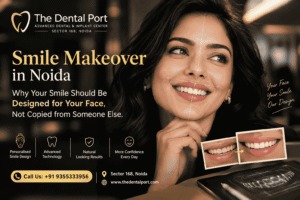
Looking for a smile makeover in Noida that looks natural, suits your facial features, and protects your dental health? The secret is personalized smile design—not copying a celebrity’s teeth.
Imagine visiting a luxury tailor for a bespoke suit. The tailor does not hand you a standard outfit and expect you to adjust to it. Instead, every measurement, from your shoulders and waist to your posture and movement, is carefully considered.
Cosmetic dentistry should follow the same principle.
Your smile is unique. Your facial proportions, lip shape, tooth dimensions, gum display, tooth shade, bite, and oral health all influence which dental treatments may be suitable for you. A successful smile makeover brings these factors together to create a result that looks harmonious, feels comfortable, and suits your individual preferences.
At The Dental Port – Advance Dental & Implant Center, Sector 168, Noida, patients can explore personalized smile makeover options based on their dental condition, aesthetic goals, and functional needs.
Whether you are concerned about yellow teeth, gaps, chipped front teeth, uneven tooth alignment, a gummy smile, worn teeth, or missing teeth, the right approach begins with a proper dental examination.
Some patients may benefit from professional teeth whitening. Others may need composite bonding, E.max veneers, zirconia crowns, orthodontic treatment, dental implants, or a combination of procedures.
The goal is not to give everyone the same smile. It is to identify the most appropriate treatment for your individual needs while preserving healthy tooth structure wherever possible.
Want to explore your smile makeover options in Noida?
Call +91 93553 33956 to enquire about a consultation at The Dental Port.
What Is a Smile Makeover in Noida?
A smile makeover is a personalized combination of cosmetic and restorative dental treatments designed to improve the appearance of the teeth and gums while considering oral health, bite function, and long-term maintenance.
Unlike a single cosmetic procedure, a comprehensive smile makeover addresses the specific concerns identified during clinical assessment.
Depending on the patient’s needs, treatment may include:
- Professional teeth whitening: To brighten suitable discolored natural teeth.
- E.max porcelain veneers: To improve selected teeth with suitable shape, color, or minor alignment concerns.
- Composite bonding: To repair minor chips, reshape teeth, or close selected small gaps.
- Orthodontic treatment: To improve tooth alignment and address bite problems.
- Zirconia crowns: To restore teeth requiring substantial structural support.
- Dental implants: To replace missing teeth and support functional, aesthetic restorations.
- Gum contouring: To improve gum-line symmetry in carefully selected cases.
- Full-mouth rehabilitation: To address extensive tooth wear, damaged teeth, missing teeth, or complex restorative needs.
Not every patient requires all these treatments. A responsible smile makeover plan recommends only those procedures that are appropriate to the clinical findings and the patient’s goals.
Why Every Smile Is Different
Even people with similar facial features can have different tooth shapes, gum contours, and smile patterns. These differences influence the appearance and function of a smile.
1. Facial Shape and Proportions
The relationship between the face, lips, chin, and teeth contributes to overall smile aesthetics.
A dentist considers facial proportions when assessing tooth width, length, shape, and the overall balance of the smile. However, there is no single tooth shape or mathematical formula that guarantees the ideal result for every person.
The objective is to create a smile that complements the patient’s natural features rather than imposing a standard design.
2. Lip Line and Smile Dynamics
Your smile changes when you speak, laugh, and express emotions.
Some people show more of their upper teeth when smiling, while others display more gum tissue or less tooth structure.
Smile analysis considers lip movement, the position of the upper lip, the visible tooth surfaces, and the relationship between the teeth and gums. These observations help guide decisions about tooth length, restorative contours, and whether gum treatment may be appropriate.
A smile that looks good in a static photograph should also be evaluated for its appearance during natural movement.
3. Tooth Shape, Size, and Alignment
Tooth proportions influence whether a smile looks balanced or disproportionate.
Rounded contours may create a softer visual effect, while more angular contours may produce a stronger appearance. Oval and square tooth forms can both look natural, depending on the individual.
The dentist also evaluates tooth rotation, crowding, spacing, worn edges, and the relationship between the upper and lower teeth.
Sometimes orthodontics or conservative bonding can address these concerns without the need for extensive restorative treatment.
4. Tooth Colour and Complexion
Many patients request extremely white teeth after seeing celebrity photographs or social media smile transformations.
However, the brightest available shade is not necessarily the most suitable shade for every patient.
Shade selection should consider the patient’s natural teeth, skin tone, age, aesthetic preferences, and the optical properties of the proposed restorative material.
Natural teeth exhibit subtle variations in translucency and surface texture. Reproducing these characteristics can be just as important as selecting the overall shade.
A natural-looking smile depends on harmony, not simply on how white the teeth appear.
5. Bite and Jaw Function
A smile makeover must work comfortably as well as look attractive.
The dentist assesses how the upper and lower teeth meet, including relevant bite relationships and contacts during jaw movement.
An unfavourable bite, excessive forces, or untreated teeth grinding can increase the risk of chipped veneers, fractured restorations, and uneven tooth wear.
This is why selecting veneers or crowns solely on appearance may compromise treatment planning. Functional assessment is an important part of responsible cosmetic dentistry.
6. Gum Health and Gingival Architecture
Healthy gums are essential for a stable and attractive smile.
Gum inflammation, recession, uneven gum margins, and periodontal disease can influence both aesthetics and restorative outcomes.
Before elective cosmetic procedures, the dentist evaluates periodontal health and recommends appropriate treatment if required.
In selected cases, gum-contouring procedures may improve symmetry. However, the correct treatment depends on the underlying cause of the visible gum display or uneven gum line.
Why Copying a Celebrity Smile Can Be a Mistake
Social media has made cosmetic dentistry more accessible, but highly edited photographs and standardized smile designs can create unrealistic expectations.
Bringing a reference photograph to a consultation can help communicate your preferences. The problem arises when the photograph becomes a fixed template rather than a starting point for discussion.
For example:
- Very bright restorations may look conspicuous if the shade is poorly matched to the patient’s appearance.
- Bulky veneers may make teeth appear unnatural.
- Lengthening teeth without considering the bite may create functional problems.
- Veneers may be unnecessarily invasive when orthodontics could address the primary concern.
- Treating the teeth alone may not correct a gummy smile caused by lip movement or jaw relationships.
A dentist must identify the cause of the concern before recommending treatment.
Your smile should complement your face, not compete with it.
How a Dentist Plans a Personalized Smile Makeover
A well-planned smile makeover involves more than selecting a tooth shade or deciding how many veneers to place. It requires clinical diagnosis, aesthetic analysis, patient communication, and a clear treatment sequence.
Step 1: Understand Your Smile Goals
The consultation begins with understanding what you want to improve.
You may be concerned about discoloration, uneven teeth, gaps, chipped edges, missing teeth, or excessive gum display.
Your dentist should also understand whether you prefer a subtle enhancement or a more noticeable change, whether you have had previous dental treatment, and whether you experience teeth grinding or jaw discomfort.
These details help establish realistic treatment objectives.
Step 2: Conduct a Comprehensive Dental Examination
Before recommending cosmetic treatment, the dentist evaluates the teeth, gums, supporting tissues, and bite.
Depending on the case, the assessment may include:
- Examination for cavities and defective restorations.
- Assessment of gum health and periodontal support.
- Evaluation of tooth wear, fractures, and existing restorations.
- Analysis of tooth alignment and bite relationships.
- Dental photographs and digital scans, when appropriate.
- Radiographs when clinically indicated.
This stage helps identify problems that could affect the safety, suitability, or longevity of cosmetic treatment.
Step 3: Analyse the Smile and Develop a Treatment Plan
The dentist combines clinical findings with facial observations and the patient’s preferences.
Planning may involve evaluating tooth proportions, smile line, gum margins, shade, incisal edge position, and functional requirements.
Where appropriate, digital simulations, diagnostic wax-ups, or trial smile techniques may help the patient visualise proposed changes. These tools assist communication and planning but cannot guarantee an exact final result.
Step 4: Select the Most Appropriate Treatment
The best treatment is not necessarily the most extensive one.
For example, healthy teeth with suitable external staining may need only whitening. Crowded teeth may benefit from orthodontics. A structurally weakened tooth may require a crown rather than a veneer.
The dentist should explain the advantages, limitations, costs, maintenance requirements, and alternatives associated with each recommended procedure.
Step 5: Review and Maintain the Results
After treatment, follow-up appointments help assess gum health, bite comfort, restoration fit, and the patient’s response to the treatment.
Regular dental reviews, good oral hygiene, and protective measures when indicated help maintain the result.
Which Smile Makeover Treatment Is Right for You?
Different dental procedures address different problems. The appropriate option depends on the diagnosis rather than the popularity of a particular treatment.
Professional Teeth Whitening in Noida
Professional teeth whitening may be suitable for patients with healthy natural teeth affected by staining or discoloration.
It can brighten the smile without requiring veneers or crowns. The degree of improvement depends on the cause of discoloration, the original tooth shade, and the whitening method used.
Whitening does not change the colour of existing veneers, crowns, or fillings. Temporary sensitivity or gum irritation can occur, making proper assessment and instructions important.
E.max Veneers in Noida
E.max veneers are thin ceramic restorations made from lithium disilicate. They are used in selected cases to improve the colour, shape, proportions, or appearance of front teeth.
Potential indications include suitable cases of minor chips, small gaps, discoloration, or irregular tooth contours.
Veneers may preserve more tooth structure than full crowns in appropriately selected patients. However, preparation may permanently remove some enamel, and veneers are not suitable for everyone.
Patients with untreated gum disease, significant structural damage, unfavourable bite conditions, or uncontrolled teeth grinding need careful evaluation before veneer treatment.
Zirconia Crowns in Noida
Zirconia crowns are ceramic restorations used to restore teeth that require substantial structural support.
They may be appropriate for selected heavily damaged, fractured, or extensively restored teeth, including some root canal-treated teeth.
The choice of crown material depends on the tooth’s condition, position, bite forces, aesthetic requirements, and the restorative design.
Because crowns generally require more extensive tooth preparation than veneers, they should be recommended when the clinical condition justifies full coverage.
Dental Implants in Noida
Missing teeth can affect chewing, speech, appearance, and the distribution of forces within the mouth.
Dental implants act as artificial tooth roots and can support individual crowns or larger restorations. They may be considered as part of a smile makeover when one or more teeth are missing.
Implant planning requires assessment of bone availability, gum health, neighbouring teeth, bite forces, medical history, and maintenance requirements.
Treatment may take several months, depending on healing and whether additional procedures are needed. Implant restorations require ongoing care and do not eliminate the possibility of future complications.
Orthodontic Treatment
When tooth alignment or bite relationships are the main concern, braces or clear aligners may be appropriate.
Orthodontics can improve tooth position and may reduce the need for restorative changes to otherwise healthy teeth.
Treatment duration varies according to the complexity of the case and the patient’s response.
Composite Bonding
Composite bonding uses tooth-coloured restorative material to repair selected chips, reshape teeth, or improve small gaps.
It can be a conservative option for suitable cases and may require less alteration of natural tooth structure than ceramic restorations.
Composite can stain, wear, or chip over time and may need polishing, repair, or replacement.
Full-Mouth Rehabilitation
Patients with extensive tooth wear, multiple missing teeth, or several damaged restorations may require full-mouth rehabilitation.
This involves comprehensive planning of the teeth, gums, bite, restorative materials, and long-term function. Treatment may involve restorative dentistry, implants, periodontal care, orthodontics, or other procedures as clinically indicated.
Full-mouth rehabilitation is not simply a more extensive cosmetic makeover. It requires careful diagnosis and coordination of treatment stages.
Why a Personalized Smile Makeover Is Better Than a Standard Package
Consider two patients who both want a more attractive smile.
Patient A has healthy teeth, mild discoloration, and two small chips. Professional whitening and carefully selected composite bonding may address the main concerns.
Patient B has several missing teeth, extensive wear, and damaged restorations. The patient may require periodontal treatment, restorative procedures, implant planning, and correction of functional problems.
Although both patients want to improve their smiles, their clinical needs are different.
Giving both patients the same package would ignore the factors that determine treatment suitability.
A responsible smile makeover plan should explain:
- Which dental concerns need treatment and why.
- Which procedures are optional or primarily aesthetic.
- Whether more conservative alternatives are available.
- The proposed treatment sequence and estimated timeline.
- The expected costs and any additional procedures that may be necessary.
- The risks, limitations, and maintenance requirements.
This approach supports informed decision-making and helps patients understand the reasoning behind their treatment plan.
The Science Behind a Natural-Looking Smile
Natural smile design involves several interacting factors. The dentist may evaluate:
- Smile line and visible tooth display.
- Dental midline and tooth alignment.
- Tooth width-to-length proportions.
- Incisal edge position and smile arc.
- Tooth translucency, shade, and surface texture.
- Gingival margins and the appearance of the spaces between teeth.
- Facial proportions and lip movement.
- Bite contacts and functional jaw movements.
Small differences in contour, tooth position, or material translucency can influence the final appearance.
Digital planning and laboratory communication may assist treatment, but clinical judgement remains essential. A successful result depends on the patient’s anatomy, the suitability of the chosen procedure, material selection, execution, and maintenance.
The goal is not to create an identical row of teeth. It is to achieve an appropriate balance between aesthetics and function.
Can a Smile Makeover Improve Confidence?
For some patients, concerns about their teeth make them reluctant to smile in photographs, speak in public, or interact socially.
Improving a specific dental concern may help a patient feel more comfortable with their appearance. However, the emotional impact varies from person to person, and cosmetic dentistry cannot guarantee a particular psychological or social outcome.
The most useful starting point is to identify the concern that matters most to you and discuss realistic ways of addressing it.
A personalized smile makeover should support your goals without creating unrealistic expectations about what dental treatment can achieve.
Why Dental Health Must Come Before Cosmetic Treatment
A beautiful smile depends on a healthy foundation.
Before beginning elective cosmetic treatment, your dentist may recommend professional cleaning, treatment of cavities, management of gum disease, replacement of failing restorations, root canal treatment when indicated, or assessment of relevant bite problems.
Treating underlying disease first can reduce avoidable complications and support better restorative outcomes.
The sequence is important because untreated decay, periodontal inflammation, or excessive bite forces can compromise treatment.
The aim is not simply to create a beautiful smile on the day of treatment. It is to develop a result that can be maintained with appropriate care.
How Long Does a Smile Makeover Take?
The treatment timeline depends on the procedures required and the patient’s oral health.
- Professional teeth whitening: Often completed in one appointment or through a dentist-supervised home protocol.
- Composite bonding: May be completed in one appointment for suitable cases.
- Veneers and crowns: Commonly require preparation and placement appointments.
- Orthodontic treatment: Usually takes several months or longer, depending on the complexity.
- Dental implants: May require several months for healing and restoration.
- Full-mouth rehabilitation: May take several months or longer when multiple treatment stages are necessary.
These are general estimates, not guarantees. Your dentist can provide a more realistic timeline after examination and treatment planning.
What Is the Cost of a Smile Makeover in Noida?
The cost of a smile makeover varies because every patient has different clinical needs.
Factors influencing the total cost include:
- The number of teeth being treated.
- The type and complexity of the procedures.
- The restorative materials selected.
- Laboratory and diagnostic requirements.
- Whether orthodontic, periodontal, implant, or other preparatory treatment is necessary.
- The need for temporary restorations and follow-up care.
A plan involving whitening and minor bonding will generally differ substantially from one requiring multiple ceramic restorations, implants, or full-mouth rehabilitation.
When comparing estimates, ask what is included, which procedures are essential, what alternatives are available, and what maintenance may be required.
For a treatment estimate relevant to your case, the first step is a clinical consultation.
Call +91 93553 33956 to enquire about a smile makeover consultation at The Dental Port, Sector 168, Noida.
How to Choose a Cosmetic Dentist in Noida
Choosing a dentist for cosmetic treatment requires more than comparing before-and-after photographs or selecting the lowest advertised price.
Look for a clinician and dental team who:
- Conduct a comprehensive dental examination before recommending treatment.
- Consider tooth preservation, gum health, and bite function.
- Explain the benefits and limitations of different procedures.
- Discuss suitable alternatives and expected costs.
- Use appropriate diagnostic and treatment-planning methods.
- Explain maintenance requirements and the possibility of future repairs.
Ask to see relevant clinical cases where available and with appropriate patient consent. Discuss your expectations openly and make sure you understand the proposed treatment before proceeding.
The right treatment plan should be clinically justified, understandable, and tailored to your needs.
Personalized Smile Makeovers at The Dental Port, Sector 168, Noida
At The Dental Port – Advance Dental & Implant Center, patients can explore dental treatment options for concerns involving tooth appearance, missing teeth, tooth damage, and smile aesthetics.
A considered smile makeover approach takes into account the patient’s dental condition, facial features, functional requirements, and personal preferences.
Whether you are considering professional teeth whitening, E.max veneers, zirconia crowns, composite bonding, dental implants, or more extensive restorative treatment, the appropriate starting point is a proper clinical assessment.
If you are searching for a smile makeover in Noida, a cosmetic dentist in Noida, or a dental clinic in Sector 168, Noida, focus on finding a treatment plan that balances appearance, oral health, and long-term maintenance.
Ready to discuss your smile goals?
Contact The Dental Port to enquire about a consultation.
Phone: +91 93553 33956
Website: https://thedentalport.com/
Location: Sector 168, Noida
Your smile is unique. Your treatment plan should reflect that.
Frequently Asked Questions About Smile Makeovers
What is the best age for a smile makeover?
There is no single ideal age for every smile makeover procedure. Suitability depends on dental development, oral health, the concern being addressed, and the treatment planned. Elective cosmetic procedures involving permanent teeth require particular care in younger patients.
Is a smile makeover painful?
The experience depends on the procedure. Whitening may cause temporary sensitivity, while veneer or crown preparation may require local anaesthesia. Orthodontic treatment can cause temporary soreness or pressure. Your dentist should explain what to expect and how discomfort can be managed.
Are veneers better than crowns?
Neither is universally better. Veneers cover the front surface of selected teeth and are used for appropriate aesthetic concerns. Crowns provide more extensive coverage when a tooth requires greater structural support. Tooth condition, remaining enamel, bite, and functional requirements determine which option may be suitable.
Can I get a smile makeover without veneers?
Yes. Depending on your concerns, treatment may involve whitening, composite bonding, orthodontics, gum treatment, or restorative procedures. Veneers are only one option and are not necessary for every patient.
Will my smile makeover look natural?
A natural-looking result is possible when the treatment plan considers tooth proportions, shade, translucency, gum health, facial features, and bite. The outcome depends on the individual case, the selected procedure, and clinical execution.
How long do smile makeover results last?
Longevity varies according to the procedure, material, oral hygiene, bite forces, diet, and maintenance. Whitening results may fade, bonding may require repair, and veneers or crowns may eventually need replacement. Regular dental reviews help maintain oral health and identify problems early.
Can a smile makeover correct a gummy smile?
In selected cases, yes. However, the appropriate treatment depends on the cause of excessive gum display, which may involve gum position, tooth eruption, upper lip movement, or jaw relationships. A clinical examination is necessary before choosing treatment.
What is the difference between a Hollywood smile and a natural smile makeover?
A Hollywood smile generally refers to a bright, uniform, prominent aesthetic, although the term has no standardized clinical definition. A natural smile makeover emphasizes harmony with the patient’s facial features and existing tooth anatomy. Both approaches should be guided by the patient’s preferences and clinical suitability.
Can missing teeth be included in a smile makeover?
Yes. Depending on the case, missing teeth may be replaced with dental implants, bridges, or removable prostheses. The dentist evaluates bone availability, gum health, neighbouring teeth, and bite function before recommending a suitable option.
How do I book a smile makeover consultation in Noida?
Contact The Dental Port – Advance Dental & Implant Center to enquire about a consultation. Call +91 93553 33956 or visit https://thedentalport.com/ to learn more about the clinic and its dental services.
Final Thoughts: The Best Smile Is One Designed for You
A master tailor does not create a suit by forcing every customer into the same pattern. The tailor studies the individual and adapts the design accordingly.
Smile makeover planning follows a similar principle.
The best treatment is not necessarily the one involving the most veneers, the brightest shade, or the most dramatic transformation. It is the approach that addresses your concerns while respecting your natural tooth structure, gum health, facial proportions, bite, and long-term needs.
Whether you need subtle improvements or comprehensive restorative treatment, a personalized clinical assessment helps identify the options most appropriate for you.
At The Dental Port – Advance Dental & Implant Center, Sector 168, Noida, take the first step towards understanding your smile makeover options.
Call +91 93553 33956 to enquire about a consultation.
A beautiful smile should not look like somebody else’s. It should feel right for you.
Suggested references for clinical review:
- American Dental Association: https://www.ada.org/
- National Institute of Dental and Craniofacial Research: https://www.nidcr.nih.gov/
- American Academy of Cosmetic Dentistry: https://www.aacd.com/