A patient-first guide to severe upper-jaw bone loss, zygomatic implants, conventional implants, bone grafting, All-on-4 and getting the right second opinion
If you have been told, “You need zygomatic implants,” your first question should not be:
“How quickly can I get fixed teeth?”
It should be:
“Why do I need an implant anchored in my cheekbone when there may be other ways to restore my teeth?”
That question matters.
Zygomatic implants are an important and highly specialized solution for people with severe upper-jaw bone loss. They can sometimes avoid extensive bone-grafting procedures and help selected patients receive a fixed implant-supported restoration much sooner.
But they are not a premium version of an ordinary dental implant.
They are a complex treatment designed for a specific clinical problem.
The International Team for Implantology (ITI) consensus identifies severe maxillary bone atrophy or deficiency, previous unsuccessful grafting or implant treatment, and situations where conventional grafting is not feasible or predictable among the important indications for zygomatic implants.
So the honest answer is:
Some patients genuinely need zygomatic implants. Many do not. The decision should come from anatomy and treatment planning, not from the appeal of a faster procedure.
At The Dental Port, Advanced Dental & Implant Center in Sector 168, Noida, we believe complex treatment should never be recommended simply because it is complex.
The simplest predictable solution should be considered first.
What Exactly Is a Zygomatic Implant?
A conventional dental implant is normally anchored into the jawbone.
A zygomatic implant is different.
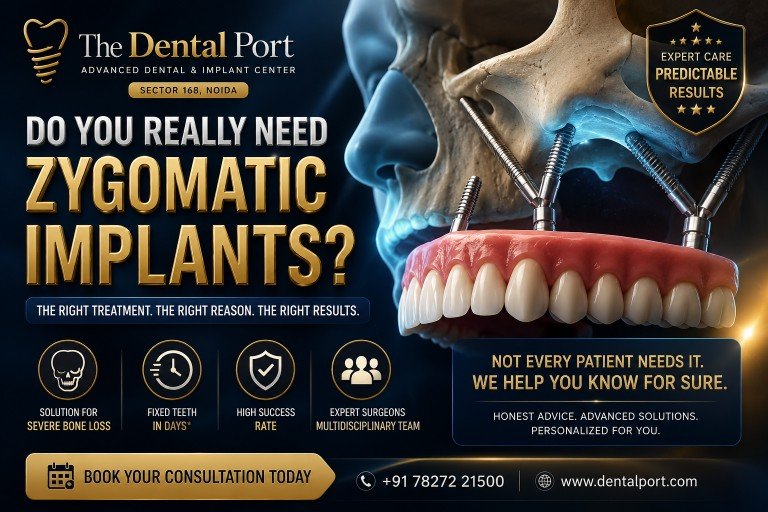
Because the upper jaw may have lost too much bone to support conventional implants, a much longer implant can be anchored into the zygoma, or cheekbone, which has a different anatomical structure and can provide a foundation for implant-supported teeth.
This makes zygomatic implants particularly valuable in patients with severe maxillary bone deficiency.
The important distinction is this:
Zygomatic implants solve a bone problem. They are not simply a faster way of placing ordinary implants.
Research supports their use in severely atrophic maxillae, with modern systematic reviews reporting high long-term implant survival. At the same time, complications such as sinus-related problems, infection, soft-tissue problems and prosthetic complications remain possible and must be discussed honestly.
Why Are Zygomatic Implants Sometimes Described as “Teeth in a Day”?
One reason patients are attracted to zygomatic implants is the possibility of immediate loading.
In carefully selected cases, implant-supported temporary fixed teeth may be provided shortly after surgery.
That can be life-changing for someone who has:
- Lost most or all upper teeth
- Severe bone loss
- Failed conventional implants
- Failed previous bone grafting
- Been told that traditional reconstruction would take many months
- Difficulty wearing conventional dentures
But there is an important distinction:
“Fixed teeth quickly” does not mean “simple surgery.”
The surgery itself is considerably more demanding than routine implant placement.
The ITI describes zygomatic implant treatment as complex and emphasizes the importance of appropriate surgical and restorative expertise.
So speed should be treated as one treatment benefit, not the primary reason to choose the treatment.
When Does a Patient Really Need Zygomatic Implants?
There is no single X-ray measurement that automatically means:
“You need zygomatic implants.”
The decision depends on the location and severity of bone loss, available anatomy, previous treatment, prosthetic requirements, medical factors and the predictability of alternative treatments.
Zygomatic implants may become appropriate when conventional implant treatment cannot provide a predictable solution.
1. Severe Upper-Jaw Bone Loss
This is the classic indication.
If the upper jaw has undergone extreme bone resorption, there may simply not be enough suitable bone in the normal implant zones.
In these cases, conventional implants may require extensive reconstruction.
The 2023 systematic review of zygomatic implant indications found that extreme maxillary bone atrophy was the principal indication reported in the literature.
2. Previous Bone Grafting Has Failed
Some patients have already undergone:
- Bone grafting
- Sinus augmentation
- Multiple implant attempts
- Repeated reconstructive procedures
If previous treatment has failed or another grafting procedure is unlikely to provide a predictable result, zygomatic implants may become a rescue or alternative strategy.
The ITI consensus specifically recognizes unsuccessful previous grafts and implants as an indication in selected cases.
3. Major Loss of the Upper Jaw After Disease, Trauma or Surgery
Zygomatic implants can also play an important reconstructive role when part or all of the upper jaw has been lost because of:
- Tumour surgery
- Trauma
- Congenital defects
- Severe disease-related destruction
These are highly individualized cases and may require a multidisciplinary approach.
4. Conventional Grafting Is Not Predictable or Not Appropriate
Sometimes the question is not:
“Can we graft bone?”
It is:
“Will grafting give this particular patient a predictable result, and is it the most sensible treatment pathway?”
In selected severely atrophic patients, zygomatic implants can avoid staged grafting procedures.
The ITI consensus recognizes avoidance of staged grafting as one potential indication, but this does not mean that every patient who wants to avoid grafting should automatically receive zygomatic implants.
That distinction is crucial.
When Might Zygomatic Implants Be Unnecessary?
This is where patients should slow down.
If there is sufficient bone for conventional implants, a zygomatic implant may add complexity without providing a meaningful clinical advantage.
Similarly, if bone deficiencies can be predictably managed with a more conventional approach, alternatives deserve serious consideration.
Depending on the individual case, these may include:
Option 1: Conventional Implants
If adequate bone exists, conventional implants may be the most straightforward option.
There is no prize for choosing the most complicated implant.
If a conventional implant can predictably do the job, why make the treatment more complex?
Option 2: Bone Grafting
A patient with inadequate bone may sometimes be a candidate for:
- Guided bone regeneration
- Ridge augmentation
- Sinus augmentation
- Other targeted grafting procedures
This may require more time and multiple stages, but in an appropriate patient it can create a conventional implant pathway.
Option 3: All-on-4 or Other Full-Arch Strategies
Some patients with bone loss still have sufficient strategically positioned bone for an All-on-4 or other tilted/full-arch implant concept.
This is why a diagnosis of “bone loss” alone does not automatically equal “zygomatic implants.”
The distribution of the remaining bone matters just as much as the amount.
Option 4: Other Advanced Implant Strategies
Depending on anatomy, clinicians may also consider approaches such as:
- Tilted implants
- Pterygoid implants
- Strategic implant positioning
- Targeted grafting
- Combination protocols
The correct treatment is determined by the patient’s anatomy, not by a treatment menu.
The Biggest Red Flag: “You Need Zygomatic Implants” Without Explaining Why
A sophisticated treatment recommendation should come with a sophisticated explanation.
If a patient is told that zygomatic implants are necessary, ask:
“What specifically makes conventional implants unsuitable for me?”
A good consultation should explain:
- Where your bone is missing
- Where adequate bone remains
- Whether grafting is possible
- Whether All-on-4 or another full-arch approach is feasible
- Why a conventional implant pathway is or is not predictable
- What risks apply to your anatomy
- What the proposed prosthetic plan is
- What happens if complications occur
If you receive only:
“Your bone is gone, so you need zygomatic implants.”
that is not enough information to make a major treatment decision.
Does a 3D CBCT Scan Matter?
Absolutely.
Zygomatic implant planning is three-dimensional.
The surgeon needs to understand the patient’s:
- Maxillary bone anatomy
- Zygomatic bone
- Maxillary sinus
- Implant trajectory
- Available anchorage
- Relationship to surrounding anatomical structures
A CBCT does not make the treatment decision by itself, but it provides the three-dimensional anatomical information needed for proper planning.
And importantly:
A CBCT should not be used to justify a predetermined treatment.
It should be used to determine which treatment is actually appropriate.
That difference separates diagnosis from sales.
Why Experience Matters More With Zygomatic Implants
A conventional implant and a zygomatic implant are not equivalent procedures.
Zygomatic implant surgery involves anatomy around the maxillary sinus, orbit and other important facial structures.
The ITI consensus specifically emphasizes that outcomes depend heavily on clinician skill and experience and recommends appropriate surgical and restorative expertise for this complex treatment.
That means patients should ask more than:
“Does this clinic offer zygomatic implants?”
Ask:
“Who will actually perform the surgery?”
And:
“How is my case being planned?”
And:
“What is the team’s experience with complex atrophic maxilla cases?”
And:
“Who will manage the case if a sinus or prosthetic complication develops?”
Those are much better questions than simply asking how quickly the teeth can be delivered.
Are Zygomatic Implants Safe?
When appropriately indicated, carefully planned and performed by experienced clinicians, zygomatic implants can be a reliable treatment option.
The evidence is encouraging.
A 2023 ITI consensus report found a mean long-term zygomatic implant survival of approximately 96.2% at a mean follow-up of 75.4 months. However, the same report identified sinusitis as the most common biological complication, with a reported prevalence of approximately 14.2% over a mean follow-up of about 65 months.
A separate systematic review comparing long-term outcomes found mean survival rates of approximately 96.5% for zygomatic implants and 95.8% for conventional implants, with no statistically significant difference in the comparative analyses. Sinusitis was the most frequently reported biological complication associated with zygomatic implants.
This leads to an important conclusion:
High success does not mean zero risk.
A responsible implantologist should explain both.
What Complications Should Patients Know About?
Potential complications can include:
- Sinusitis
- Soft-tissue irritation
- Infection
- Oroantral communication
- Prosthetic complications
- Implant positioning problems
- Sensory symptoms in uncommon cases
- Other surgical complications
The exact risk depends on the patient, anatomy, surgical approach, prosthetic design and clinical expertise.
Systematic reviews consistently identify sinus-related complications among the most important complications associated with zygomatic implants.
So be cautious of any advertisement or consultation that makes a complex surgical procedure sound like it has “zero risk.”
No responsible surgical treatment should be presented that way.
The “Teeth in 24 Hours” Marketing Trap
Let’s address the elephant in the room.
“Fixed teeth in 24 hours” sounds incredible.
And for the right patient, it can be.
But it can also become a marketing shortcut.
The real clinical question isn’t:
“Can this clinic give me teeth quickly?”
It is:
“Do I actually need this procedure to achieve a predictable long-term result?”
If you have enough bone for conventional implants, getting zygomatic implants simply because they can provide a faster pathway may expose you to unnecessary surgical complexity.
Likewise, if a predictable grafting or conventional implant solution is available and your circumstances allow a longer treatment timeline, that option deserves discussion.
Fast is not automatically better.
Advanced is not automatically better.
Expensive is not automatically better.
The best treatment is the one that appropriately balances:
clinical need + predictability + risk + anatomy + long-term function + patient priorities.
7 Questions to Ask Before Agreeing to Zygomatic Implants
If you have been recommended zygomatic implants, take these questions to your consultation.
1. Why can’t conventional implants work in my case?
Ask for a specific anatomical explanation.
2. Is bone grafting possible?
If not, ask why.
3. Could All-on-4 or another full-arch protocol work?
The answer should be based on your CBCT and prosthetic requirements.
4. What does my CBCT actually show?
Ask the clinician to show you the relevant areas.
5. Why are zygomatic implants better for me?
Not generally.
For you.
6. Who is performing the surgery?
Ask about the surgeon’s specific experience with complex zygomatic cases.
7. What happens if there is a complication?
A good treatment plan includes a complication-management plan.
A Simple Clinical Decision Hierarchy
At The Dental Port, we believe complex implant rehabilitation should be approached logically.
A simplified decision pathway is:
3D CBCT + clinical examination + prosthetic planning
↓
Adequate bone available?
Consider conventional implants.
↓
Moderate or localized bone deficiency?
Consider targeted grafting, tilted/full-arch strategies or other appropriate conventional approaches.
↓
Severe bone deficiency but reconstructable anatomy?
Assess grafting, sinus augmentation and other advanced alternatives.
↓
Conventional implants and predictable grafting are not feasible or appropriate?
Assess advanced anchorage options, including zygomatic implants, when clinically indicated.
This is not a rigid recipe.
Every patient is different.
But the principle is powerful:
Do not start with the most complex treatment. Start with the patient’s anatomy.
Zygomatic Implants vs Conventional Implants: The Real Difference
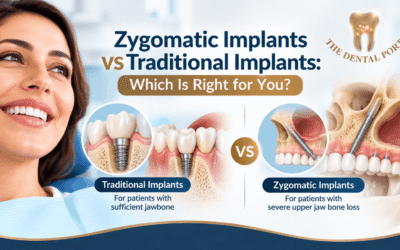
| Factor | Conventional Implants | Zygomatic Implants |
|---|---|---|
| Primary anchorage | Jawbone | Zygomatic/cheekbone |
| Typical indication | Adequate or reconstructable jawbone | Severe maxillary bone deficiency |
| Surgical complexity | Usually lower | Higher |
| Bone grafting | Sometimes required | Often designed to reduce/avoid major grafting in selected cases |
| Treatment timeline | May be longer when grafting is needed | Can allow immediate provisional fixed teeth in selected cases |
| Planning requirements | Advanced planning recommended | Highly detailed 3D planning is particularly important |
| Expertise | Implant experience required | Advanced surgical and restorative expertise essential |
| Complication profile | Implant-specific risks | Includes sinus and other anatomy-related risks |
| Best treatment? | When predictably suitable | When conventional pathways are not predictably suitable |
The point is not that one is “better.”
The point is that they are solutions for different clinical situations.
So, Are Zygomatic Implants Overprescribed?
This question deserves nuance.
There is strong evidence supporting zygomatic implants for appropriately selected patients with severe maxillary atrophy. The evidence does not support treating them as the default solution for every patient with missing teeth or bone loss.
The concern is not that zygomatic implants are “bad.”
The concern is using a complex treatment when a simpler predictable treatment would achieve the same clinical objective.
That is why patients should be suspicious of treatment recommendations based primarily on:
- “Teeth in 24 hours”
- “No bone graft needed”
- “Premium implants”
- “Most advanced treatment”
- “One-day transformation”
without a detailed explanation of why the procedure is necessary for their particular anatomy.
What We Believe at The Dental Port
At The Dental Port, Advanced Dental & Implant Center, Sector 168, Noida, our philosophy is straightforward:
The most advanced treatment is not always the best treatment.
If conventional implants are predictable, there is no reason to make treatment unnecessarily complex.
If grafting can provide a reliable pathway and is appropriate for the patient, it should be discussed.
If an All-on-4 or other full-arch approach can achieve the desired result, it should be evaluated.
And if the upper jaw has such severe bone loss that conventional approaches are unlikely to provide a predictable solution, zygomatic implants may be a valuable advanced option.
That is where advanced implantology should actually make a difference:
not by doing the biggest procedure, but by knowing when the biggest procedure is genuinely necessary.
Have You Been Told You Need Zygomatic Implants?
Don’t make the decision based on a promotional headline.
Get the anatomy understood first.
At The Dental Port, a complex implant case should begin with clinical examination, appropriate 3D imaging, prosthetic planning and discussion of reasonable alternatives.
If you have been told:
“You don’t have enough bone.”
ask:
“How much bone do I have, where is it, and what treatment options does that leave me with?”
If you have been told:
“You need zygomatic implants.”
ask:
“Why are conventional implants, grafting, All-on-4 or other approaches not predictable in my case?”
And if the explanation still isn’t clear:
Get a second opinion.
A second opinion is not an insult to your dentist.
For a complex surgical procedure, it is a sensible patient decision.
Frequently Asked Questions About Zygomatic Implants
Do I need zygomatic implants if I have severe bone loss?
Not automatically. Zygomatic implants are primarily considered when upper-jaw bone deficiency is severe enough that conventional implant treatment is not predictably feasible. Other options may include grafting, sinus augmentation, conventional implants or full-arch protocols, depending on your anatomy.
Are zygomatic implants better than normal dental implants?
Not universally. They solve a different problem. Conventional implants are generally preferred when sufficient suitable jawbone exists. Zygomatic implants become particularly valuable when severe maxillary bone deficiency makes conventional treatment unreliable or impractical.
Can zygomatic implants avoid bone grafting?
Often, yes, in appropriately selected cases. Their cheekbone anchorage can reduce or avoid the need for extensive staged grafting. But avoiding a graft does not automatically make zygomatic implants the best choice.
Are zygomatic implants safe?
They can be highly successful when appropriately indicated and performed by an experienced team. However, they are complex surgical procedures and can have complications, with sinusitis being one of the most commonly reported biological complications.
Can I get fixed teeth on the same day?
In selected cases, immediate loading with a fixed provisional restoration may be possible. The final prosthesis is usually planned separately. Immediate teeth should never be confused with immediate completion of the entire treatment.
What scan is needed before zygomatic implants?
A 3D CBCT scan is an important part of evaluating the anatomy and planning implant position. The scan should be interpreted alongside clinical and prosthetic assessment.
What if another dentist has already told me I need zygomatic implants?
Consider getting a second opinion, particularly if you have not been shown your CBCT findings or discussed conventional implants, grafting and other alternatives.
Can zygomatic implants be used after cancer surgery or severe jawbone loss?
Yes. They can be considered in selected patients with partial or complete maxillary bone loss resulting from tumour resection, trauma or congenital defects. These cases generally require individualized multidisciplinary planning.
The Bottom Line
Zygomatic implants are neither a miracle shortcut nor a treatment to fear.
They are a powerful reconstructive option for a specific group of patients.
The real question is not:
“Can you place zygomatic implants?”
It is:
“Do I genuinely need them?”
If conventional implants can predictably restore your teeth, they may be the more conservative choice.
If grafting can predictably rebuild the required foundation, it deserves consideration.
If an All-on-4 or another full-arch strategy is suitable, that should be evaluated.
But when severe maxillary bone loss makes conventional approaches unreliable or impractical, zygomatic implants can provide an important route to fixed implant-supported teeth.
Good implantology is not about choosing the most advanced procedure.
It is about choosing the right procedure for the right patient.
If you have been advised to undergo zygomatic implant treatment, The Dental Port in Sector 168, Noida can help you understand your available options through an individualized implant assessment.
Bring your existing CBCT and treatment plan if you already have one.
Ask the right questions.
Understand the alternatives.
Then make the decision with confidence.
Medical Disclaimer
This article is intended for general patient education and should not replace an individual clinical examination, CBCT assessment or professional medical advice. Zygomatic implant suitability varies substantially between patients. Treatment decisions should be made after evaluation of the patient’s anatomy, oral and general health, prosthetic requirements, previous treatment and individual preferences.
Sources and evidence: This article has been informed by the user’s supplied reference material and current peer-reviewed/systematic-review evidence and ITI consensus recommendations on zygomatic implants.



Pingback: Straumann vs Nobel Biocare Dental Implants in Noida: Which Implant Brand Is Right for You? - The Dental Port