
Considering dental implants in India? Learn how international patients can plan treatment in Noida, understand the number of visits required, compare costs, prepare for travel and arrange dental aftercare at home.
Clinic: The Dental Port, Advance Dental & Implant Centre, Noida, India
Website: https://thedentalport.com/
Appointments and enquiries: +91 9355333956
Primary topic: Dental implants in India for international patients
Location: Noida, Uttar Pradesh, Delhi NCR, India
Key Takeaways
- Dental implants can replace missing teeth and help restore chewing function, appearance and confidence.
- The cost of dental implants in India depends on the implant system, the number of missing teeth, the type of restoration and whether additional procedures are required.
- Many implant treatments involve two main stages, with healing between implant placement and the final crown or bridge.
- Patients travelling from abroad should obtain a preliminary assessment before booking flights and accommodation.
- A CBCT scan, when clinically indicated, helps the dental team assess the available bone and plan implant placement.
- Patients should discuss travel timing, healing, follow-up appointments and long-term maintenance with their treating dentist.
- The Dental Port in Noida offers a point of contact for patients exploring dental implant treatment in the Delhi NCR region.
Introduction: Why Consider Dental Implants in India?
Losing a tooth can affect more than your smile. It may make chewing difficult, change the way you speak and influence your confidence in social and professional situations. When several teeth are missing, eating comfortably and maintaining a balanced diet can become more challenging.
Dental implants are one option for replacing missing teeth. They are placed in the jawbone to support a dental crown, bridge or, in selected cases, a full-arch restoration.
For patients living in the United Kingdom, the United States, Canada, Australia, the UAE and other countries, India may be an option worth exploring for dental treatment. The decision should involve more than comparing the initial treatment price. The quality of clinical assessment, the proposed treatment plan, the implant system, the clinician’s experience and access to aftercare are equally important.
At The Dental Port, Advance Dental & Implant Centre, Noida, patients can enquire about dental implant options and discuss their individual requirements.
Call +91 9355333956 or visit The Dental Port website to enquire about an appointment.
This guide explains how international patients can prepare for dental implants in India, what the treatment journey may involve, which costs to consider and how to plan follow-up care after returning home.
1. Are You a Suitable Candidate for Dental Implants?
Dental implants may be suitable for adults who have lost one or more teeth and want a fixed replacement. However, suitability depends on the condition of the jawbone, gums, remaining teeth and general health.
An individual assessment is necessary before treatment can be recommended.
You may wish to explore dental implants if you:
- Have one missing tooth and want to avoid relying on a removable replacement.
- Have several missing teeth and need a more stable restoration.
- Wear dentures that feel loose or uncomfortable.
- Have lost most or all of your teeth and want to discuss full-mouth rehabilitation.
- Have difficulty chewing because of missing teeth.
- Want to understand whether implant-supported crowns, bridges or dentures could meet your needs.
When should you delay booking your flights?
Certain conditions can affect implant planning or healing. These include uncontrolled diabetes, active gum disease, heavy smoking, some medications that affect bone metabolism, a history of radiotherapy to the jaw and inadequate bone volume.
These factors do not automatically rule out implant treatment. They do mean that the dental team needs to assess your circumstances before recommending a procedure.
If you have been missing teeth for several years, you may also have experienced bone loss. Some patients need bone grafting or a sinus lift before or during implant treatment.
Practical advice: Send your existing dental records for an initial review before making non-refundable travel arrangements. A preliminary review can help identify potential complications, although a remote assessment cannot replace an in-person examination and any required diagnostic imaging.
2. What Types of Dental Implant Treatment Are Available?
The right treatment depends on how many teeth are missing and the condition of the surrounding tissues.
Single-tooth dental implants
A single dental implant can support a crown that replaces one missing tooth. The aim is to restore function and achieve a natural-looking result while preserving neighbouring teeth where appropriate.
Multiple dental implants
When several teeth are missing, two or more implants may support individual crowns or a dental bridge. The number and position of implants depend on the available bone, the distribution of missing teeth and the forces expected during chewing.
Full-mouth dental implants
Patients who have lost most or all of their teeth may be candidates for full-arch implant rehabilitation.
Depending on the clinical findings, options may include an implant-supported bridge or a full-mouth rehabilitation plan involving separate upper and lower restorations.
All-on-4 and All-on-6 treatment
All-on-4 and All-on-6 are approaches that use four or six implants, respectively, to support a full-arch restoration in selected cases.
They are not interchangeable solutions for every patient. Bone availability, bite forces, medical history, implant positioning and the planned restoration influence the decision.
Bone grafting and sinus lift procedures
When the jawbone does not provide sufficient support for an implant in the planned position, additional procedures may be considered.
A bone graft may help rebuild deficient bone. A sinus lift may be considered when the available bone in the upper back jaw is insufficient and the sinus anatomy allows the procedure.
These treatments can add complexity, healing time and cost. Your dentist should explain why a procedure is recommended and whether alternatives exist.
3. How Does Dental Implant Treatment Work for International Patients?
Planning treatment from another country requires coordination between the dental team and the patient. The following steps provide a general overview.
Step 1: Share your dental records
Begin by sharing any available panoramic dental X-ray, also called an OPG, relevant CBCT scans, photographs and a brief medical and dental history.
Tell the clinic how many teeth are missing, how long they have been missing and whether you currently wear dentures or have existing implants.
These records may help the dental team identify questions that need to be addressed during consultation.
Step 2: Arrange an initial consultation
Discuss your goals, treatment options, expected appointments and possible additional procedures.
Ask whether an in-person examination or further imaging will be needed before the treatment plan can be confirmed.
An estimate based on photographs or existing X-rays should be treated as preliminary rather than a final clinical recommendation.
Step 3: Attend the clinical examination in Noida
Once you arrive, the treating dentist can examine your mouth, assess your gums and bite, review your medical history and arrange appropriate diagnostic imaging.
A CBCT scan may be recommended to evaluate three-dimensional bone anatomy and important anatomical structures.
The dentist can then explain the proposed implant positions, restoration type, treatment stages and expected healing period.
Step 4: Undergo implant placement
Implant placement is generally performed using local anaesthesia. Sedation or other approaches may be available in suitable clinical settings, depending on the patient’s needs and the clinic’s facilities.
The procedure depends on the number of implants, the complexity of the case and whether additional surgery is required.
Your dentist will explain the expected recovery, medication instructions, oral hygiene measures and warning signs that require attention.
Step 5: Allow time for healing
After placement, the implant generally needs time to integrate with the surrounding bone. This biological process is called osseointegration.
The healing period varies between patients. Bone quality, implant stability, grafting requirements, general health and other clinical factors influence the timeline.
Some patients may receive a temporary restoration during the initial treatment stage. Immediate loading is appropriate only when the clinical conditions support it. A temporary fixed bridge should never be assumed to be possible in every case.
Step 6: Receive the final crown or bridge
After the treating dentist confirms that the implant is ready for restoration, the final crown, bridge or full-arch prosthesis can be fitted.
The dental team checks the fit, bite, appearance and function of the restoration.
Before travelling home, request copies of your treatment records, including the implant brand and model, relevant dimensions, available batch or identification details, X-rays, scans and restoration information.
These records can help your dentist at home provide appropriate maintenance and future care.
4. How Many Trips to India Are Needed for Dental Implants?
This is one of the most important questions for patients travelling from abroad.
There is no single travel schedule that suits every implant patient. Many conventional implant treatments involve two main treatment stages, but the required number of visits and the length of each stay depend on the clinical plan.
| Treatment type | General treatment pattern | What to plan for |
|---|---|---|
| Single dental implant | Implant placement followed by restoration after healing | Initial treatment visit and a later visit for the final crown may be required |
| Multiple implants | Placement followed by crowns or a bridge | Time depends on the number of implants and complexity |
| Full-arch implants | Implant placement and a temporary or definitive restoration, followed by later restorative care as indicated | A longer initial stay and a later visit may be necessary |
| Implant treatment with bone grafting | Grafting and implant placement may be combined or staged | Additional healing time and potentially more visits |
| Sinus lift with implants | May be performed with implant placement or as a separate stage | Timing depends on the available bone and surgical plan |
Some straightforward cases may require relatively short visits, while more complex treatment can take considerably longer.
Do not book return flights solely on the assumption that your implants can be restored within a particular number of days. Ask the treating dentist to explain the expected schedule and the factors that could change it.
5. How Much Do Dental Implants Cost in India?
The cost of dental implants in India varies according to the implant system, the number of implants, the type of crown or bridge, the need for grafting and the complexity of the treatment.
There is no reliable single price that applies to every patient.
For international patients, it is especially important to compare complete treatment plans rather than the advertised price of an implant fixture alone.
What determines the cost?
Implant system: Different manufacturers and implant systems have different costs and clinical indications.
Number of implants: Replacing one tooth is different from restoring an entire upper or lower arch.
Final restoration: A crown, a multi-unit bridge and a full-arch prosthesis have different materials, laboratory requirements and costs.
Additional procedures: Extractions, bone grafting, sinus lifts and treatment of gum disease may add to the overall fee.
Diagnostic and preparatory work: Consultations, imaging, temporary restorations and other investigations may be charged separately.
Travel expenses: International flights, accommodation, local transport, meals and repeat visits should be included in the total budget.
Ask for a written treatment estimate
Before committing to treatment, ask The Dental Port for a case-specific estimate after the appropriate assessment.
The estimate should clarify:
- The number and type of implants proposed.
- The implant system and the information supplied with it.
- Whether the crown or bridge is included.
- The proposed restoration material.
- Whether temporary teeth are included, if applicable.
- The cost of imaging and any additional surgical procedures.
- The likely number of visits and expected duration of treatment.
- The arrangements for follow-up care and management of complications.
For an accurate comparison, ask clinics in your home country and India to quote for the same treatment components.
A lower initial quote does not necessarily mean a lower total cost. Equally, a higher price does not automatically establish better clinical quality.
6. How Should You Choose a Dental Implant Clinic in India?
Choosing a clinic is one of the most important decisions you will make when planning dental treatment abroad.
Use the following checklist when comparing providers.
Verify the treating dentist
Ask who will examine you, place the implants and supervise the restorative treatment. Confirm the clinician’s qualifications, registration and relevant experience.
If several clinicians are involved, understand who is responsible for each stage.
Ask about diagnosis and planning
A proper treatment plan should be based on clinical findings, appropriate imaging and an assessment of the patient’s needs.
Ask how the proposed implant positions will be determined and whether a digital planning workflow is appropriate for your case.
Understand the implant system
Ask which implant manufacturer and system will be used. Find out whether replacement components and compatible restorative parts are likely to be accessible to a dentist in your home country.
Keep a written record of the implant details.
Request a complete estimate
Make sure the quote distinguishes between the implant fixture, the crown or bridge, additional surgery, temporary teeth, diagnostic investigations and follow-up appointments.
Ask which circumstances could result in additional costs.
Discuss aftercare before surgery
Implants need long-term maintenance. Ask how you can contact the treating clinic after returning home and what information will be supplied to your local dentist.
You should also understand how the clinic handles complications and what any written warranty actually covers.
Look beyond photographs and testimonials
Before-and-after photographs and patient reviews can help you understand a clinic’s approach, but they do not establish that a particular treatment will work for you.
Give greater weight to a clear diagnosis, informed consent, transparent fees, appropriate infection control and a realistic explanation of risks and alternatives.
7. Can You Fly After Dental Implant Surgery?
Air travel should be discussed with your treating dentist, particularly if you are planning a long-haul flight shortly after surgery.
There is no universally appropriate waiting period for every dental implant procedure.
The advice may differ according to whether you have had straightforward implant placement, a bone graft, a sinus lift or a more extensive full-arch procedure.
After a sinus lift, pressure changes during air travel may be a particular concern. Your surgeon may recommend a longer interval before flying.
Before arranging your return journey, ask:
- When can I safely take my planned flight?
- What symptoms should prompt an examination before departure?
- Will I need a postoperative appointment before travelling?
- What medication and written instructions should I carry?
- Whom should I contact if swelling, bleeding or pain worsens after I arrive home?
Allow flexibility in your itinerary. An unexpected clinical review or a change in healing may require you to stay longer than planned.
Seek urgent medical or dental attention for uncontrolled bleeding, rapidly increasing swelling, difficulty breathing or swallowing, fever with worsening symptoms, or other signs of a serious complication.
8. What Happens After You Return Home?
Returning home does not end your implant treatment.
Dental implants require ongoing care, and the surrounding gums and bone need to be monitored. Although an implant cannot develop tooth decay in the same way as a natural tooth, the tissues around it can become inflamed or infected.
A good aftercare plan should include:
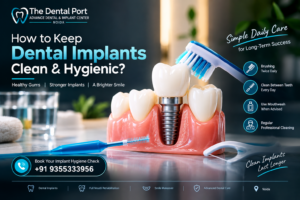
Daily cleaning: Brush carefully around the implant-supported restoration and clean between the teeth using suitable interdental aids recommended by your dentist.
Professional maintenance: Attend regular dental examinations and professional cleaning at intervals appropriate to your oral health.
Bite assessment: Report changes in the way your teeth meet, a loose restoration or discomfort when chewing.
Early attention to symptoms: Bleeding gums, persistent swelling, discharge, increasing pain or implant mobility require professional assessment.
Communication between dentists: Give your local dentist the implant records, relevant X-rays and details of the restoration.
Ask The Dental Port about obtaining your records and arranging communication regarding follow-up care, if required.
The availability of remote advice depends on the clinical information provided and the circumstances. An online review cannot replace an examination when one is necessary.
9. Is Dental Tourism in India Worth Considering?
Dental tourism may make financial sense for some patients, particularly when they need extensive restorative work. However, the decision should account for the entire treatment journey.
Consider the following before making a decision.
- Compare the complete cost of treatment, including travel and accommodation.
- Confirm whether the planned restoration can be completed within the available time.
- Understand what happens if healing takes longer than expected.
- Establish who will manage urgent problems after you return home.
- Check whether your local dentist can maintain the implant system and restoration.
- Make sure you have adequate time for recovery before resuming work or other commitments.
India is not automatically the best choice for every patient, just as treatment in a patient’s home country is not automatically the better option.
The most appropriate decision is the one that balances clinical suitability, transparent costs, continuity of care and your ability to attend the appointments your treatment requires.
10. Why Contact The Dental Port in Noida?
The Dental Port, Advance Dental & Implant Centre, is a dental clinic in Noida, Uttar Pradesh, serving patients seeking assessment and treatment for a range of dental concerns, including missing teeth.
Patients exploring dental implants can enquire about the available treatment options, diagnostic requirements, expected stages of care and estimated costs.
If you are travelling from abroad, start by sharing your existing dental records and explaining your goals. This can help the team determine what additional information may be needed before an appointment is arranged.
Before proceeding, ask for a clear explanation of the recommended treatment, the expected number of visits, the components included in the estimate and the aftercare arrangements.
Planning dental implants in Noida?
Call or WhatsApp +91 9355333956 to enquire about an assessment at The Dental Port.
Website: https://thedentalport.com/
Address and directions: Please confirm the clinic’s current address and appointment availability directly with the team before travelling.
Frequently Asked Questions About Dental Implants in India
1. Can international patients get dental implants in Noida, India?
International patients can enquire about dental implant treatment in Noida. Suitability, appointment availability and the required treatment schedule must be confirmed with the clinic after reviewing the patient’s circumstances.
2. How much do dental implants cost in India?
Dental implant costs vary according to the number of implants, the implant system, the crown or bridge, diagnostic investigations and any additional procedures. Request a written, case-specific estimate that includes all planned treatment components.
3. How long do I need to stay in India for dental implants?
The required stay depends on the procedure, healing requirements and whether a temporary or final restoration is planned. Some patients need a later visit after several months. Your dentist should provide a proposed schedule before you book flights.
4. Can I get a dental implant in one visit?
Implant placement may take place during one appointment, but the entire treatment often involves additional stages. Some suitable cases may receive immediate or early loading, while others require healing before the final crown or bridge can be fitted.
5. Can I get full-mouth dental implants in India?
Full-mouth implant rehabilitation may be possible for suitable patients with extensive tooth loss. The treatment plan depends on bone availability, oral health, general health, bite forces and the type of restoration required.
6. Are All-on-4 and All-on-6 implants suitable for everyone?
No. These approaches are options for selected patients. A clinical examination and appropriate imaging are needed to determine whether either approach is suitable.
7. Do I need a CBCT scan before dental implants?
A CBCT scan provides three-dimensional information about the jawbone and surrounding anatomy. It is commonly used when indicated for implant planning. Your dentist will decide which diagnostic images are appropriate for your case.
8. Can I fly home after dental implant surgery?
The appropriate timing depends on the procedure and your recovery. Ask your surgeon for individual advice, especially after bone grafting, sinus lift surgery or extensive implant treatment. Do not rely on a general timeline when planning a long-haul flight.
9. Can my dentist in my home country maintain my dental implants?
In many cases, yes. Your local dentist can assess the implant and surrounding tissues, provide maintenance and identify potential problems. Supply the implant manufacturer, model, available component details, restoration information and relevant X-rays.
10. What should I send before enquiring about dental implants in India?
Share any available OPG or CBCT scans, photographs of your teeth, a list of missing teeth, relevant medical history and details of existing dental treatment. Do not delay urgent care while gathering records. A preliminary review cannot replace a full clinical examination.
11. Does dental implant treatment always require bone grafting?
No. Many patients have sufficient bone for the planned implant placement. Grafting may be recommended when the available bone is inadequate. The decision depends on the clinical examination and imaging.
12. How do I contact The Dental Port for dental implants in Noida?
Call or WhatsApp +91 9355333956 to enquire about an appointment and the information required for an initial assessment.
Final Thoughts
Dental implants can provide a fixed replacement for missing teeth, but successful treatment begins with careful diagnosis and realistic planning.
For international patients, the decision also involves travel arrangements, healing time, a clear estimate and access to long-term maintenance.
Before choosing a clinic, make sure you understand the complete treatment plan, the likely number of visits and what happens after you return home.
If you are considering dental implants in Noida, contact The Dental Port, Advance Dental & Implant Centre, on +91 9355333956 to discuss your requirements and arrange an assessment.
Medical disclaimer: This article is for general educational purposes and does not constitute an individual diagnosis or treatment recommendation. Dental implant suitability, costs, recovery and travel advice depend on a clinical examination and the patient’s individual circumstances.