By The Dental Port – Advance Dental & Implant Center, Noida
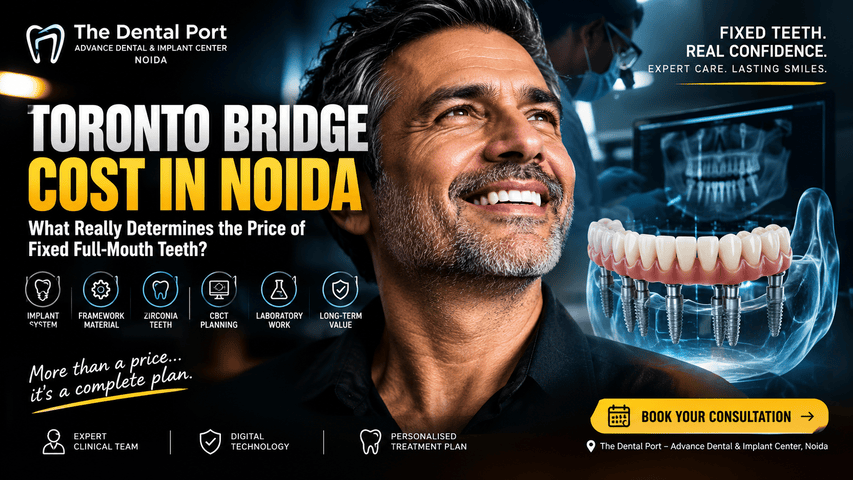
If you have been researching Toronto Bridge cost in Noida, you may have noticed that different dental clinics can quote very different prices for what appears to be the same treatment.
This often leaves patients asking:
Why does one clinic quote less while another recommends a significantly different treatment plan? What exactly am I paying for? Is a Toronto Bridge the same as All-on-4? Does the implant brand matter? Are zirconia teeth worth the additional cost?
The answer is that a fixed full-mouth restoration is not simply a set of artificial teeth.
It is a custom implant-supported prosthetic system involving diagnosis, implant positioning, surgical planning, temporary teeth, prosthetic components, framework engineering, individual crowns, bite adjustment and long-term maintenance.
At The Dental Port – Advance Dental & Implant Center, Noida, we therefore recommend looking at the complete treatment plan rather than comparing one headline price with another.
Quick Answer: How Much Does a Toronto Bridge Cost in Noida?
There is no single appropriate Toronto Bridge price for every patient.
The final cost depends on factors such as:
- Number and position of dental implants
- Whether the treatment is for one arch or both arches
- Bone volume and quality
- Need for extractions
- Bone grafting or sinus-related procedures, when indicated
- Implant system and prosthetic components
- Type of temporary teeth
- Framework material and design
- Final crown material
- Laboratory fabrication
- Digital planning and diagnostic requirements
- Bite and occlusal considerations
- Follow-up and maintenance requirements
A meaningful quotation should therefore be based on your clinical examination and diagnostic records, not simply on the number of teeth being replaced.
What Is a Toronto Bridge?
A Toronto Bridge is a type of fixed, implant-supported full-arch dental restoration.
Instead of replacing every missing tooth with an individual implant, several strategically positioned dental implants support a prosthetic arch.
The restoration is designed to remain fixed in the mouth and is generally removed by the dental professional when maintenance or laboratory work is required.
Depending on the patient’s anatomy and treatment design, a full-arch restoration may involve concepts such as:
- All-on-4
- All-on-6
- Other implant-supported full-arch configurations
- Fixed hybrid prostheses
- Toronto-style segmented crown restorations
These terms should not automatically be treated as interchangeable.
The correct design depends on the patient’s bone anatomy, implant position, restorative space, bite, aesthetic requirements and long-term maintenance needs.
Why Can Two Toronto Bridge Quotes Be So Different?
This is one of the most important questions patients should ask before choosing a full-mouth implant treatment.
Two clinics may both advertise:
“Fixed teeth on implants”
Yet the actual treatment may differ considerably.
For example, the two plans may use different:
1. Implant systems
The implant itself is the foundation of the restoration.
Different implant manufacturers have different implant geometries, prosthetic connections, surface technologies, component availability and clinical documentation.
The appropriate implant is selected according to the clinical situation rather than simply choosing the most expensive brand.
2. Number and position of implants
A full-arch restoration is not planned simply by counting missing teeth.
The implant team considers:
- Available bone
- Bone density
- Anatomical structures
- Implant angulation
- Prosthetic space
- Force distribution
- Smile line
- Final tooth position
- Maintenance requirements
This is why CBCT-based planning is an important part of complex implant treatment.
Why CBCT Matters Before Full-Mouth Implant Treatment
A panoramic X-ray provides a useful two-dimensional overview.
A CBCT scan provides three-dimensional information about the jaws and surrounding anatomy.
It can help the clinician assess:
- Bone height
- Bone width
- Anatomical limitations
- Relationship to important structures
- Implant positioning possibilities
- Areas where grafting may be required
- Prosthetic and surgical planning considerations
The purpose is not simply to “take a scan.”
The objective is to use the diagnostic information to answer a much more important question:
Where should the implants be positioned to support the final teeth safely and predictably?
That distinction is particularly important in full-mouth rehabilitation.
What Is Included in a Proper Full-Arch Implant Treatment Plan?
A comprehensive treatment plan may include several stages.
Step 1: Clinical examination
The dentist evaluates:
- Remaining teeth
- Gum health
- Bone condition
- Bite
- Facial and smile characteristics
- Existing restorations
- Functional requirements
Step 2: Digital diagnostics
Depending on the case, this may include:
- CBCT
- Digital intraoral scanning
- Clinical photographs
- Digital treatment planning
Step 3: Implant planning
The surgical and restorative requirements are considered together.
The final position of the teeth should influence implant planning, rather than placing implants without considering the definitive prosthesis.
Step 4: Implant placement
Implants are positioned according to the individual treatment plan.
Step 5: Provisional fixed teeth
Where clinically appropriate, a temporary fixed restoration may be provided during the healing and treatment process.
This is not merely a cosmetic replacement.
It can help the clinical team evaluate:
- Tooth position
- Smile aesthetics
- Speech
- Bite
- Facial support
- Gum contours
Step 6: Definitive prosthesis
After the appropriate healing and assessment period, the definitive restoration is fabricated.
Step 7: Bite and maintenance evaluation
The final restoration must function with the patient’s bite.
Regular reviews are important for monitoring:
- Implant health
- Gum tissues
- Prosthetic components
- Occlusion
- Hygiene
- Wear or damage
Framework: The Part Patients Often Don’t See
One of the less visible components of a full-arch restoration is the framework.
The framework provides structural support to the prosthetic teeth and connects the restoration to the implant-supported components.
Depending on the design, framework materials can include options such as:
- Titanium
- Cobalt-chromium
- High-performance polymer systems
- Other laboratory-specific materials
The appropriate choice depends on the clinical design and prosthetic requirements.
There is no single framework material that is automatically appropriate for every patient.
What Does “Passive Fit” Mean?
If you are comparing Toronto Bridge or full-arch implant quotes, this is a term worth understanding.
A passive fit means that the framework should seat accurately on the implant-supported components without requiring excessive force to compensate for a discrepancy.
Why does this matter?
Because an implant-supported restoration is a mechanically connected system.
Poorly fitting components can contribute to mechanical complications such as:
- Screw loosening
- Component wear
- Prosthetic fracture
- Difficulty with maintenance
- Uneven loading
This is why laboratory accuracy and verification are important parts of complex implant rehabilitation.
Does the Material of the Final Teeth Affect Cost?
Yes.
The final prosthetic teeth may be manufactured using different materials depending on the design.
Common possibilities include:
Zirconia
Zirconia is widely used in implant prosthetics because of its strength and aesthetic possibilities.
Modern zirconia materials are available in different formulations and translucencies.
Acrylic or composite-based teeth
These may offer advantages in repairability and cost, depending on the design.
However, their wear and maintenance characteristics differ from ceramic restorations.
Hybrid approaches
Some full-arch restorations combine different materials and structural components to achieve an appropriate balance between strength, aesthetics, weight and repairability.
The correct material should therefore be selected after evaluating the patient’s functional and aesthetic requirements.
Toronto Bridge vs All-on-4: Are They the Same?
Not necessarily.
All-on-4 generally refers to a treatment concept in which a full arch is supported by four implants.
A Toronto Bridge describes a particular type of implant-supported prosthetic restoration/design rather than simply the number of implants.
A patient can therefore have a full-arch restoration supported by four implants without every restoration being identical in its prosthetic design.
This is an important distinction when comparing treatment quotations.
Why the Temporary Teeth Matter
Patients sometimes focus entirely on the final teeth and overlook the provisional stage.
However, temporary teeth can provide valuable clinical information.
During this stage, the dentist can evaluate:
- Smile appearance
- Tooth length
- Tooth position
- Speech
- Lip support
- Bite
- Patient comfort
- Cleaning access
For extensive rehabilitation, this feedback can help guide the definitive restoration.
What Can Increase the Cost of Full-Mouth Implant Treatment?
The basic implant restoration may not represent the entire treatment requirement.
Additional procedures may sometimes be necessary.
These can include:
Tooth extraction
Hopeless or severely damaged teeth may need to be removed before or during implant treatment.
Bone grafting
Long-standing tooth loss can result in loss of supporting bone.
If there is insufficient bone for the planned implant position, augmentation may be considered.
Sinus-related procedures
In selected upper-jaw cases, the position of the maxillary sinus may affect implant placement.
Treatment of gum disease
Active periodontal disease should be addressed because healthy supporting tissues are important for long-term implant maintenance.
Temporary prosthesis
The provisional restoration may form an important part of the treatment sequence.
Additional prosthetic components
Multi-unit abutments and other implant-specific components can influence the overall treatment cost.
Why You Should Not Compare Implant Prices Alone
Suppose Clinic A quotes ₹X and Clinic B quotes ₹Y.
That comparison tells you very little unless you know what both quotations contain.
Ask whether the quotation specifies:
- Number of implants
- Implant manufacturer/system
- Implant components
- Temporary teeth
- Final prosthesis
- Framework material
- Crown material
- CBCT and diagnostic planning
- Extractions
- Bone grafting, if required
- Laboratory charges
- Follow-up visits
- Maintenance
- Warranty terms, where applicable
A lower initial quotation may simply represent a different treatment design.
The useful comparison is treatment plan against treatment plan, not price against price.
How a Dentist Determines the Right Full-Mouth Implant Design
There is no universal full-mouth implant prescription.
At The Dental Port, the treatment planning process should begin with the patient’s clinical condition rather than a predetermined package.
The dentist considers:
Bone + gums + bite + implant position + tooth position + aesthetics + function + maintenance
These factors are interconnected.
For example, a patient with significant bone loss may require a different implant strategy from a patient with adequate bone.
Likewise, a patient with heavy clenching may require different prosthetic considerations from someone without significant parafunctional loading.
What About Severe Bone Loss?
Severe upper-jaw bone loss does not automatically mean that fixed implant teeth are impossible.
However, the treatment may become more complex.
Depending on the anatomy, options can include:
- Bone augmentation
- Angled implant strategies
- Zygomatic implants in appropriately selected cases
- Alternative full-arch implant configurations
- Other graftless or graft-assisted approaches
Zygomatic implants are a specialized treatment option and are not required for every patient with missing upper teeth.
A CBCT-based assessment is necessary to determine whether they are clinically appropriate.
Questions to Ask Before Paying for a Full-Mouth Implant Treatment
Before accepting a quotation, ask your dentist:
“How many implants will I receive?”
“Which implant system will you use?”
“What temporary teeth are included?”
“What material will be used for the final prosthesis?”
“Is the framework milled or conventionally fabricated?”
“Are all prosthetic components included?”
“Will CBCT planning be performed?”
“Will I need bone grafting or another preparatory procedure?”
“What happens if a crown chips or a prosthetic component needs repair?”
“What maintenance will I need after treatment?”
These questions often reveal more about the treatment than the advertised package price.
How Long Can a Toronto Bridge Last?
The lifespan of an implant-supported restoration cannot be guaranteed by a single number.
Its longevity depends on several variables, including:
- Implant health
- Gum health
- Oral hygiene
- Bite forces
- Bruxism
- Prosthetic material
- Framework design
- Laboratory quality
- Maintenance
- Regular professional reviews
- Patient-specific biological factors
The implants and the prosthetic teeth also have different maintenance considerations.
A successful full-mouth implant treatment therefore does not end when the final teeth are fitted.
Maintenance is part of the treatment.
What Does Full-Mouth Implant Maintenance Involve?
Patients with fixed implant-supported teeth should maintain a structured hygiene routine.
Depending on the restoration, this may involve:
- Professional implant cleaning
- Interdental cleaning
- Water flossing where appropriate
- Cleaning underneath the prosthesis
- Regular clinical examination
- Bite assessment
- Prosthetic screw/component evaluation when indicated
- Periodic radiographic assessment when clinically required
The exact maintenance schedule should be individualized.
Toronto Bridge Cost in Noida: What Should You Really Be Paying For?
When patients search “Toronto Bridge cost in Noida,” they are often looking for one number.
Clinically, the more useful question is:
“What treatment am I receiving for that amount?”
A full-mouth implant restoration is a combination of:
Diagnosis → Surgical planning → Implant placement → Healing → Provisional teeth → Digital records → Framework → Final teeth → Bite adjustment → Maintenance
The cost reflects this entire clinical and laboratory pathway.
At The Dental Port – Advance Dental & Implant Center, Noida, we believe patients should understand their treatment before committing to it.
Frequently Asked Questions
What is the average Toronto Bridge cost in Noida?
There is no single price applicable to every patient. The cost depends on the number of implants, implant system, bone condition, temporary restoration, framework, final teeth, laboratory work and any additional procedures required.
Is a Toronto Bridge fixed?
Yes. A Toronto-style full-arch restoration is designed as a fixed implant-supported prosthesis. It is not intended to be removed by the patient like a conventional removable denture.
Is Toronto Bridge the same as All-on-4?
No. All-on-4 primarily describes an implant treatment concept using four implants to support an arch, while Toronto Bridge refers to a prosthetic restoration/design. The two terms can be used together in some treatment plans but are not synonymous.
Is zirconia better than acrylic for full-mouth implants?
They have different properties and indications. Zirconia can provide high strength and excellent aesthetics, while acrylic or composite-based restorations may offer different advantages such as repairability and lower laboratory cost. The appropriate material depends on the individual case.
Do I need a CBCT before full-mouth dental implants?
For complex implant treatment, three-dimensional imaging is commonly important for evaluating bone anatomy and planning implant placement. Your dentist can determine the appropriate diagnostic imaging after clinical examination.
Can I get fixed teeth if I have severe bone loss?
Possibly. The treatment depends on where and how much bone has been lost. Options may include grafting, alternative implant positioning or, in selected severe upper-jaw cases, zygomatic implants.
Can a Toronto Bridge be repaired if one tooth breaks?
Depending on the specific prosthetic design, individual components may be repairable or replaceable without remaking the entire restoration. Your dentist should explain the repair pathway before treatment.
How long do fixed implant teeth last?
There is no guaranteed lifespan. Implant health, prosthetic material, bite forces, oral hygiene and professional maintenance all influence long-term performance.
The Dental Port’s Approach to Full-Mouth Implant Planning
At The Dental Port – Advance Dental & Implant Center, Noida, full-mouth implant treatment begins with diagnosis rather than a package.
Our clinical team evaluates the patient’s:
Bone condition
Gum health
Remaining teeth
Bite
Facial aesthetics
Implant requirements
Prosthetic design
Long-term maintenance needs
The objective is to design a restoration that is not only functional when delivered, but also practical to maintain over time.
Considering full-mouth fixed teeth in Noida?
Bring your existing CBCT, OPG or dental records for a clinical evaluation. The dentist can then determine whether an All-on-4, All-on-6, Toronto-style restoration, conventional implant bridge or another approach is appropriate for your anatomy.
The right treatment plan should be determined by your mouth, not by an advertised package price.
Medically reviewed by Dr. Suresh Kumar, Implantologist, for clinical accuracy and patient-focused guidance on Toronto Bridge treatment, implant planning, materials and maintenance.