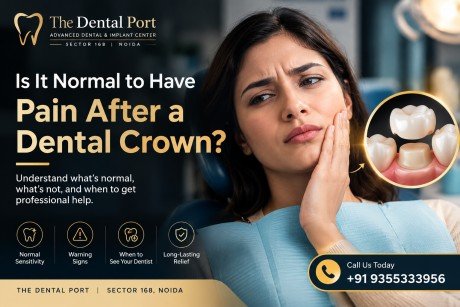
A dental crown is designed to protect a damaged tooth, restore chewing function, and improve its appearance. But what happens when the tooth feels sensitive or painful after the crown is placed?
Mild sensitivity or tenderness after a dental crown can be normal, especially during the initial healing period. However, persistent, worsening, spontaneous, or severe pain should not simply be ignored.
The important question is not only “How much does it hurt?” but also “What triggers the pain, how long does it last, and is it getting better or worse?”
At The Dental Port – Advance Dental & Implant Center, Sector 168, Noida, we assess post-crown pain by looking at the tooth, bite, gums, previous dental treatment, and the condition of the nerve inside the tooth rather than assuming that every painful crowned tooth needs a root canal.
Quick Answer: Is Pain After a Dental Crown Normal?
Yes, some short-term sensitivity can occur after crown treatment. A recently prepared tooth may be sensitive to hot or cold, and the gum around the crown can feel tender for a few days. Cleveland Clinic notes that sensitivity may continue for a couple of weeks, particularly in teeth that have not undergone root canal treatment.
What matters clinically is the pattern of symptoms.
A sensitivity that is gradually decreasing is different from pain that is becoming stronger, occurring without a trigger, lingering after hot or cold, waking you at night, or making it difficult to bite.
What Pain Is Usually Considered Normal After a Crown?
After crown preparation or placement, some patients notice:
- Mild sensitivity to cold or hot drinks
- Temporary tenderness around the gum
- Slight discomfort while chewing
- A sensation that the new crown feels different from the natural tooth
These symptoms are often temporary and should generally improve rather than progressively worsen.
During the First Few Days
The tooth and surrounding tissues are recovering from the crown preparation. If the tooth is still vital, its pulp may also react temporarily following dental treatment.
For the first few days, it can help to:
- Choose lukewarm rather than very hot or cold foods.
- Eat softer foods if chewing feels uncomfortable.
- Avoid repeatedly testing the tooth by biting hard foods.
- Continue brushing and cleaning around the crown gently.
The key clinical sign is improvement over time.
When Is Pain After a Crown Not Normal?
Persistent pain does not automatically mean that the crown has failed. It means the tooth deserves a proper examination.
Contact your dentist sooner when you experience:
1. Pain That Is Getting Worse
Pain that becomes more intense instead of gradually settling should be investigated.
2. Severe or Spontaneous Toothache
Pain that starts without eating, drinking, biting, or touching the tooth can indicate inflammation of the dental pulp.
3. Lingering Hot or Cold Sensitivity
A tooth that continues to hurt after the hot or cold stimulus has been removed may need evaluation for pulpal inflammation. The American Association of Endodontists identifies lingering thermal pain as a symptom that can warrant further assessment.
4. Pain That Wakes You at Night
Night-time or spontaneous throbbing pain is more concerning than mild, stimulus-related sensitivity and should not be dismissed as routine crown sensitivity.
5. Pain When Biting or Chewing
Pain specifically associated with biting can have several causes, including bite interference, a crack, problems involving the pulp, or other structural issues.
A dentist should determine the actual cause rather than treating the symptom alone.
Why Does My New Crown Hurt When I Bite?
One common possibility is an occlusal or bite problem.
A crown must contact the opposing teeth correctly. If it is slightly too high, excessive force may be concentrated on that tooth every time you close your mouth or chew.
A crown that feels “too high,” causes pain mainly while biting, or makes your bite feel different should be checked. In many cases, a minor occlusal adjustment can resolve the problem.
This is one reason a post-cementation bite check is an important part of crown care.
Why Does My Crown Hurt With Hot or Cold?
If the tooth has not had a root canal, it still contains living pulp tissue.
After tooth preparation, the pulp can become temporarily irritated. This may cause sensitivity to temperature, particularly during the early recovery period.
The pattern matters.
More reassuring pattern
Cold causes a brief sensation that stops quickly and becomes less noticeable as the days pass.
More concerning pattern
Hot or cold causes significant pain that lingers after the stimulus is removed, becomes more intense, occurs spontaneously, or is associated with night pain. These symptoms can indicate more significant pulpal inflammation and require clinical assessment.
Does a Painful Crown Mean I Need a Root Canal?
No.
This is one of the most important misconceptions about dental crowns.
A crown does not automatically require root canal treatment, and pain after a crown does not automatically mean a root canal is necessary.
The decision depends on the condition of the tooth’s pulp and supporting tissues.
Root canal treatment may be considered when there is evidence of significant or irreversible pulp inflammation, infection, deep decay, a crack involving the pulp, or other findings indicating that the nerve cannot recover. Symptoms can include severe biting pain, lingering thermal sensitivity, spontaneous pain, swelling, or other clinical findings.
When the pulp is healthy, preserving the living tooth whenever clinically possible is generally preferred.
Common Causes of Pain After a Dental Crown
Post-crown pain has more than one possible cause. Correct diagnosis comes before treatment.
1. Temporary Tooth Sensitivity
The tooth may be temporarily sensitive after preparation, particularly when it is still vital.
Typical approach: observation, sensitivity control, and review if symptoms persist or worsen.
2. High Bite or Occlusal Interference
The crown may contact the opposing tooth too heavily.
Typical approach: clinical bite assessment and adjustment where indicated.
3. Gum Irritation
The gum around a newly placed crown can be mildly irritated or tender.
Typical approach: careful brushing, flossing or interdental cleaning, and monitoring of gum health.
4. Pulp Inflammation
The nerve inside the tooth may become significantly inflamed, particularly when the original tooth had deep decay, extensive restorations, trauma, or other risk factors.
Typical approach: pulp testing, clinical examination and dental radiographs, followed by endodontic treatment when indicated.
5. Cracked or Structurally Compromised Tooth
Pain on biting is not always caused by the crown itself. A crack or structural problem in the underlying tooth can produce sharp or inconsistent symptoms.
Typical approach: careful clinical examination and appropriate imaging or tests.
6. Bruxism or Teeth Grinding
Repeated clenching and grinding can overload the crowned tooth and surrounding structures.
Your dentist may recommend bite assessment, load management, or a custom night guard when clinically appropriate.
7. Temporary Crown Problems
With a temporary crown, loosening, leakage, or poor retention can lead to discomfort and should be addressed rather than allowed to continue.
What About Pain After a Zirconia Crown?
Patients sometimes assume that zirconia itself must be responsible for post-crown pain.
In practice, the material alone does not explain most cases of tooth pain after a crown.
A zirconia-crowned tooth can still develop:
- Bite-related pain
- Temporary sensitivity
- Gum irritation
- Pulp inflammation
- Pain associated with a crack or underlying tooth problem
Therefore, when a zirconia crown hurts, the dentist should evaluate the crown, the bite, the tooth underneath, and the pulp rather than assuming the material is the cause.
Can a Root Canal Be Needed After a Crown?
Yes, occasionally.
A tooth may look fine externally while the pulp inside the tooth becomes inflamed after restorative treatment. This is why persistent or spontaneous pain should be clinically evaluated.
The American Association of Endodontists notes that recent dental treatment can sometimes temporarily inflame the pulp, but persistent or worsening symptoms should be assessed by a dentist or endodontist.
A root canal is therefore based on diagnosis, not simply on the fact that a crown has been placed.
What Happens During a Dental Crown Procedure? Does It Hurt?
Modern crown treatment is performed using local anesthesia, so patients should generally remain comfortable during tooth preparation.
You may feel:
- Pressure
- Vibration
- Movement
- Water and air
- Temporary gum pressure
These sensations are different from sharp pain.
Your dentist should know immediately if you feel significant pain during treatment so additional anesthesia or another comfort measure can be provided.
What Should You Do During the First Few Days?
Eat Sensibly
Choose softer, lukewarm foods when the tooth feels sensitive.
Avoid Extreme Temperatures
Very hot and very cold foods may temporarily trigger sensitivity.
Keep the Area Clean
Do not stop brushing or cleaning around the crown because of mild tenderness. Plaque accumulation can irritate the gum further.
Do Not Keep Testing the Crown
Repeatedly biting hard objects or deliberately checking whether the tooth still hurts can aggravate a sensitive tooth.
Use Pain Medication Responsibly
Pain medicines may be useful for acute dental pain, but the appropriate choice depends on your medical history, medications, age, and contraindications. The ADA’s current evidence-based guidance supports non-opioid analgesics as important options for acute dental pain management.
Do not start antibiotics simply because a crowned tooth hurts. Antibiotics are not a substitute for definitive dental treatment and are not routinely recommended for most pulpal or periapical dental pain without appropriate indications.
How Long Should a Tooth Hurt After a Crown?
There is no single number of days that applies to every patient.
A useful clinical guide is:
First few days:
Mild sensitivity, gum tenderness, or slight chewing discomfort may occur.
First couple of weeks:
Some temperature sensitivity can still be present in a vital tooth, but it should generally be settling rather than escalating.
Any time:
Severe spontaneous pain, night pain, significant swelling, persistent worsening symptoms, or pronounced pain on biting deserves dental review rather than prolonged self-monitoring.
The trend of the symptoms is often more useful than an exact day count.
How a Dentist Diagnoses Pain After a Crown
At The Dental Port, the first step is to determine where the pain is coming from.
Depending on the symptoms, a dentist may assess:
1. Your bite
Does the new crown contact too heavily?
2. Pulp vitality
Does the nerve inside the tooth respond normally?
3. Percussion and biting response
Does tapping or loading the tooth reproduce the pain?
4. Gums and surrounding tissues
Is there local inflammation, tenderness, swelling, or food trapping?
5. Dental imaging
Is there evidence of decay, infection, bone changes, or another underlying problem?
The treatment should then address the diagnosed cause.
When Should You Contact a Dentist Immediately?
Seek prompt dental assessment if you develop:
- Facial or gum swelling
- Severe or rapidly worsening pain
- Fever associated with dental symptoms
- Difficulty swallowing or breathing
- Significant swelling around the face or jaw
- A loose or displaced crown
- Severe pain that prevents sleep or normal function
These symptoms should not be managed by simply waiting for the crown to “settle.”
Frequently Asked Questions About Dental Crown Pain
Is it normal for a crown to be sensitive to cold?
Yes. A recently treated vital tooth can experience temporary cold sensitivity. What matters is whether the sensitivity is improving and whether the pain stops promptly after the stimulus is removed. Lingering or worsening pain requires assessment.
Why does my crown hurt only when I bite?
Biting pain can result from an uneven bite, a crack, pulp involvement, or another structural problem. A dentist needs to identify the cause instead of assuming the crown needs replacement.
Can a tooth need a root canal after getting a crown?
Yes, but not every painful crowned tooth needs one. Root canal treatment is considered when examination and diagnostic testing indicate significant pulp disease or infection.
Is pain at night after a crown a concern?
Night-time or spontaneous throbbing pain is more concerning than mild temporary sensitivity and should be evaluated, particularly when symptoms are worsening or occur without a trigger.
How long should I wait before seeing my dentist?
Do not rely only on a fixed number of days. If symptoms are mild and steadily improving, short-term observation may be reasonable. Persistent, worsening, spontaneous, or severe pain should be checked sooner.
Doctor’s Perspective: The Crown May Not Be the Problem
When a patient says, “My crown hurts,” the crown is not automatically the source of the problem.
The discomfort may actually be coming from the tooth’s nerve, the bite, the gum, a crack, or the tissues around the tooth.
That distinction matters because replacing a crown without identifying the underlying cause may not solve the pain.
A proper diagnosis helps determine whether the patient needs:
a simple bite adjustment, sensitivity management, gum care, further observation, endodontic treatment, or another form of dental treatment.
That is why persistent crown pain should be diagnosed rather than guessed at.
Dental Crown Pain Treatment in Sector 168, Noida
At The Dental Port – Advance Dental & Implant Center, Noida, we evaluate painful or sensitive crowned teeth using clinical examination, bite assessment, pulp testing and dental imaging when required.
Whether you have recently received a zirconia crown, E-max crown, PFM crown, DMLS crown, or another dental restoration, the correct treatment depends on the condition of the underlying tooth and surrounding tissues.
Concerned About Pain After Your Dental Crown?
Book a dental evaluation instead of continuing to guess whether the pain is normal.
The Dental Port – Advance Dental & Implant Center
Sector 168, Noida
Call: +91 9355333956
Website: www.thedentalport.com
A timely examination can often identify whether the problem is simply a bite adjustment or something that requires further treatment.
Medical Disclaimer
This article is intended for general dental education and does not replace an in-person examination. Pain after a dental crown can have different causes, and the correct diagnosis depends on the individual tooth, clinical findings, and appropriate diagnostic tests.