Medically Reviewed By The Dental Port Team
Written By Dr.Purnima sharma
Have you ever received a dental treatment plan that says tooth 36, while your dentist in another country calls the same tooth 19?
Or perhaps your dentist mentions tooth 46, while an American dental record says tooth 30?
The tooth has not changed.
The numbering system has.
This can become especially important when you are comparing dental treatment plans, transferring X-rays, getting a second opinion, planning a dental implant, undergoing root canal treatment, or travelling internationally for dental care.
At The Dental Port, Advance Dental & Implant Center, Sector 168, Noida, we routinely deal with patients who have dental records, X-rays, implant reports and treatment histories from different dentists and countries. Understanding the numbering system makes communication much easier.
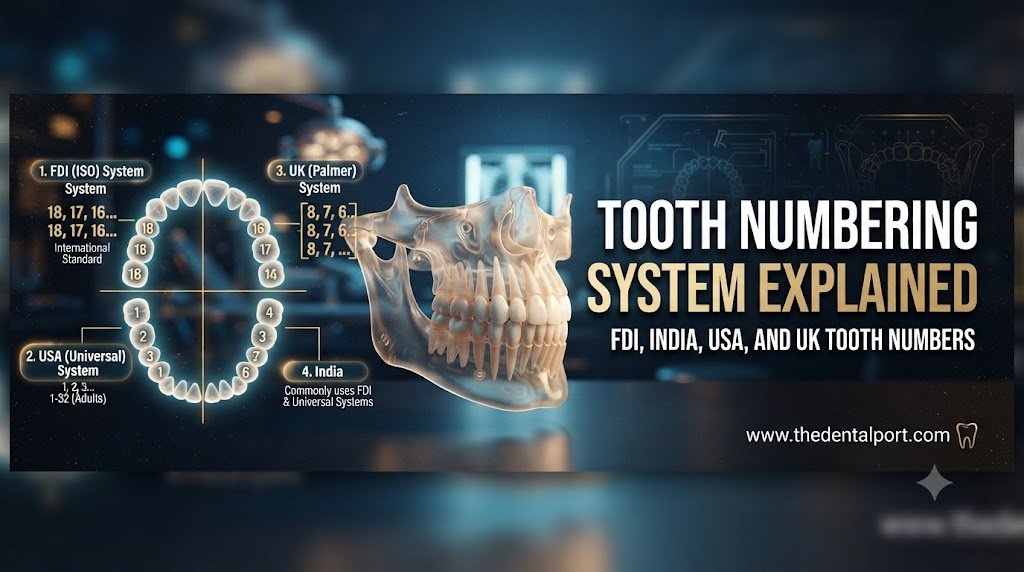
This guide explains the major dental tooth numbering systems, including the FDI two-digit system, US Universal system and UK Palmer-style notation, with practical conversion charts.
Quick Answer: What Does a Tooth Number Mean?
A tooth number is simply a standardized way of identifying a particular tooth or tooth position.
The same physical tooth can have different numbers depending on the system being used.
For example:
| Physical tooth | FDI / International | USA Universal | UK shorthand |
|---|---|---|---|
| Upper right central incisor | 11 | 8 | UR1 |
| Upper left central incisor | 21 | 9 | UL1 |
| Upper right first molar | 16 | 3 | UR6 |
| Upper left first molar | 26 | 14 | UL6 |
| Lower left first molar | 36 | 19 | LL6 |
| Lower right first molar | 46 | 30 | LR6 |
| Lower left wisdom tooth | 38 | 17 | LL8 |
| Lower right wisdom tooth | 48 | 32 | LR8 |
Important: Always confirm which numbering system is being used before interpreting a tooth number.
The 3 Dental Tooth Numbering Systems You Should Know
For international dental communication, three systems are particularly useful to understand.
1. FDI two-digit system
Commonly used internationally and represented in ISO 3950.
2. Universal tooth numbering system
Most commonly used by dental professionals in the United States.
3. Palmer notation
Traditionally used in the UK and also encountered in other dental settings.
The American Dental Association describes the Universal/National system as the system most commonly used in the United States, while also recognising the ISO/ANSI/ADA two-digit system used internationally.
What Is the FDI Tooth Numbering System?
The FDI tooth numbering system is a two-digit system used to identify permanent and primary teeth.
It is incorporated into ISO 3950, titled Dentistry: Designation system for teeth and areas of the oral cavity. The current published edition is ISO 3950:2016.
The clever part is that you can understand the tooth number by separating the two digits.
FDI formula
First digit = quadrant
Second digit = tooth position
For permanent teeth:
| First digit | Quadrant |
|---|---|
| 1 | Upper right |
| 2 | Upper left |
| 3 | Lower left |
| 4 | Lower right |
The second digit identifies the tooth starting from the centre line:
| Second digit | Tooth |
|---|---|
| 1 | Central incisor |
| 2 | Lateral incisor |
| 3 | Canine |
| 4 | First premolar |
| 5 | Second premolar |
| 6 | First molar |
| 7 | Second molar |
| 8 | Third molar / wisdom tooth |
Example: What is tooth 36?
Break 36 into:
3 = lower left
6 = first molar
Therefore:
FDI 36 = lower-left first molar
In the US Universal system, this same tooth is tooth 19.
In UK shorthand, it may be written as LL6.
FDI Tooth Numbering Chart
Think of the mouth as four numbered zones.
                 UPPER JAW

        RIGHT                    LEFT
     18 17 16 15 14 13 12 11 | 21 22 23 24 25 26 27 28
     ─────────────────────────────────────────────────────

        RIGHT                    LEFT
     48 47 46 45 44 43 42 41 | 31 32 33 34 35 36 37 38

                 LOWER JAW
Remember that these directions refer to the patient’s right and left, not the viewer’s right and left.
Complete FDI Permanent Tooth Chart
| Tooth region | FDI numbers |
|---|---|
| Upper right | 11 to 18 |
| Upper left | 21 to 28 |
| Lower left | 31 to 38 |
| Lower right | 41 to 48 |
The sequence moves from the central incisor toward the back of the mouth.
Upper right
11, 12, 13, 14, 15, 16, 17, 18
Upper left
21, 22, 23, 24, 25, 26, 27, 28
Lower left
31, 32, 33, 34, 35, 36, 37, 38
Lower right
41, 42, 43, 44, 45, 46, 47, 48
What Do Common FDI Tooth Numbers Mean?
This is one of the most useful sections for patients comparing dental reports.
| FDI number | Tooth |
|---|---|
| 11 | Upper right central incisor |
| 12 | Upper right lateral incisor |
| 13 | Upper right canine |
| 14 | Upper right first premolar |
| 15 | Upper right second premolar |
| 16 | Upper right first molar |
| 17 | Upper right second molar |
| 18 | Upper right wisdom tooth |
| 21 | Upper left central incisor |
| 22 | Upper left lateral incisor |
| 23 | Upper left canine |
| 24 | Upper left first premolar |
| 25 | Upper left second premolar |
| 26 | Upper left first molar |
| 27 | Upper left second molar |
| 28 | Upper left wisdom tooth |
| 31 | Lower left central incisor |
| 32 | Lower left lateral incisor |
| 33 | Lower left canine |
| 34 | Lower left first premolar |
| 35 | Lower left second premolar |
| 36 | Lower left first molar |
| 37 | Lower left second molar |
| 38 | Lower left wisdom tooth |
| 41 | Lower right central incisor |
| 42 | Lower right lateral incisor |
| 43 | Lower right canine |
| 44 | Lower right first premolar |
| 45 | Lower right second premolar |
| 46 | Lower right first molar |
| 47 | Lower right second molar |
| 48 | Lower right wisdom tooth |
Tooth 36 in USA Numbering
One of the most common international dental-numbering questions is:
What is tooth 36 in the USA?
If your treatment plan uses FDI notation:
FDI 36 = lower-left first molar
The corresponding US Universal number is:
USA #19
The UK shorthand equivalent is:
LL6
In other words:
36 = 19 = LL6
These are different names for the same physical tooth when the systems are correctly mapped.
Tooth 46 in USA Numbering
Another common search is:
What is tooth 46 in the USA?
FDI 46 means:
Lower-right first molar
The corresponding US Universal number is:
#30
UK shorthand:
LR6
Therefore:
46 = 30 = LR6
This distinction matters when transferring an implant plan, crown prescription, root canal record or X-ray between dentists.
FDI vs USA Tooth Numbering Chart
Here is a practical conversion chart for permanent teeth.
| Tooth | FDI | USA |
|---|---|---|
| Upper right third molar | 18 | 1 |
| Upper right second molar | 17 | 2 |
| Upper right first molar | 16 | 3 |
| Upper right second premolar | 15 | 4 |
| Upper right first premolar | 14 | 5 |
| Upper right canine | 13 | 6 |
| Upper right lateral incisor | 12 | 7 |
| Upper right central incisor | 11 | 8 |
| Upper left central incisor | 21 | 9 |
| Upper left lateral incisor | 22 | 10 |
| Upper left canine | 23 | 11 |
| Upper left first premolar | 24 | 12 |
| Upper left second premolar | 25 | 13 |
| Upper left first molar | 26 | 14 |
| Upper left second molar | 27 | 15 |
| Upper left third molar | 28 | 16 |
| Lower left third molar | 38 | 17 |
| Lower left second molar | 37 | 18 |
| Lower left first molar | 36 | 19 |
| Lower left second premolar | 35 | 20 |
| Lower left first premolar | 34 | 21 |
| Lower left canine | 33 | 22 |
| Lower left lateral incisor | 32 | 23 |
| Lower left central incisor | 31 | 24 |
| Lower right central incisor | 41 | 25 |
| Lower right lateral incisor | 42 | 26 |
| Lower right canine | 43 | 27 |
| Lower right first premolar | 44 | 28 |
| Lower right second premolar | 45 | 29 |
| Lower right first molar | 46 | 30 |
| Lower right second molar | 47 | 31 |
| Lower right third molar | 48 | 32 |
The ADA’s current Universal Tooth Designation System confirms the permanent-tooth sequence from #1 through #32 and provides mapping to the ISO designation system.
Why Can the Same Tooth Have Two Different Numbers?
Because the systems were designed differently.
The FDI system encodes information into the two digits.
For example:
46
means:
4 = lower right
6 = first molar
The American Universal system instead numbers permanent teeth sequentially around the arches.
So:
#30 = lower-right first molar
The physical tooth is identical.
Only the notation changes.
A Simple Way to Remember FDI Numbers
You do not need to memorize all 32 teeth.
Remember these four starting points:
UPPER RIGHT  → 1
UPPER LEFT   → 2
LOWER LEFT   → 3
LOWER RIGHT  → 4
Then remember:
1 = central incisor
2 = lateral incisor
3 = canine
4 = first premolar
5 = second premolar
6 = first molar
7 = second molar
8 = wisdom tooth
Now you can decode almost any permanent FDI tooth number.
Example
Tooth 27
2 = upper left
7 = second molar
Therefore:
27 = upper-left second molar
Why Tooth Numbering Matters for Dental Implants
Tooth numbering becomes particularly important when planning dental implants.
Suppose a patient has lost a lower-right first molar.
A dentist using FDI notation may document:
Missing tooth 46
An American dentist may document:
Missing tooth #30
Both can refer to the same anatomical position.
However, the tooth number is only one part of an implant treatment plan.
A complete implant record may also need to identify:
- Missing tooth position
- Bone volume
- Bone height and width
- Nerve location
- Sinus anatomy where relevant
- Implant diameter
- Implant length
- Implant system and model
- Abutment
- Crown design
- Occlusion
- CBCT findings
- Surgical and prosthetic stages
Important distinction
“Implant at 46” identifies the tooth position.
It does not identify the implant brand, implant dimensions or crown type.
This is particularly important when a patient receives an implant in India and later has the crown or maintenance performed by another dentist.
Tooth Numbering and Root Canal Treatment
Tooth numbering is equally important in endodontics.
A treatment plan may say:
RCT 36
That means root canal treatment is planned for the lower-left first molar, assuming FDI notation is being used.
But the number alone does not tell you:
- Why the root canal is required
- Whether the tooth is restorable
- How many canals are present
- Whether there is an abscess
- Whether a previous root canal has failed
- Whether a crown is required afterward
Diagnosis requires clinical examination and appropriate radiographic assessment.
This is why patients should not interpret a tooth number as a diagnosis.
Tooth Numbering for Crowns and Bridges
The same principle applies to dental crowns and bridges.
For example:
Zirconia crown on 26
means the upper-left first molar if FDI notation is being used.
A laboratory prescription may use a different notation system depending on where the laboratory and dentist are located.
For international cases, the safest documentation includes both the number and the anatomical description.
Better documentation
Tooth 26, upper-left first molar, FDI notation
is clearer than simply writing:
26
What About UK Tooth Numbers?
The UK can be slightly more complicated because Palmer notation and FDI notation may both be encountered.
In an alphanumeric shorthand version of Palmer notation:
- UR1 = upper-right central incisor
- UR6 = upper-right first molar
- UL3 = upper-left canine
- LL6 = lower-left first molar
- LR8 = lower-right wisdom tooth
So:
LL6 = FDI 36 = USA #19
and:
LR6 = FDI 46 = USA #30
For international dental communication, it is better to identify the notation system instead of assuming it from the country alone.
The Most Confusing Tooth Numbers
Some numbers are particularly easy to misunderstand because they look familiar in both systems but mean different things.
FDI 11 vs USA #11
FDI 11:
Upper-right central incisor
USA #11:
Upper-left canine
Completely different teeth.
FDI 12 vs USA #12
FDI 12:
Upper-right lateral incisor
USA #12:
Upper-left first premolar
Again, completely different teeth.
FDI 18 vs USA #18
FDI 18:
Upper-right wisdom tooth
USA #18:
Lower-left second molar
This is why a tooth number should never be interpreted without knowing the numbering system.
Children’s Tooth Numbering Is Different
Primary or baby teeth have their own notation.
In the FDI system, primary teeth use quadrants:
5, 6, 7 and 8
The second digit runs from:
1 to 5
For example:
| Primary tooth | FDI | USA |
|---|---|---|
| Upper right central incisor | 51 | E |
| Upper right lateral incisor | 52 | D |
| Upper right canine | 53 | C |
| Upper right first molar | 54 | B |
| Upper right second molar | 55 | A |
| Upper left central incisor | 61 | F |
| Lower left second molar | 75 | K |
| Lower right second molar | 85 | T |
The ADA Universal system uses letters A through T for primary teeth.
Tooth Numbering Infographic: Save This Chart
PERMANENT TEETH
                 UPPER JAW

       PATIENT'S RIGHT       PATIENT'S LEFT

       18 17 16 15 14 13 12 11
              ↓
          RIGHT SIDE

       21 22 23 24 25 26 27 28
              ↑
          LEFT SIDE


       48 47 46 45 44 43 42 41
              ↓
          RIGHT SIDE

       31 32 33 34 35 36 37 38
              ↑
          LEFT SIDE

                 LOWER JAW
FDI memory rule
1 = upper right
2 = upper left
3 = lower left
4 = lower right
1 to 8 = centre toward the back
International Dental Treatment Plans: What Should Be Written?
If you are receiving dental treatment abroad or sending records to another dentist, a good treatment document should ideally include:
1. Tooth number
Example:
46
2. Numbering system
Example:
FDI
3. Anatomical description
Example:
Lower-right first molar
4. Treatment
Example:
Dental implant
5. Supporting records
Where appropriate:
IOPA X-ray / OPG / CBCT / clinical photographs
This gives another dentist multiple ways to verify the intended treatment site.
Why X-rays and CBCT Still Matter
Tooth numbers improve communication, but they do not replace clinical examination or imaging.
For implant treatment, a CBCT may be required to assess anatomy and implant-site conditions.
For root canal treatment, radiographs and clinical findings help the dentist evaluate the tooth and surrounding structures.
For wisdom tooth removal, imaging may help assess the relationship of the tooth to nearby anatomical structures.
The number tells you which tooth.
The clinical examination and imaging help determine what is happening with that tooth and what treatment may be appropriate.
Common Mistakes Patients Make With Tooth Numbers
Mistake 1: Assuming every country uses the same system
They do not.
Mistake 2: Thinking 36 means “tooth number thirty-six”
In FDI notation, it is read as:
three-six
The digits have separate meanings.
Mistake 3: Assuming US #19 is a different physical tooth from FDI 36
It is the same physical tooth when correctly converted.
Mistake 4: Looking only at the number
Always check the notation system and tooth description.
Mistake 5: Assuming the tooth number tells you the diagnosis
It does not.
Mistake 6: Assuming an implant number identifies the implant brand
It does not.
Tooth Number Conversion Cheat Sheet
| If your dentist says… | The tooth is… |
|---|---|
| FDI 11 | USA #8 |
| FDI 16 | USA #3 |
| FDI 21 | USA #9 |
| FDI 26 | USA #14 |
| FDI 36 | USA #19 |
| FDI 38 | USA #17 |
| FDI 46 | USA #30 |
| FDI 48 | USA #32 |
The two worth remembering
FDI 36 = USA 19 = UK LL6
FDI 46 = USA 30 = UK LR6
These two conversions are particularly useful when discussing molar root canal treatment, crowns and dental implants.
How The Dental Port Uses Tooth Numbering
At The Dental Port, Advance Dental & Implant Center in Sector 168, Noida, tooth numbers are used as part of clinical documentation and treatment planning.
For patients coming to us with previous dental records, implant reports, root canal reports or X-rays from another dentist, the number is considered together with the actual tooth position and clinical findings.
For international patients or patients returning to a dentist in another country, clear documentation can be especially helpful.
For example:
FDI 46 | Lower-right first molar | Implant site
is much clearer for international communication than simply:
Implant 46
The same principle applies to:
- Dental implants
- Full-mouth rehabilitation
- Root canal treatment
- Re-root canal treatment
- Dental crowns
- Bridges
- Wisdom tooth removal
- Extractions
- Veneers
- Smile rehabilitation
Frequently Asked Questions
What tooth numbering system is used in India?
The FDI two-digit system is widely used in Indian dental education and clinical communication, although documentation can vary by institution, software and practice. Always check the notation system on an international treatment document.
What is tooth 36?
In FDI notation, 36 is the lower-left first molar.
It corresponds to USA #19 and UK LL6.
What is tooth 46?
In FDI notation, 46 is the lower-right first molar.
It corresponds to USA #30 and UK LR6.
What is tooth 19?
In the US Universal system, #19 is the lower-left first molar.
That corresponds to FDI 36.
What is tooth 30?
In the US Universal system, #30 is the lower-right first molar.
That corresponds to FDI 46.
Is FDI tooth 11 the same as US tooth 11?
No.
FDI 11 is the upper-right central incisor.
US #11 is the upper-left canine.
The numbering system must always be identified.
What is the FDI number for the upper-left first molar?
The FDI number is 26.
In the US Universal system it is #14.
What is the FDI number for the lower-left first molar?
The FDI number is 36.
In the US Universal system it is #19.
What is the FDI number for the lower-right first molar?
The FDI number is 46.
In the US Universal system it is #30.
What are the FDI numbers for wisdom teeth?
The four permanent third molars are:
18 = upper right
28 = upper left
38 = lower left
48 = lower right
The corresponding US Universal numbers are:
1, 16, 17 and 32
Can an implant be called “implant 46”?
Clinically, 46 identifies the tooth position in FDI notation. It does not identify the implant itself. The implant record should separately document the implant system, dimensions, components and prosthetic plan.
Before You Approve an International Dental Treatment Plan
If you are comparing a treatment plan from India, the UK, USA, Turkey or another country, check these five things:
✓ 1. What numbering system is being used?
FDI, Universal or Palmer?
✓ 2. What is the anatomical tooth description?
For example:
Lower-right first molar
✓ 3. Does the tooth number match the X-ray?
The written plan and imaging should refer to the same site.
✓ 4. Is the tooth present or missing?
An implant plan may refer to a missing-tooth position rather than an existing tooth.
✓ 5. Are the treatment and tooth position separately documented?
For example:
FDI 46 | Lower-right first molar | Implant planned
This is clearer than simply writing:
Implant 46
Final Takeaway
A tooth does not have one universal number everywhere.
The FDI two-digit system uses the first digit to identify the quadrant and the second digit to identify the tooth position. ISO 3950 provides the international two-digit designation framework.
The US Universal system numbers permanent teeth from 1 to 32 and is the system most commonly used by dental professionals in the United States.
For quick reference:
FDI 36 = USA #19 = UK LL6
FDI 46 = USA #30 = UK LR6
When dental care crosses countries, the safest approach is simple:
Tooth number + numbering system + anatomical description + clinical/imaging records.
That combination makes communication clearer for patients, dentists, implantologists, endodontists and dental laboratories.
If you have a dental treatment plan from another country and are unsure what a tooth number means, bring the report and relevant X-ray or CBCT to your dentist. The number can then be verified against the actual tooth and clinical findings before treatment is planned.
About The Dental Port
The Dental Port, Advance Dental & Implant Center is a dental clinic in Sector 168, Noida, serving patients from Noida, Greater Noida and nearby areas including Sectors 137, 142, 143, 135, 150, 128, 120 and 118.
Our clinical services include dental implants, full-mouth rehabilitation, root canal treatment, crowns, cosmetic dentistry, veneers, smile makeover, wisdom tooth removal, teeth whitening, orthodontics and preventive dental care.
For implant and complex restorative cases, treatment planning may include clinical examination, digital scans, dental X-rays and CBCT imaging where clinically indicated.
The Dental Port
Advance Dental & Implant Center
Sector 168, Noida, Uttar Pradesh
Opposite Advant Navis Business Park
Noida-Greater Noida Expressway
Call for an appointment: +91 9355333956
Sources
- International Organization for Standardization, ISO 3950:2016, Dentistry: Designation system for teeth and areas of the oral cavity.
- American Dental Association, Universal Tooth Designation System Value Set.
- American Dental Association, ADA Dental Claim Form and tooth-designation guidance.
- American Dental Association, Glossary of Dental Terms.