Why Some Dental Implants Cost More Than Others and How to Make the Right Decision
Author: The Dental Port Clinical Team
If You’re Comparing Dental Implant Prices, Read This Before Making a Decision
Imagine walking into two different dental clinics.
The first clinic quotes ₹18,000 for a dental implant.
The second clinic recommends treatment costing ₹45,000 to ₹70,000.
Both dentists tell you they are placing a titanium implant.
Naturally, the first question most people ask is:
“If both are made of titanium, why is one implant almost three times more expensive?”
It is a fair question.
Choosing a dental implant is not like buying a mobile phone or selecting a restaurant. Once an implant is placed inside your jawbone, it becomes part of your body. Ideally, it should function comfortably for decades while preserving your bone, supporting your bite, and maintaining a natural-looking smile.
Unfortunately, many patients compare implant treatment using only one factor—price.
That is understandable because dental implants are an investment. However, focusing only on the initial cost may overlook important factors such as long-term performance, available clinical evidence, precision of manufacturing, maintenance, and future compatibility of components.
At The Dental Port – Advance Dental & Implant Center, Sector 168, Noida, we believe every patient deserves clear, evidence-based information before making this decision. This guide has been created to help you understand what influences implant quality, where premium and budget systems differ, and how to evaluate treatment based on long-term value rather than cost alone.
Our goal is not to convince every patient to choose the most expensive option. Instead, we want you to understand what you are paying for and why those differences may matter in your specific clinical situation.
What Is a Dental Implant?
A dental implant is a small titanium or titanium-alloy fixture that is surgically placed into the jawbone to replace the root of a missing tooth. After healing, the implant supports a custom-made crown, bridge, or denture that restores function and appearance.
Unlike removable dentures, implants are fixed in place and help preserve the surrounding bone by transmitting chewing forces through the jaw in a way that resembles a natural tooth root.
A complete implant restoration consists of three main components:
1. Implant Fixture
This is the part placed inside the bone. It acts as an artificial tooth root and forms the foundation for the restoration.
2. Abutment
The abutment connects the implant fixture to the visible crown. A precisely engineered connection helps improve stability and reduce mechanical complications.
3. Crown
The crown is the visible replacement tooth. It is typically fabricated from zirconia or porcelain to match the colour, shape, and function of natural teeth.
Although these components may appear similar across different manufacturers, significant differences can exist in design, engineering, manufacturing precision, and long-term clinical evidence.
Why Are Dental Implants Considered the Gold Standard for Replacing Missing Teeth?
Replacing a missing tooth is about much more than restoring appearance.
A missing tooth can gradually lead to:
- Difficulty chewing certain foods
- Shifting of neighbouring teeth
- Changes in bite alignment
- Progressive bone loss
- Altered facial appearance over time
- Increased stress on remaining teeth
Dental implants are designed to address these issues because they replace both the visible tooth and the supporting root.
Compared with removable dentures or conventional bridges, implants offer several potential advantages:
- Stable chewing function
- Preservation of jawbone volume
- No need to prepare adjacent healthy teeth
- Natural appearance
- Improved speech
- Better comfort during eating
- Long-term treatment option when maintained appropriately
It is important to note that no dental treatment is guaranteed to last forever. Long-term success depends on careful planning, surgical technique, oral hygiene, regular maintenance, and individual health factors such as smoking, diabetes, and gum disease.
Why Do Dental Implant Prices Vary So Much?
One of the biggest misconceptions is that all implants are identical because they are made from titanium.
In reality, the implant itself is only one part of the overall treatment. The final cost reflects numerous factors beyond the metal used.
These include:
- Research and development
- Manufacturing accuracy
- Surface treatment technology
- Quality assurance processes
- Regulatory certifications
- Digital treatment planning
- Surgical expertise
- Sterilisation standards
- Availability of prosthetic components
- Long-term clinical evidence
- Follow-up care and maintenance
An implant system supported by decades of published research, advanced manufacturing processes, and worldwide availability of replacement components may cost more than a newer or less extensively studied system. That higher cost does not automatically mean it is the right choice for every patient, but understanding what contributes to the difference is essential.
The Difference Between the Cost of Treatment and the Value of Treatment
Many patients naturally look for the lowest quote, especially when comparing treatments online.
However, healthcare decisions are different from most consumer purchases.
Imagine buying two helmets for riding a motorcycle.
One costs ₹800.
The other costs ₹5,000.
Both look similar from a distance.
The difference is not simply the material—it may include engineering, testing, certifications, and proven performance under real-world conditions.
Dental implants are similar.
The value of an implant is not determined solely by the price tag. It also depends on:
- How well it integrates with bone
- The precision of its components
- Availability of replacement parts years later
- Clinical documentation over time
- Ease of maintenance
- Compatibility with digital restorative workflows
- Predictable long-term performance
This is why experienced implantologists often discuss “value” rather than just “cost.”
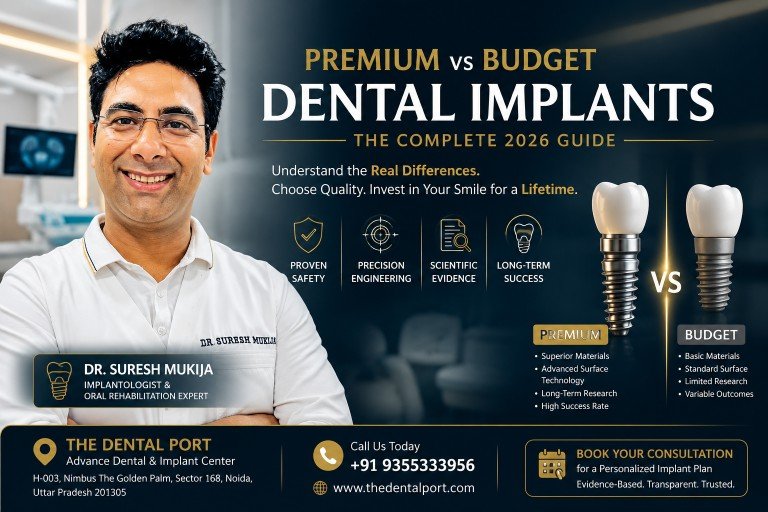
What Does “Premium Dental Implant” Really Mean?
The word “premium” is often used in marketing, but in implant dentistry it should refer to measurable characteristics rather than advertising language.
A premium implant system is generally associated with:
- Extensive clinical research
- Long-term published follow-up studies
- High manufacturing precision
- Established quality control systems
- International regulatory approvals where applicable
- Reliable prosthetic component availability
- Comprehensive clinician training and support
- Compatibility with modern digital workflows
These factors contribute to predictable outcomes but should always be considered alongside the experience of the treating clinician and the patient’s individual needs.
What Is a Budget Dental Implant?
The term “budget implant” does not necessarily mean “poor quality.”
Some lower-cost implant systems are manufactured by reputable companies and may perform well in appropriately selected cases.
However, budget systems can vary considerably in:
- Length of clinical evidence
- Availability of long-term studies
- Range of restorative components
- Global availability
- Manufacturing consistency
- Digital compatibility
- Warranty and technical support
Rather than assuming an implant is good or bad based solely on price, patients should ask informed questions about the implant system being recommended.
Is an Expensive Implant Always Better?
Not necessarily.
Higher cost alone does not guarantee superior outcomes.
Likewise, a lower-cost implant should not automatically be dismissed.
Successful implant treatment depends on a combination of factors:
- Comprehensive diagnosis
- Accurate CBCT imaging
- Proper treatment planning
- Adequate bone volume
- Surgical expertise
- Appropriate implant selection
- High-quality prosthetic restoration
- Good oral hygiene
- Regular follow-up care
An experienced implantologist may recommend different implant systems for different patients depending on bone quality, medical history, aesthetic expectations, and financial considerations.
The most appropriate implant is the one that is suitable for your clinical situation, not simply the most expensive or the least expensive.
Questions Every Patient Should Ask Before Choosing an Implant
Before deciding on treatment, consider asking your dentist:
- Which implant brand are you recommending and why?
- How long has this implant system been in clinical use?
- Is there published scientific research supporting it?
- What certifications does it have?
- Will replacement components be available years from now?
- Is the quoted price inclusive of the implant, abutment, and final crown?
- Will I need additional procedures such as bone grafting or sinus augmentation?
- What maintenance is recommended after treatment?
- How often should I attend follow-up visits?
- What factors could influence the long-term success of my implant?
These questions encourage a transparent discussion and help patients make decisions based on information
Frequently Asked Questions (FAQs)
1. What is the difference between premium and budget dental implants?
The main difference is not simply the price but the amount of research, manufacturing precision, implant surface technology, quality control, long-term clinical evidence, and availability of replacement components. Some premium implant systems have decades of published research and global support, while budget implants vary widely depending on the manufacturer.
2. Are premium dental implants worth the extra cost?
For many patients, premium dental implants can provide long-term value through extensive clinical evidence, precise engineering, and predictable performance. The right choice depends on your oral health, treatment goals, and budget. Your implantologist should explain why a specific implant system is recommended for your case.
3. Are all dental implants made from titanium?
Most dental implants are made from medical-grade titanium or titanium alloys because they are highly biocompatible and integrate well with bone. Some newer implants are made from zirconia, but titanium remains the most widely used material.
4. Why do dental implant prices vary so much?
The cost of dental implants depends on several factors, including the implant brand, research and development, manufacturing quality, digital planning, surgeon’s experience, CBCT imaging, bone grafting, prosthetic materials, and follow-up care. Comparing only the implant price can be misleading.
5. Can a budget dental implant last as long as a premium implant?
Some budget implant systems can perform well when used in appropriate clinical situations and maintained properly. Long-term success depends on proper treatment planning, surgical technique, oral hygiene, regular maintenance, and patient health rather than price alone.
6. Which dental implant brand is the best?
There is no single implant brand that is best for every patient. The ideal implant depends on bone quality, bite, medical history, aesthetic requirements, and the experience of the treating dentist. Choosing an evidence-based implant system is more important than focusing only on brand names.
7. Does implant brand really matter?
Yes. Implant systems differ in design, surface treatment, precision manufacturing, prosthetic compatibility, and scientific evidence. A reputable implant system with published long-term research may offer greater predictability, especially for complex cases.
8. How long do dental implants usually last?
With proper planning, excellent oral hygiene, and regular dental check-ups, many dental implants can function for decades. While no dental treatment lasts forever, long-term success rates for well-maintained implants are high.
9. Is a more expensive implant always better?
Not necessarily. Higher cost does not automatically mean better treatment. The success of an implant depends on accurate diagnosis, careful planning, surgical expertise, appropriate implant selection, and regular maintenance.
10. Are imported dental implants better than Indian implants?
Quality depends on the manufacturer, research, certifications, and clinical evidence rather than the country of origin. Both imported and locally manufactured implants should be evaluated based on scientific evidence and quality standards.
11. What certifications should a dental implant have?
Patients can ask whether the implant system has recognized regulatory approvals or certifications applicable to the markets where it is used, along with published clinical research supporting its performance.
12. Can smokers get dental implants?
Yes, but smoking increases the risk of delayed healing, implant complications, and long-term failure. Quitting or reducing smoking before and after implant surgery can improve treatment outcomes.
13. Can diabetic patients have dental implants?
Many people with well-controlled diabetes are suitable candidates for dental implants. Good blood sugar control and careful treatment planning are important for successful healing.
14. Is a CBCT scan necessary before implant placement?
A CBCT scan provides a three-dimensional view of the jawbone, nerves, and surrounding structures. It helps your implantologist assess bone availability and plan implant placement more accurately.
15. Why is bone quality important for dental implants?
The implant needs sufficient healthy bone for stability during healing. Poor bone quality or insufficient bone may require procedures such as bone grafting or sinus augmentation before implant placement.
16. Can every missing tooth be replaced with an implant?
Many missing teeth can be replaced with implants, but suitability depends on factors such as bone volume, gum health, medical history, and overall oral condition. A clinical examination is essential before treatment.
17. Do dental implants look like natural teeth?
A well-planned implant restoration with a custom-made crown is designed to blend naturally with your existing teeth in colour, shape, and function.
18. Is dental implant surgery painful?
Implant placement is usually performed under local anaesthesia, so patients generally experience minimal discomfort during the procedure. Mild soreness after surgery is common and usually manageable with prescribed medication.
19. How can I choose the right dental implant clinic?
Look for a clinic that provides comprehensive diagnosis, CBCT-based planning, experienced implantologists, transparent treatment plans, high sterilization standards, and regular follow-up care rather than choosing based on price alone.
20. Why choose The Dental Port for dental implants in Noida?
At The Dental Port – Advance Dental & Implant Center, Sector 168, Noida, every implant treatment begins with a detailed clinical examination, digital imaging, and a personalized treatment plan. Our focus is on evidence-based dentistry, patient education, transparent communication, and long-term oral health rather than one-size-fits-all solutions.
Thinking about dental implants?
Every smile is different, and the right implant choice depends on your bone quality, oral health, and long-term goals.
Book a consultation at The Dental Port – Advance Dental & Implant Center, Sector 168, Noida, and receive:
- Comprehensive implant evaluation
- Digital CBCT assessment (if required)
- Personalized treatment plan
- Transparent discussion of implant options
- Long-term maintenance guidance
Take the first step toward a confident, functional smile with evidence-based implant care.

Pingback: Straumann Implants in Noida | Cost & Expert Implant Care
Pingback: Tooth Numbering System: FDI, USA & UK Explained