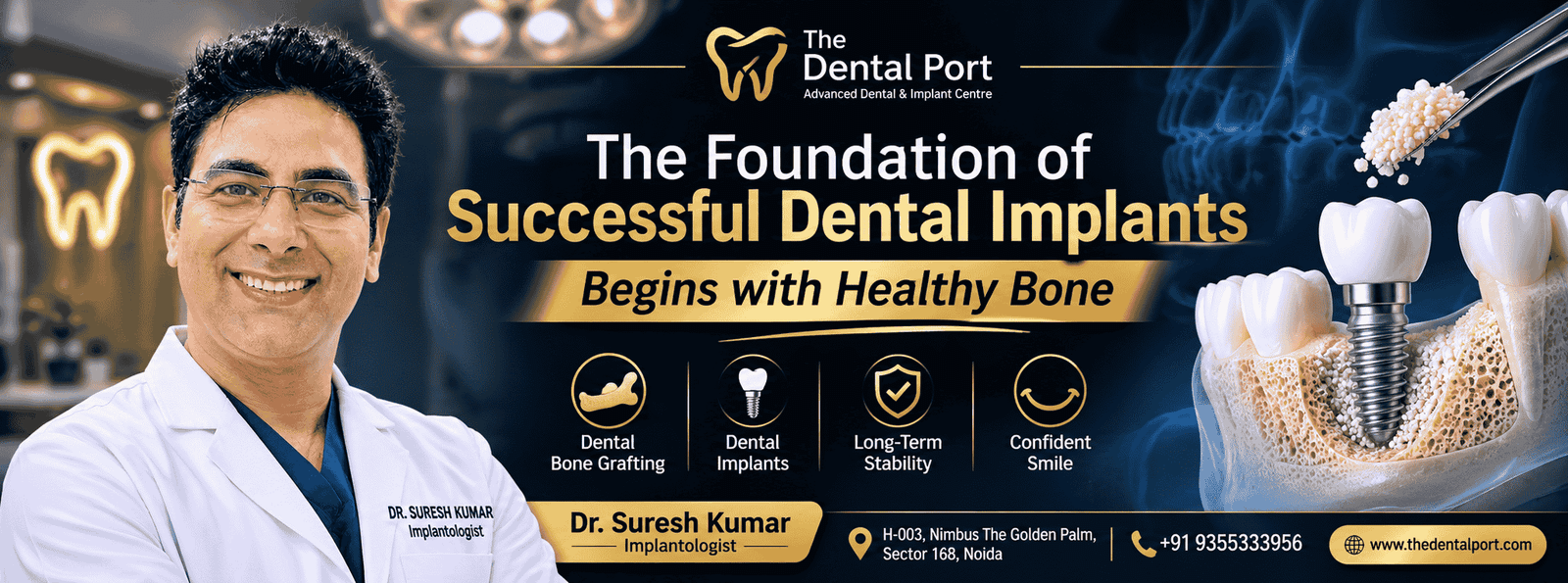
A dental bone graft is an important procedure for patients who have lost jawbone volume due to missing teeth, gum disease, infection or dental trauma. It is frequently recommended before dental implant treatment when there is not enough healthy bone to support an implant securely.
However, getting the bone graft placed is only the first step. What you do during the days and weeks following surgery can influence how comfortably the area heals and how successfully the graft integrates with your natural jawbone.
So, how do you take care of your mouth after a dental bone graft?
The most important steps are to protect the surgical site, maintain gentle oral hygiene, eat soft foods, avoid smoking, take prescribed medicines correctly and attend your follow-up appointments. You should also avoid disturbing the stitches or graft material with your tongue or fingers.
At The Dental Port, Advanced Dental & Implant Centre in Sector 168, Noida, we believe patients should understand both the procedure and the recovery process before undergoing bone grafting or dental implant treatment.
This guide explains what to do after dental bone graft surgery, what foods to eat, how long healing takes and which symptoms require attention.
What happens after a dental bone graft?
A dental bone graft involves placing bone graft material into an area of the jaw where additional bone volume is required. The material may come from a human donor, an animal-derived source, the patient’s own bone or a synthetic substitute.
After placement, the graft is protected by the surrounding gum tissue and sometimes a special healing membrane. Over time, the body remodels the grafted area and new bone develops.
This process is known as bone regeneration or bone integration.
Depending on the size and location of the graft, healing may take several months. During this period, protecting the surgical area is essential.
10 essential tips for taking care of your mouth after a dental bone graft
1. Protect the surgical area during the first 24 hours
The first 24 hours are particularly important because a stable blood clot helps protect the surgical wound.
Follow these precautions:
- Avoid touching the surgical area with your fingers or tongue.
- Do not rinse your mouth forcefully.
- Avoid forceful spitting.
- Do not drink through a straw.
- Avoid pulling your cheek or lip to inspect the stitches.
- Do not disturb the dressing or protective membrane.
A small amount of blood mixed with saliva can be normal during the initial recovery period. However, persistent or heavy bleeding needs attention from your dentist.
2. Apply an ice pack to reduce swelling
Some swelling, tenderness and bruising are expected after dental bone graft surgery.
To help manage swelling:
- Place a cold pack against the outside of your cheek.
- Apply it for approximately 15 to 20 minutes at a time.
- Take a similar break before applying it again.
- Keep your head slightly elevated while resting.
- Avoid pressing directly against the surgical area.
Swelling may increase during the first 48 to 72 hours before gradually settling. If swelling continues to increase after the third day, contact your dentist.
3. Eat soft foods and avoid chewing near the graft
Your diet matters because hard or crunchy foods can put unnecessary pressure on the healing area.
For the first few days, choose foods that require very little chewing.
Recommended foods after dental bone graft surgery:
- Curd and plain yoghurt
- Soft scrambled eggs
- Mashed potatoes
- Lukewarm soups
- Soft khichdi
- Well-cooked dal
- Soft paneer
- Oatmeal and porridge
- Soft pasta
- Smooth fruit puree
For patients following an Indian diet, soft khichdi, dal without hard grains, mashed vegetables and soft paneer are practical options.
Foods to avoid during early recovery:
- Nuts and seeds
- Popcorn
- Chips and crunchy snacks
- Hard toast and biscuits
- Raw carrots and hard vegetables
- Sticky sweets and chewing gum
- Very spicy foods
- Very hot foods and beverages
Chew on the opposite side of your mouth whenever possible. Gradually return to your regular diet as your dentist advises and as the surgical area becomes comfortable.
4. Maintain oral hygiene without disturbing the graft
Keeping your mouth clean is important because plaque accumulation around the surgical area can increase the risk of infection.
However, brushing directly over a fresh graft can disturb the healing tissue.
Follow these guidelines:
- Brush the unaffected teeth gently with a soft-bristled toothbrush.
- Avoid brushing directly over the graft until your dentist says it is safe.
- Follow the recommended timing for restarting mouth rinses.
- If advised, use a prescribed chlorhexidine mouthwash.
- After the initial healing period, use gentle warm salt-water rinses if recommended.
A typical salt-water rinse can be prepared using half a teaspoon of salt in a glass of warm water. Let the water move gently around the mouth and allow it to fall out rather than spitting forcefully.
Do not use hydrogen peroxide, strong commercial mouthwashes or other antiseptic solutions unless your dentist recommends them.
Important: The timing of rinsing and brushing depends on the type of bone graft, sutures and protective membrane used. Follow your surgeon’s specific instructions rather than applying a general schedule to every procedure.
5. Avoid smoking and tobacco completely during healing
Smoking is one of the most important risk factors to address after dental bone graft surgery.
Tobacco exposure can reduce blood supply to the healing tissues, interfere with wound healing and increase the risk of infection and graft complications.
Avoid:
- Cigarettes
- Vaping
- Hookah
- Chewing tobacco
- Gutkha and other smokeless tobacco products
Ideally, stop smoking before surgery and remain tobacco-free throughout recovery. Ask your implantologist how long you should avoid nicotine products after your particular procedure.
6. Take prescribed medicines as directed
Your dentist may prescribe medicines to control pain, reduce inflammation or manage the risk of infection.
Depending on your clinical condition, these may include:
- Pain-relieving medicines
- Antibiotics when clinically indicated
- Anti-inflammatory medicines
- Prescribed antiseptic mouthwash
Take medication according to the prescription. Do not increase the dose, stop an antibiotic early or take additional medicines without professional advice.
If you experience an allergic reaction, severe stomach discomfort or another unexpected reaction, contact your healthcare provider.
7. Avoid strenuous physical activity
Rest is helpful during the initial recovery period.
For the first 24 to 48 hours, avoid activities that increase physical exertion or blood pressure.
These include:
- Heavy gym workouts
- Running
- Heavy lifting
- Intense sports
- Repeated bending or strenuous exercise
You can gradually resume normal activities as you feel comfortable and according to your dentist’s advice.
8. Do not disturb stitches or loose bone graft particles
Some patients notice tiny grain-like particles in their mouth during the first few days after surgery.
This can happen because dental bone graft material is often made up of small particles. A few loose granules do not necessarily mean the graft has failed.
However, avoid trying to remove them yourself.
Do not:
- Pick at the graft with your fingers.
- Use a toothpick near the surgical area.
- Pull at the stitches.
- Push the graft with your tongue.
- Use a water flosser directly over the wound.
Contact your dentist if you notice substantial graft material coming out, wound opening or any unexpected change in the surgical area.
9. Follow special instructions after a sinus lift
A sinus lift is a specific type of bone grafting procedure performed in the upper jaw to increase bone volume near the maxillary sinus.
If you have undergone a sinus lift, additional precautions are necessary because pressure changes inside the sinus can affect healing.
Your surgeon may advise you to:
- Avoid blowing your nose.
- Sneeze with your mouth open.
- Avoid forceful rinsing.
- Avoid using straws.
- Avoid activities that create pressure in the sinus.
- Take prescribed nasal medication if indicated.
Follow your surgeon’s instructions regarding flying, exercise and other activities. These precautions are different from those following a routine socket bone graft.
10. Attend your follow-up appointments
Even when you feel comfortable, the graft needs professional monitoring.
During follow-up visits, your dentist or implantologist may assess:
- Gum tissue healing
- Stitches and protective membranes
- Signs of infection
- Stability of the grafted area
- Bone regeneration using appropriate imaging
Do not skip follow-up appointments simply because pain and swelling have reduced.
Dental bone graft recovery timeline: What to expect day by day
Every patient heals differently. The recovery period depends on the size of the graft, surgical technique, overall health and whether the procedure was performed alongside tooth extraction or dental implant placement.
Here is a general recovery timeline.
| Recovery period | What you may experience | What you should do |
|---|---|---|
| First 24 hours | Mild bleeding, tenderness and initial swelling | Rest, protect the graft and avoid forceful rinsing |
| Days 2–3 | Swelling, bruising and discomfort may increase | Continue soft foods, cold compresses as advised and prescribed medicines |
| Days 4–7 | Swelling usually starts settling | Maintain gentle oral hygiene and avoid chewing over the graft |
| Week 2 | Gum tissues continue healing | Attend review and follow instructions about brushing and diet |
| Weeks 3–6 | Soft tissue healing progresses | Maintain oral hygiene and avoid unnecessary pressure on the site |
| Months 3–6 or longer | Bone graft continues to mature | Attend clinical reviews and imaging when advised |
The timeline is an approximate guide, not a guarantee. Larger grafts and certain sinus lift procedures may require longer healing periods.
What are the signs of normal healing after a dental bone graft?
Patients often worry about every change they notice after surgery. Some symptoms are part of the normal healing process.
These may include:
- Mild to moderate soreness.
- Slight swelling around the cheek or gums.
- Minor bruising.
- Small amounts of blood-tinged saliva during the initial period.
- Temporary difficulty opening the mouth fully.
- Slight tenderness around the stitches.
- Occasional tiny graft granules.
These symptoms should generally improve over time.
Warning signs: When should you contact your dentist?
Do not ignore symptoms that suggest infection, excessive bleeding or complications.
Contact your dentist promptly if you experience:
- Severe or increasing pain that is not controlled by prescribed medication.
- Swelling that continues to worsen after the third day.
- Persistent bleeding.
- Fever or chills.
- Pus or discharge from the surgical site.
- A persistent foul taste or smell.
- Wound opening or significant movement of the protective membrane.
- A substantial amount of graft material coming loose.
Seek emergency medical attention if you develop difficulty breathing or swallowing, or rapidly increasing facial or neck swelling.
Early assessment can help identify complications and prevent further problems.
How long does a dental bone graft take to heal?
One of the most common questions patients ask is how long they must wait before getting dental implants after bone grafting.
The answer depends on the type and extent of the graft.
In many cases, bone grafts require approximately 3 to 6 months to mature sufficiently for implant placement. Larger grafts, complex defects and certain sinus lift procedures may require additional time.
Your implantologist will assess healing clinically and may recommend a CBCT scan to evaluate the available bone before proceeding with dental implant treatment.
It is important to understand that gum healing and bone healing are not the same thing. Your gums may look healthy well before the underlying graft has completed its maturation.
Can a dental implant be placed at the same time as a bone graft?
Yes, in selected cases, dental implant placement and bone grafting can be performed during the same appointment.
This is sometimes called simultaneous implant placement with bone augmentation.
However, it is not suitable for every patient.
Your implantologist will evaluate:
- The quantity of existing jawbone.
- Bone density and quality.
- The size of the bone defect.
- Primary implant stability.
- Gum and periodontal health.
- Presence of active infection.
- Overall medical and dental history.
If adequate implant stability cannot be achieved, a staged approach may be recommended. In this approach, the bone graft is allowed to heal before implant placement.
The most appropriate treatment depends on clinical examination and CBCT findings, not simply on the patient’s preference for faster treatment.
Dental bone graft aftercare infographic: Your recovery checklist
THE FIRST 24 HOURS
- Protect the surgical site.
- Avoid forceful rinsing and spitting.
- Do not use a straw.
- Eat soft, cool or lukewarm foods.
- Rest and take prescribed medication.
DAYS 2–3
- Continue a soft-food diet.
- Apply cold compresses as advised.
- Start gentle rinsing only at the recommended time.
- Avoid strenuous activity.
- Do not touch the graft.
DAYS 4–7
- Continue careful oral hygiene.
- Chew away from the surgical area.
- Avoid tobacco and smoking.
- Monitor swelling and pain.
- Contact your dentist if symptoms worsen.
WEEK 2 ONWARDS
- Attend your follow-up appointment.
- Resume brushing around the area as instructed.
- Gradually return to your normal diet.
- Continue protecting the graft.
MONTHS 3–6 OR LONGER
- Allow the bone to mature.
- Attend clinical assessments.
- Get imaging if recommended.
- Proceed with implant placement only after your implantologist confirms suitability.
Always follow the individual post-operative instructions provided by your treating dentist.
Frequently asked questions about dental bone graft aftercare
1. What should I avoid after dental bone graft surgery?
Avoid smoking, tobacco, forceful rinsing, straws, hard and crunchy foods, strenuous exercise and touching the surgical site. Also avoid disturbing the stitches or protective membrane.
2. Can I brush my teeth after a bone graft?
Yes, but you must protect the surgical area. You can generally clean the unaffected teeth gently, while brushing directly over the graft should wait until your dentist advises that it is safe.
3. Can I drink tea or coffee after a dental bone graft?
Avoid hot beverages during the initial recovery period, particularly while bleeding is possible or the area is numb. Cool or lukewarm drinks are generally more comfortable. Avoid using a straw.
4. Can I eat rice after dental bone graft surgery?
Soft, well-cooked rice may be suitable once your dentist allows you to resume soft foods. Khichdi is often a more comfortable option because it is softer. Avoid small, hard or dry grains that can become trapped near the surgical site.
5. Is it normal for bone graft material to come out?
A few small granules may occasionally become loose during early healing. However, substantial graft loss, wound opening or persistent discomfort should be assessed by your dentist.
6. How painful is dental bone graft surgery?
Most patients experience some soreness, swelling and tenderness after the procedure. The level of discomfort depends on the size of the graft and the surgical technique. Prescribed medication and appropriate aftercare generally help manage recovery.
7. When can I return to work after a dental bone graft?
Many patients return to routine work within one or two days after a relatively uncomplicated procedure. Larger grafts or more complex surgery may require additional rest. Follow your surgeon’s advice.
8. Can a bone graft fail?
Although many bone grafts heal successfully, complications can occur. Infection, wound opening, smoking, inadequate blood supply and other patient-specific factors may affect the outcome. Regular follow-up helps identify problems early.
9. How long after a bone graft can I get dental implants?
Many patients can proceed with implant placement after approximately 3 to 6 months, although some cases need longer. Your implantologist will determine readiness through clinical examination and appropriate imaging.
10. Does everyone need a dental bone graft before getting an implant?
No. Patients with sufficient healthy jawbone may be suitable for dental implant placement without additional grafting. A CBCT scan and clinical assessment help determine whether bone augmentation is necessary.
Where can you get dental bone graft and implant treatment in Noida?
If you have been advised to undergo dental bone grafting before dental implants, choosing a centre with experience in implant planning and bone augmentation is important.
At The Dental Port – Advanced Dental & Implant Centre, Sector 168, Noida, treatment planning focuses on evaluating the available jawbone, gum health and long-term suitability for dental implants.
Depending on individual requirements, treatment planning may involve:
- Dental bone grafting and ridge augmentation.
- Socket preservation after tooth extraction.
- Sinus lift procedures.
- CBCT-based implant assessment.
- Single-tooth dental implants.
- Full-mouth dental implant rehabilitation.
- Guided implant planning where clinically appropriate.
Dr. Suresh Kumar, Implantologist, and the clinical team evaluate each case to determine whether bone grafting is required and which treatment approach is appropriate.
Whether you have recently undergone bone graft surgery or are considering implants after tooth loss, a proper clinical assessment can help you understand your treatment options.
Looking for dental bone graft treatment in Noida?
Visit The Dental Port at H-003, Nimbus The Golden Palm, Sector 168, Noida, near Noida Expressway and Advant Navis Business Park.
Call or WhatsApp: +91 9355333956
Website: https://www.thedentalport.com
Book a consultation to discuss dental bone grafting, jawbone regeneration and dental implant treatment.
Medical review
Reviewed by Dr. Suresh Kumar,Senior Implantologist, zygomatic implant specialist ImThe Dental Port – Advanced Dental & Implant Centre, Sector 168, Noida.
Disclaimer: This article provides general educational information and does not replace an examination or personalised post-operative instructions from your treating dentist. Bone graft aftercare varies according to the surgical procedure, graft material and individual clinical condition.
