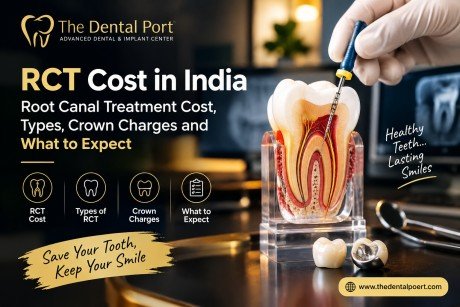
What is the cost of RCT in India? Root canal treatment generally costs about ₹3,000 to ₹15,000 per tooth, depending on the tooth, number and shape of root canals, severity of infection, whether it is a first-time RCT or Re-RCT, and the technology and expertise required.
At The Dental Port, Advance Dental & Implant Center, Noida, the cost of root canal treatment is planned after examining the tooth and reviewing the required dental X-ray or CBCT. A front tooth usually requires less complex treatment than a molar, while a previously treated tooth with persistent infection may require a more advanced Re-RCT.
The important point is this: there is no single RCT price that is correct for every tooth. A reliable estimate should be based on the actual condition of your tooth.
Quick Answer: RCT Cost in India
| Root Canal Treatment | Approximate Cost in India |
|---|---|
| Front tooth RCT | ₹3,000 to ₹7,000 |
| Premolar RCT | ₹5,000 to ₹10,000 |
| Molar RCT | ₹6,000 to ₹15,000 |
| Re-RCT | ₹8,000 to ₹15,000+ |
| RCT with dental crown | RCT cost + crown cost |
These are indicative ranges. The actual fee can vary between cities, clinics, tooth anatomy, infection severity, materials used and whether a specialist endodontic procedure is required.
At The Dental Port, Noida, patients are given a treatment plan and cost estimate before treatment begins.
What Is RCT?
RCT stands for Root Canal Treatment. It is a dental procedure used to treat a tooth when the pulp inside the tooth becomes inflamed or infected.
The pulp contains nerves and blood vessels. Deep dental decay, a crack, repeated dental procedures or trauma can allow bacteria to reach the pulp.
Common symptoms include:
- Severe toothache
- Pain while chewing
- Prolonged sensitivity to hot or cold
- Night-time tooth pain
- Swelling around the tooth
- A pimple or gum boil near the tooth
- Darkening or discoloration of a tooth
- Tenderness around the tooth
Sometimes, however, an infected tooth may cause little or no pain. This is why a dental examination and X-ray can be important even when symptoms appear to have improved.
How Does Root Canal Treatment Save a Tooth?
During root canal treatment, the dentist:
- Examines the tooth and takes appropriate X-rays.
- Numbs the tooth with local anesthesia.
- Isolates the tooth to keep the treatment area clean and dry.
- Creates access to the infected pulp.
- Removes infected or inflamed tissue.
- Cleans and shapes the root canals.
- Disinfects the canals.
- Seals the cleaned canals, commonly using gutta-percha.
- Restores the tooth with an appropriate filling or dental crown.
The objective is to remove infection from inside the tooth while preserving the natural tooth structure wherever possible.
Why Does RCT Cost Differ From One Tooth to Another?
Searching for “RCT cost near me” can produce very different prices. That does not necessarily mean one clinic is overcharging or another is offering the same treatment for less.
The complexity of the tooth matters.
1. Type of Tooth
Front teeth generally have fewer and more straightforward canals.
Premolars can have more complex canal anatomy, while molars commonly have several canals and can be considerably more difficult to clean and shape.
This is one of the main reasons molar RCT cost is usually higher than front-tooth RCT.
2. Number and Shape of Canals
Not every tooth has the same internal anatomy.
Some canals are narrow, curved, calcified or difficult to locate. Treating these teeth can require more time, magnification, specialized instruments and additional imaging.
3. Severity of Infection
A tooth with significant infection, swelling or an abscess may require additional clinical management.
In some cases, treatment can be completed in one appointment. In others, more than one appointment may be appropriate.
4. First RCT vs Re-RCT
A Re-RCT, or root canal retreatment, is performed when a previously treated tooth develops persistent or recurrent infection or other complications.
The dentist may need to remove the previous filling material, locate untreated canals, manage complex anatomy and disinfect the tooth again.
Therefore, Re-RCT is usually more technically demanding than an initial root canal.
5. Dental Technology and Technique
Modern endodontic treatment may use technologies such as:
- Rotary or reciprocating endodontic instruments
- Electronic apex locators
- Digital dental X-rays
- Dental operating microscopes in selected cases
- CBCT imaging when clinically indicated
- Rubber dam isolation
- Modern canal irrigation and disinfection techniques
The appropriate technology depends on the tooth and the clinical situation. More technology does not automatically mean better treatment. It should be used when it improves diagnosis, safety or treatment quality.
Is RCT Painful?
This is one of the most common questions patients ask.
Does root canal treatment hurt?
With effective local anesthesia, most patients should not experience significant pain during a properly performed RCT. You may feel pressure, vibration or movement during different stages of treatment.
The tooth may remain sensitive or mildly sore for a few days afterward, particularly if there was already significant inflammation or infection.
If you experience severe or increasing pain, swelling, fever, or symptoms that do not improve, contact your dentist rather than simply taking pain medication and waiting.
Modern root canal treatment is designed to control infection and preserve the natural tooth, not to create unnecessary discomfort.
How Long Does a Root Canal Take?
The duration depends on the tooth and its condition.
A straightforward case may sometimes be completed in a single appointment. More complicated infections, difficult anatomy, retreatment cases or teeth requiring additional procedures may need multiple visits.
For this reason, “single sitting RCT” should not automatically be considered better than multiple-sitting RCT.
The correct number of appointments depends on what is clinically appropriate for the tooth.
Is a Dental Crown Necessary After RCT?
This is an important part of the total treatment cost.
RCT treats the infection inside the tooth. A crown or other suitable final restoration protects the tooth after treatment when the remaining tooth structure requires it.
Root canal treated back teeth often need cuspal coverage because they may have lost substantial tooth structure from decay, previous fillings and the access required for treatment.
The dentist should assess the remaining tooth structure before deciding the appropriate restoration.
Possible restorations can include:
- Zirconia crown
- E-max crown in selected cases
- PFM crown
- Metal or other suitable restorations depending on the tooth and clinical requirements
So when comparing root canal treatment prices, do not compare only the RCT fee. Ask whether the quoted amount includes the final restoration.
RCT Cost vs RCT + Crown Cost
A common mistake is to search only for “root canal treatment cost” and assume that this is the complete cost of saving the tooth.
The final treatment may involve:
Diagnosis + X-ray → RCT → temporary or permanent restoration → dental crown when indicated
The crown is priced separately in many dental clinics because the type of crown, laboratory, material and tooth position can vary.
At The Dental Port, the treatment plan can be explained component by component so patients understand what they are paying for.
RCT or Tooth Extraction: Which Is Better?
If a tooth can be predictably restored, preserving the natural tooth is often worth considering.
| Option | Root Canal + Restoration | Extraction + Replacement |
|---|---|---|
| Natural tooth retained | Yes | No |
| Removes infected pulp | Yes | Tooth removed |
| May require crown | Often, depending on tooth structure | No crown on the extracted tooth, but replacement may require one |
| Long-term treatment | Usually fewer stages | Replacement may require additional treatment |
| Implant required | No | If replacement with implant is chosen |
| Bone preservation | Natural tooth remains | Bone may resorb after extraction |
Extraction is sometimes the right treatment. A tooth that is severely fractured, unrestorable, or has inadequate remaining structure may not be suitable for RCT.
The decision should be based on the condition and prognosis of the tooth, not simply on the lowest immediate price.
What Happens If You Delay RCT?
An infected pulp generally does not recover simply because the pain disappears.
Pain can decrease when the pulp dies, but infection may remain and spread into the tissues around the root.
Untreated dental infection can lead to:
- Gum swelling
- Dental abscess
- Facial swelling
- Bone loss around the tooth
- Difficulty chewing
- Recurrent infection
- More complicated treatment
If you have persistent tooth pain, swelling or sensitivity, an examination is more useful than trying to determine the cause from symptoms alone.
Can a Root Canal Fail?
Root canal treatment has a high rate of success when the tooth is properly diagnosed, treated and restored, but no dental procedure has a 100% guarantee.
A previously treated tooth may develop problems because of:
- Missed canals
- Complex canal anatomy
- Inadequate cleaning or sealing
- New decay
- Leakage around the restoration
- Tooth fracture
- Persistent or recurrent infection
Signs that may indicate a problem include persistent pain, swelling, a gum boil or tenderness around the treated tooth.
A dentist may recommend examination, new X-rays or CBCT in selected cases before deciding whether Re-RCT, surgery, restoration or extraction is appropriate.
What Is Re-RCT?
Re-RCT means root canal retreatment.
It is performed when a tooth that has already undergone root canal treatment develops a new or persistent endodontic problem.
During Re-RCT, the dentist may need to:
- Remove existing root canal filling material
- Locate previously untreated canals
- Re-clean and disinfect the canal system
- Manage complicated anatomy
- Reseal the canals
- Restore the tooth appropriately
Because retreatment can be technically demanding, the cost of Re-RCT is usually higher than a straightforward first-time RCT.
Can RCT Be Done in One Sitting?
Yes, some teeth can be treated successfully in a single appointment.
However, single-sitting RCT is not suitable for every case.
The dentist may recommend multiple visits depending on:
- Severity of infection
- Presence of an abscess
- Drainage
- Canal anatomy
- Retreatment requirements
- Difficulty of achieving adequate disinfection and sealing
The priority should be appropriate treatment, not simply completing the procedure as quickly as possible.
Is RCT Safe?
Root canal treatment is a well-established dental procedure used to remove infected or inflamed pulp and preserve a natural tooth.
As with any dental procedure, proper diagnosis, infection control, appropriate instrumentation and a good final restoration are important.
A tooth that has been successfully treated and properly restored can continue to function for many years.
How Much Does RCT Cost in Noida?
The cost of root canal treatment in Noida depends on the tooth and the complexity of the case.
At The Dental Port, Advance Dental & Implant Center, Sector 168, Noida, patients can receive treatment planning based on clinical examination and appropriate diagnostic imaging.
The clinic provides treatment options including:
- Single-sitting RCT where clinically suitable
- Rotary endodontics
- Laser-assisted endodontic treatment where indicated
- Re-RCT
- RCT with dental crowns
- Management of complex root canal cases
Patients should ask for the complete treatment estimate, including the restoration or crown if one is required.
What Should You Ask Before Starting RCT?
Before agreeing to treatment, ask your dentist:
- Which tooth needs the root canal?
- How many canals are likely to be present?
- Is the tooth restorable?
- Can the RCT be completed in one visit?
- Is a crown required afterward?
- What type of crown is recommended?
- Is the quoted price for RCT only or RCT plus restoration?
- Is this a first-time RCT or Re-RCT?
- Do I need an X-ray or CBCT?
- What are the alternatives if the tooth cannot be saved?
These questions can prevent unpleasant surprises later.
RCT Cost in India: Frequently Asked Questions
What is the average RCT cost in India?
The approximate cost of root canal treatment in India is ₹3,000 to ₹15,000 per tooth, although the actual price depends on tooth type, canal anatomy, infection, treatment complexity and clinic.
What is the cost of RCT for a molar?
Molar RCT commonly costs more than front-tooth RCT because molars usually have more complex root canal anatomy. A broad indicative range is ₹6,000 to ₹15,000, depending on the case.
How much does Re-RCT cost in India?
Re-RCT is generally more expensive than a first-time root canal because the dentist must manage a previously treated tooth. Indicative pricing can start around ₹8,000 and may exceed ₹15,000 for complex cases.
Does RCT cost include the crown?
Not necessarily. Many clinics charge separately for the root canal procedure and the final dental crown. Always ask for a complete treatment estimate.
Is root canal treatment painful?
With appropriate local anesthesia, most patients do not experience significant pain during treatment. Some tenderness or soreness can occur after the procedure.
How many visits are required for RCT?
A simple case may be completed in one appointment. Other cases require two or more visits depending on infection, anatomy and treatment complexity.
How long does a root canal tooth last?
A properly treated and appropriately restored tooth can function for many years. Longevity depends on the quality of the root canal treatment, remaining tooth structure, final restoration, oral hygiene, bite forces and regular dental care.
Can I avoid a crown after RCT?
Not every root canal treated tooth requires the same type of restoration. Back teeth frequently benefit from a crown or other cuspal coverage because of the amount of tooth structure lost. Your dentist should determine the appropriate restoration after evaluating the tooth.
Is RCT better than extraction?
If the tooth can be predictably restored, preserving the natural tooth is often a good option. However, extraction may be appropriate when a tooth is severely fractured, unrestorable or has a poor prognosis.
Does RCT remove the infection permanently?
The objective of RCT is to remove infected pulp, clean and disinfect the canal system and seal it. A good final restoration and regular dental care are important for long-term success.
When should I see a dentist for tooth pain?
Do not wait for severe pain. Persistent toothache, sensitivity that lingers, swelling, pain while chewing, a gum boil or unexplained tooth discoloration should be evaluated by a dentist.
Need a Root Canal in Noida?
If you have tooth pain, sensitivity, swelling or have been advised to undergo RCT, The Dental Port, Advance Dental & Implant Center, Sector 168, Noida can assess the tooth and explain the available treatment options.
The first step is not choosing the cheapest RCT.
The first step is finding out whether the tooth can be saved, what treatment it actually needs, and what the complete cost will be.
Book a dental consultation at The Dental Port to get a clinical assessment and personalized RCT treatment plan.
The Dental Port
Advance Dental & Implant Center
Sector 168, Noida