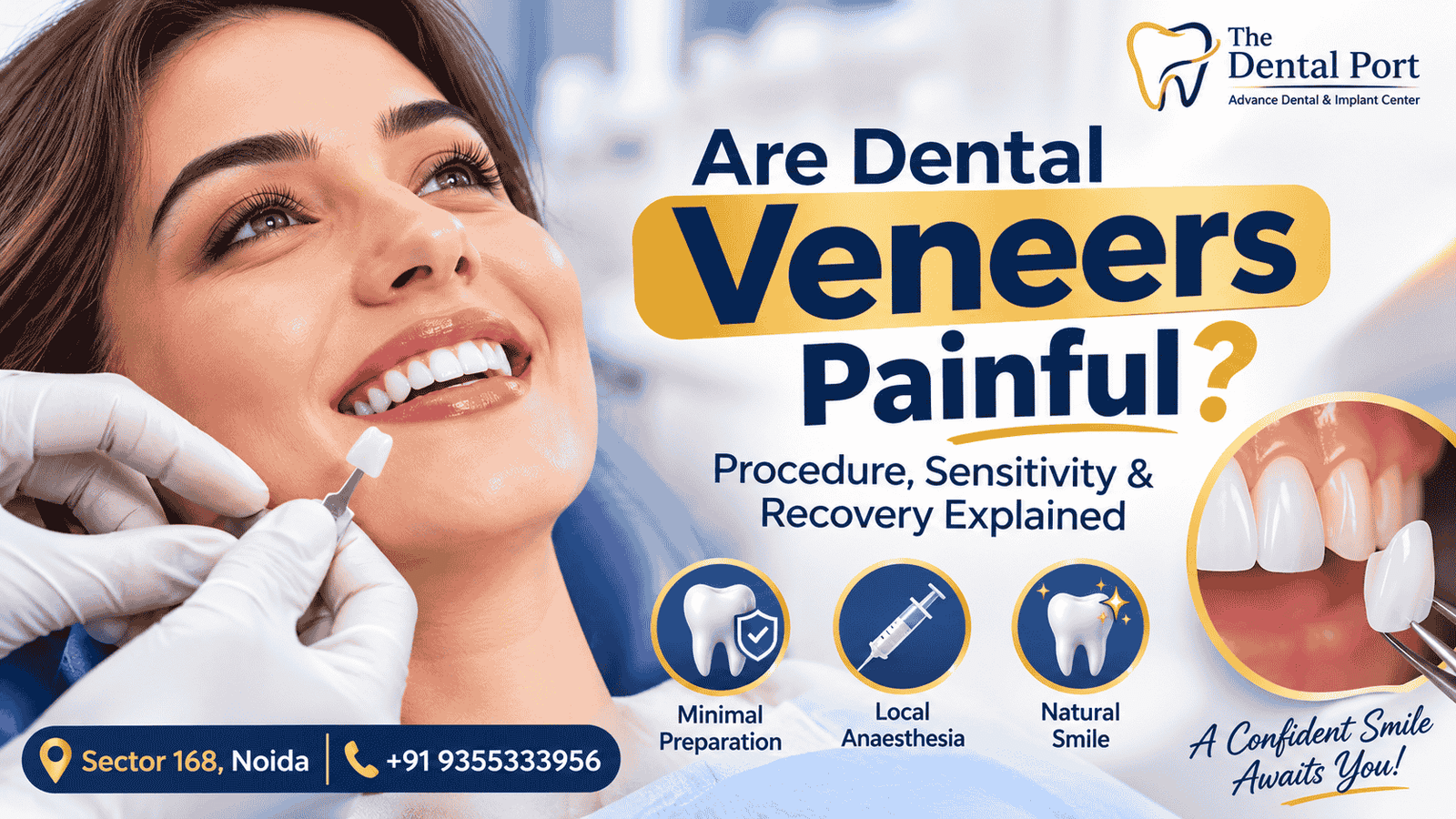
Are dental veneers painful? This is one of the first questions patients ask before considering a smile makeover. If you are thinking about correcting stained, chipped, uneven or slightly misaligned teeth, it is natural to wonder whether getting veneers will hurt or involve significant removal of your natural tooth structure.
The reassuring answer is that dental veneer treatment is generally comfortable, and any discomfort can usually be managed with appropriate dental techniques and local anaesthesia when required. However, the experience depends on the type of veneers, the amount of tooth preparation needed and your individual dental condition.
At The Dental Port, Advance Dental & Implant Center, Sector 168, Noida, we believe patients should understand exactly what happens to their natural teeth before deciding on cosmetic treatment.
Let’s look at how veneers are prepared, whether the procedure hurts, what happens during each appointment and how to manage sensitivity afterwards.
Are Dental Veneers Painful?
For most patients, getting dental veneers does not involve significant pain during treatment. The dentist may need to reshape a very thin layer of enamel to create space for the veneer and achieve a natural-looking result.
If tooth preparation is required, local anaesthesia can be used to numb the treated area. This helps prevent pain while the dentist works.
After the appointment, some patients experience temporary sensitivity to hot, cold or pressure. This is usually manageable and tends to settle, although persistent or worsening discomfort should be assessed by the dentist.
It is important to understand that veneers are not completely non-invasive in every case. Conventional porcelain veneers generally involve some enamel preparation, which permanently changes the natural tooth.
Why Does Veneer Preparation Usually Cause Minimal Discomfort?
To understand why veneer treatment is generally comfortable, it helps to know the basic anatomy of a tooth.
A natural tooth has three important layers:
- Enamel: The hard outer protective layer of the tooth.
- Dentin: The layer beneath enamel, containing microscopic tubules that can transmit sensitivity.
- Dental pulp: The innermost tissue containing nerves and blood vessels.
Most conventional veneer preparations are planned conservatively, with the aim of retaining as much healthy enamel as possible.
When preparation remains within enamel, patients generally experience less sensitivity than when dentin becomes exposed.
The amount of enamel removed is not identical for every patient. It depends on the existing tooth position, shape, colour, desired result, bite and the material selected.
The goal is not to remove as much tooth structure as possible. It is to prepare only what is clinically necessary for a well-fitting, natural-looking restoration.
What Dental Problems Can Veneers Correct?
Dental veneers are thin, custom-made coverings bonded to the front surfaces of teeth. They are primarily used to improve the appearance of teeth with cosmetic concerns such as:
1. Deep tooth discolouration
Some intrinsic stains, including certain cases of fluorosis or discolouration that does not respond adequately to whitening, may be improved with veneers.
2. Chipped or worn teeth
Small chips, uneven edges and mild wear can sometimes be corrected with carefully designed veneers.
3. Peg-shaped or naturally small teeth
Some people have congenitally small or unusually shaped teeth, particularly the upper lateral incisors. Veneers may help improve their proportions and symmetry.
4. Small gaps between teeth
Veneers can sometimes close minor spaces and improve the appearance of the smile.
5. Uneven tooth shape
Teeth that look irregular in length, width or contour may be reshaped visually using custom veneers.
Important: Veneers are not a substitute for orthodontic treatment in every case. Significant crowding, bite problems, active tooth decay and gum disease need appropriate assessment before cosmetic treatment.
What Happens During Dental Veneer Treatment?
Understanding each stage can make the process less intimidating.
1. Smile Assessment and Treatment Planning
The first appointment involves examining your teeth, gums, bite and overall smile.
Your dentist evaluates:
- Existing tooth structure and enamel thickness.
- Tooth colour and the type of discolouration.
- Gum health and smile proportions.
- Bite alignment and any signs of teeth grinding.
- Whether porcelain veneers, composite bonding, whitening or orthodontic treatment would be more appropriate.
Photographs, digital scans and other diagnostic records may be used to plan the proposed smile.
2. Tooth Preparation
If conventional porcelain veneers are recommended, the dentist carefully prepares the front surface of the selected teeth.
Only the amount of enamel required for the planned restoration should be removed.
The preparation varies from patient to patient. Some cases require very minimal reduction, while others need more extensive reshaping to correct existing tooth contours or colour.
Local anaesthesia may be administered to keep the procedure comfortable, particularly if preparation is likely to cause sensitivity.
3. Digital Scanning and Temporary Veneers
Once the preparation is complete, the dentist records the shape of the teeth using a digital scanner or conventional impressions.
These records are used to create custom veneers that fit the prepared teeth.
Depending on the case and laboratory turnaround, temporary veneers may be provided to protect prepared teeth and maintain appearance while the permanent restorations are being made.
Temporary veneers also help reduce discomfort from exposed or sensitive tooth surfaces when necessary.
4. Permanent Veneer Placement
When the custom veneers are ready, the dentist checks their:
- Fit and margins.
- Shape and proportions.
- Colour and translucency.
- Relationship with neighbouring teeth.
- Bite and contact points.
After the necessary adjustments, the teeth are cleaned and the veneers are bonded using dental adhesive materials.
Local anaesthesia is not routinely required for every bonding appointment. It can be considered if the patient has sensitivity or the clinical situation requires it.
The final result should look balanced and complement the patient’s facial features, natural teeth and smile line.
Can Dental Veneers Cause Sensitivity?
Yes. Some patients experience temporary sensitivity after veneer preparation or placement.
This can happen for several reasons:
Enamel reduction: Preparing the enamel may expose areas that are more sensitive to temperature.
Dentin exposure: If preparation extends into dentin, the likelihood of sensitivity may increase.
Pre-existing sensitivity: Patients who already have sensitive teeth or enamel defects may be more susceptible.
Bite adjustment: If a newly placed veneer interferes with the natural bite, it may cause discomfort while chewing.
Gum irritation: The gums may feel slightly tender after dental procedures, especially when the margins are close to the gumline.
Mild sensitivity can improve as the teeth settle. However, sharp pain, spontaneous toothache, prolonged temperature sensitivity or discomfort when biting should not be ignored.
Your dentist should examine the tooth rather than assuming that every post-veneer symptom is normal.
Are No-Prep Veneers Completely Pain-Free?
No-prep veneers are designed to preserve more natural tooth structure by requiring little or, in selected cases, no enamel reduction.
They may be considered for patients who want to improve:
- Small spaces between front teeth.
- Minor irregularities in tooth shape.
- Slightly undersized teeth.
- Selected cosmetic imperfections where additional thickness will not make the teeth look bulky.
However, no-prep veneers are not suitable for every smile.
For example, placing an additional layer over teeth that are already prominent, crowded or bulky may produce an unnatural result. Severe intrinsic discolouration may also require a different approach.
Another important point: the term no-prep does not guarantee that absolutely no tooth adjustment will be needed. Some cases described as minimal-prep still involve limited enamel modification.
The decision should be based on the final tooth proportions, bite, available space and long-term oral health, not simply the promise of avoiding preparation.
What Is the Difference Between No-Prep and Conventional Veneers?
| Feature | No-prep veneers | Conventional veneers |
|---|---|---|
| Tooth preparation | Little or none in selected cases | Usually requires enamel reduction |
| Natural tooth preservation | Greater in suitable cases | Some enamel is permanently removed |
| Suitability | Selected cosmetic cases | Wider range of cosmetic corrections |
| Sensitivity | Often minimal, but not guaranteed absent | Temporary sensitivity may occur |
| Final appearance | Depends on available space and tooth position | More flexibility in correcting contours and colour |
| Reversibility | Depends on whether any enamel was modified | Generally irreversible |
Neither option is automatically better. The right choice depends on your existing teeth and the result that can be achieved without compromising dental health.
What Should You Expect After Getting Veneers?
Most patients return to their normal routine shortly after veneer placement.
During the first few days, you may notice:
- Mild sensitivity to very hot or cold foods.
- A slightly unfamiliar feeling when speaking.
- Minor awareness of the new tooth shape.
- Temporary gum tenderness.
Your lips, tongue and cheeks may need a little time to adapt to the new contours.
Here are some practical aftercare recommendations:
- Avoid biting directly into very hard foods with your front teeth.
- Do not use your teeth to open packaging or bite fingernails.
- Brush twice daily using a soft-bristled toothbrush and fluoride toothpaste.
- Clean between your teeth every day.
- Attend regular dental check-ups to monitor the veneers and surrounding gums.
- If you grind or clench your teeth, discuss whether a protective night guard is appropriate.
If your bite feels uneven or you experience persistent pain, arrange a dental review rather than waiting for the discomfort to disappear.
Can Veneers Damage Your Natural Teeth?
Dental veneers do not automatically damage healthy teeth. However, they require careful case selection, appropriate preparation and long-term maintenance.
There are a few important considerations:
- Enamel removed during conventional preparation does not grow back.
- Veneers can chip, crack, loosen or require replacement over time.
- Tooth decay can still develop around the edges of a veneer.
- Gum inflammation can affect the appearance and health of the restored teeth.
- Excessive bite forces and teeth grinding may increase the risk of damage.
This is why a cosmetic consultation should focus on preserving healthy tooth structure, not simply achieving a particular shade or shape.
Dental Veneers in Noida: Why Clinical Assessment Matters
If you are considering dental veneers in Noida, the most important decision is not simply choosing porcelain or composite material. It is understanding whether veneers are the right treatment for your teeth.
At The Dental Port, Advance Dental & Implant Center, Sector 168, Noida, cosmetic smile planning begins with an assessment of tooth structure, gum health, bite and individual aesthetic expectations.
Our clinical approach focuses on:
- Conservative tooth preparation wherever clinically appropriate.
- Individualised veneer selection and smile design.
- Attention to natural tooth proportions, shade and symmetry.
- Evaluation of bite and gum health before treatment.
- Clear discussion of treatment options, limitations and maintenance.
Led by Dr. Purnima Sharma, Cosmetic and Aesthetic Dentist, and supported by the clinic’s multidisciplinary dental team, our aim is to help patients make informed decisions about cosmetic dental treatment.
Whether you are considering porcelain veneers, composite veneers or a more conservative smile correction, the treatment plan should be designed around the health of your natural teeth.
Visit The Dental Port in Sector 168, Noida, near the Noida Expressway, for a personalised dental veneer consultation.
Website: https://www.thedentalport.com
Call or WhatsApp: +91 9355333956
Frequently Asked Questions About Dental Veneers
1. Are dental veneers painful to get?
Dental veneer treatment is generally comfortable. If tooth preparation is required, local anaesthesia can be used to prevent pain. Mild temporary sensitivity may occur afterwards.
2. Do dentists shave your teeth for veneers?
Conventional porcelain veneers usually require removal of a small amount of enamel to create adequate space and achieve a natural fit. No-prep or minimal-prep options may preserve more tooth structure in suitable cases.
3. How much enamel is removed for dental veneers?
There is no single measurement for every patient. The amount depends on tooth position, existing shape, colour, bite and the type of veneer. Your dentist should explain the proposed preparation before treatment.
4. Are no-prep veneers better than traditional veneers?
Not necessarily. No-prep veneers can be appropriate for selected teeth that need little change in shape or position. Conventional veneers may offer greater control when correcting significant colour or contour concerns.
5. How long does sensitivity last after veneers?
Some patients experience sensitivity for a short period after preparation or bonding. The duration varies. Persistent, worsening or spontaneous pain needs a clinical examination.
6. Can I eat normally after getting veneers?
Once the veneers are permanently bonded and your dentist confirms that your bite is comfortable, you can generally return to your usual diet. Avoid using veneered teeth to bite very hard objects or foods.
7. Can veneers correct yellow or stained teeth?
Yes. Veneers can mask certain types of intrinsic discolouration that may not respond adequately to teeth whitening. However, the dentist should first determine the cause and whether whitening or another conservative treatment would be more appropriate.
8. Are dental veneers permanent?
Veneers are long-term restorations, but they are not necessarily lifelong. They may need repair or replacement. Conventional veneer preparation is generally irreversible because natural enamel is removed.
9. Can veneers be placed on all front teeth?
Veneers can be placed on selected front teeth or across a larger smile zone. The number depends on the patient’s smile line, tooth condition, symmetry and treatment goals.
10. Where can I get dental veneers in Noida?
You can consult The Dental Port, Advance Dental & Implant Center, located at Nimbus The Golden Palm, Sector 168, Noida, near the Noida Expressway. Call or WhatsApp +91 9355333956 to enquire about a cosmetic dentistry consultation.
Reviewed by Dr. Purnima Sharma
Cosmetic and Aesthetic Dentist, The Dental Port, Advance Dental & Implant Center, Noida.
Clinical note: This article provides general educational information. Suitability for dental veneers and the expected level of sensitivity can only be determined after an individual dental examination.