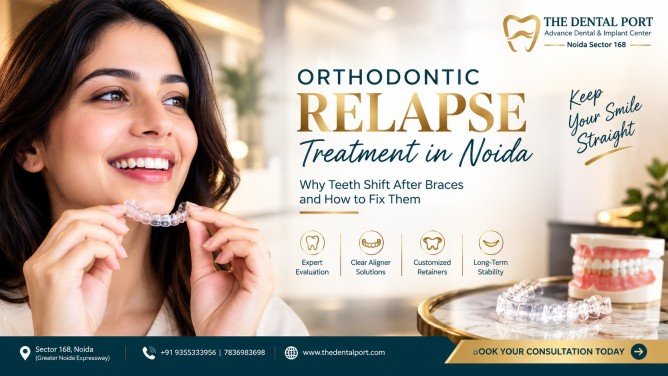
Have your teeth started shifting after braces or clear aligners? You are not alone.
Many people assume that once braces or aligners are removed, their teeth will remain perfectly straight forever. In reality, teeth can gradually move after orthodontic treatment. This movement is known as orthodontic relapse.
The good news is that orthodontic relapse can often be treated without repeating the entire original orthodontic treatment. Depending on how much your teeth have moved, treatment may involve a new retainer, retainer adjustment, clear aligners, or limited orthodontic correction.
At The Dental Port – Advance Dental & Implant Center, Noida, we evaluate why the teeth have shifted and create a personalized plan to restore alignment while focusing on long-term stability.
What Is Orthodontic Relapse?
Orthodontic relapse is the unwanted movement of teeth after orthodontic treatment has been completed.
After braces or clear aligners move your teeth into their desired positions, the surrounding bone, periodontal tissues and supporting fibres need time to adapt. Teeth can also continue to respond to normal forces from chewing, the tongue, facial muscles and changes associated with ageing.
This is why retention is an important part of orthodontic treatment.
A retainer helps maintain the corrected position of the teeth and reduces the chance of unwanted movement.
In simple terms:
Braces or aligners straighten your teeth.
Retainers help keep them straight.
Why Do Teeth Shift After Braces?
There isn’t always one single reason for orthodontic relapse.
Common contributing factors include:
1. Not Wearing Your Retainer
This is one of the most common preventable reasons for teeth shifting after orthodontic treatment.
If your orthodontist has prescribed a specific retainer schedule, inconsistent wear can allow teeth to gradually move.
2. Lost, Broken or Ill-Fitting Retainer
A retainer that is cracked, distorted, lost or no longer fits properly cannot provide effective retention.
If your retainer suddenly feels unusually tight or doesn’t fit, don’t force it into position. A professional evaluation is safer.
3. Natural Changes With Age
Teeth can move throughout life. Changes in the supporting tissues, jaw and bite may contribute to gradual tooth movement even years after braces.
4. Original Tooth Position
Certain orthodontic corrections have a greater tendency to relapse than others. Your original crowding, spacing, rotations and bite relationship can influence long-term stability.
5. Changes in Bite or Missing Teeth
Changes in the way your upper and lower teeth contact each other can influence tooth position. Missing teeth and other dental changes can also affect the surrounding dentition.
Early Signs of Orthodontic Relapse You Shouldn’t Ignore
Orthodontic relapse often begins with subtle changes.
Look out for:
- Your old retainer becoming tight
- A retainer no longer fitting properly
- Small gaps appearing between teeth
- Front teeth becoming slightly crowded
- A tooth starting to rotate
- Teeth looking different in photographs
- Your bite feeling different
- Difficulty inserting your previous retainer
- Changes becoming noticeable several months or years after orthodontic treatment
The important point?
Don’t wait until the teeth have significantly moved.
Early evaluation can make correction considerably simpler.
Can Orthodontic Relapse Be Fixed?
Yes, orthodontic relapse can often be corrected.
However, the appropriate treatment depends on:
- How much the teeth have shifted
- Which teeth have moved
- How long ago orthodontic treatment was completed
- Your current bite
- Your previous orthodontic treatment
- The condition of your existing retainer
- Your long-term retention requirements
A small relapse may require only a retainer-related solution, while more significant tooth movement may require short-term orthodontic treatment.
This is why there is no single “best retainer” or “best relapse treatment” for everyone.
Orthodontic Relapse Treatment Options in Noida
At The Dental Port, the treatment approach is based on the extent and cause of relapse rather than automatically restarting complete orthodontic treatment.
1. Retainer Adjustment or Replacement
If the tooth movement is minor, a new or modified retainer may sometimes help maintain or improve the alignment.
Digital dental scans can be used to design accurately fitting removable retainers.
Depending on your case, options may include clear removable retainers such as Essix-type retainers or other professionally prescribed retention appliances.
2. Clear Aligners for Relapsed Teeth
For mild to moderate relapse, clear aligners may be an excellent option for selected patients.
Instead of repeating a complete orthodontic journey, a limited series of aligners may be planned to correct specific tooth movements.
This can be particularly useful when:
- Only a few teeth have shifted
- Mild crowding has returned
- Small spaces have reopened
- Front teeth have rotated
- You want a discreet treatment option
However, aligners are not automatically appropriate for every relapse case. A clinical assessment is necessary.
3. Limited Braces Treatment
Some patients may benefit from a short course of braces when the relapse involves tooth movement that is better controlled with fixed appliances.
The goal is not necessarily to repeat the entire original orthodontic treatment.
Instead, the orthodontist can determine whether limited orthodontic correction can address the specific relapse.
4. Fixed or Bonded Retainers
A fixed retainer is bonded to the back surfaces of selected teeth.
It can provide continuous retention without relying entirely on remembering to wear a removable appliance.
Fixed retainers are particularly useful in some cases where maintaining tooth position is a major concern.
They still require proper oral hygiene and periodic professional checks.
5. Combination Retention
Some patients may benefit from a combination of fixed and removable retention.
For example, a patient may have a bonded retainer for selected teeth along with a removable retainer for additional stabilization.
The appropriate retention strategy depends on your orthodontic history, bite and relapse risk.
Do You Need Braces Again After Relapse?
Not necessarily.
This is one of the biggest misconceptions about orthodontic relapse.
If only minor tooth movement has occurred, complete orthodontic treatment may not be necessary.
Depending on your situation, treatment could involve:
Minor relapse → retainer management
Mild/moderate relapse → clear aligner refinement
More significant movement → limited or comprehensive orthodontic treatment
The earlier you address relapse, the more options you may have.
Can an Old Retainer Move Teeth Back?
Sometimes, but do not assume that a tight old retainer should simply be forced onto your teeth.
A retainer is primarily designed to maintain tooth position. In some situations, a properly fitting retainer may help manage very minor movement, but an old appliance that no longer fits can potentially cause discomfort or exert undesirable forces.
If your retainer is very tight, won’t seat completely, is damaged or causes pain, get it checked by a dental professional.
Orthodontic Relapse After Clear Aligners vs Braces
A common question is:
“Does Invisalign or clear aligner treatment relapse more than braces?”
The answer is not simply about the appliance used.
Both braces and clear aligners move teeth into corrected positions. Long-term retention and individual biological factors are important determinants of stability.
The same principle applies:
Braces → Retainer
Clear aligners → Retainer
The orthodontic treatment isn’t truly complete when the attachments or brackets come off. Retention is part of maintaining the result.
How Long After Braces Can Teeth Start Shifting?
Teeth can begin to move relatively soon after orthodontic treatment, and changes can also occur years later.
The period immediately after treatment is particularly important because the supporting tissues are still adapting to the new tooth positions.
However, retention is not only a short-term requirement.
Teeth naturally change throughout life, which is why many patients need some form of long-term retention according to their individual orthodontic plan.
How Common Is Orthodontic Relapse?
The likelihood and degree of relapse vary considerably between patients.
It depends on factors such as:
- The original orthodontic problem
- Amount and direction of tooth movement
- Tooth rotations
- Growth and ageing
- Periodontal health
- Retainer compliance
- Individual biological response
- Type of retention used
Therefore, there is no single relapse percentage that accurately predicts what will happen to every patient.
Your orthodontic history and current tooth position matter much more than a generic statistic found online.
Orthodontic Relapse Treatment in Noida: What Happens During Your Consultation?
If you visit The Dental Port – Advance Dental & Implant Center, Noida for teeth that have shifted after braces or aligners, the evaluation may include:
Step 1: Clinical Examination
Your teeth, gums, bite and current alignment are assessed.
Step 2: Orthodontic History
We review your previous braces or aligner treatment and retention history where available.
Step 3: Digital Assessment
Digital scanning may be used when appropriate to assess tooth position and help plan a new retainer or orthodontic correction.
Step 4: Relapse Assessment
We determine whether the movement is minor, moderate or more significant.
Step 5: Personalized Treatment Plan
Your options may include retainer replacement, clear aligners, limited orthodontic treatment, fixed retention or a combination approach.
Why Early Orthodontic Relapse Treatment Matters
A small change can become more difficult to correct if it is ignored for a long time.
For example, a patient may initially notice that one front tooth has rotated slightly. Months or years later, additional crowding or bite changes may develop.
That doesn’t mean every relapse will become severe.
It means that early assessment gives you the opportunity to understand what is happening before assuming that you need complete orthodontic retreatment.
How to Prevent Teeth From Shifting After Braces
You have already invested time and money into creating your smile.
Protect it.
Follow these simple retention habits:
1. Wear your retainer as prescribed
Don’t stop wearing it simply because your teeth look straight.
2. Keep your retainer clean
Follow the cleaning instructions provided by your dental professional.
3. Replace damaged retainers
A cracked or distorted retainer should be assessed rather than ignored.
4. Don’t ignore tightness
A retainer suddenly becoming tight can be an early warning sign of tooth movement.
5. Attend periodic reviews
Your retention requirements can change over time.
Orthodontic Relapse Treatment in Noida at The Dental Port
At The Dental Port – Advance Dental & Implant Center, Noida, we focus on treating the reason behind the relapse, not simply straightening the teeth again.
Our approach may include:
- Orthodontic evaluation
- Digital dental scanning
- Clear aligner refinement
- Retainer planning
- Fixed/bonded retention
- Limited orthodontic correction
- Long-term retention planning
The right treatment depends on your individual case.
Don’t start braces again before understanding why your teeth shifted.
If your teeth have started moving after braces or clear aligners, a professional assessment can help determine whether you need a new retainer, aligner refinement or further orthodontic treatment.
The smile you worked for deserves a retention plan that protects it.
Book an Orthodontic Relapse Consultation in Noida
The Dental Port – Advance Dental & Implant Center
📍 Sector 168, Noida, Uttar Pradesh
🌐 www.thedentalport.com
📞 +91 9355333956 | +91 7836983698
Looking for orthodontic relapse treatment in Noida, clear aligners for relapsed teeth, or a replacement retainer? Contact The Dental Port for an individual assessment.
Frequently Asked Questions About Orthodontic Relapse
1. What is orthodontic relapse?
Orthodontic relapse is the unwanted movement of teeth after braces or clear aligner treatment. It can occur when teeth gradually move away from their corrected positions.
2. Can orthodontic relapse be corrected?
Yes. Many cases can be corrected, particularly when identified early. Treatment may involve retainer management, clear aligners or limited orthodontic treatment depending on the severity.
3. Why are my teeth shifting after braces?
Teeth can shift because of inconsistent retainer use, natural changes with age, the original tooth position, changes in the bite and individual biological factors.
4. Can I fix shifted teeth without braces?
Sometimes. Minor relapse may be managed with an appropriate retainer, while mild or moderate relapse may be suitable for clear aligners. A professional assessment is required to determine the appropriate option.
5. Do I need braces again after orthodontic relapse?
Not always. Some patients need only retainer management or a short period of orthodontic correction. More significant relapse may require more comprehensive treatment.
6. What should I do if my old retainer feels tight?
Don’t force a very tight or damaged retainer into place. Contact your dentist or orthodontist for an assessment, especially if it no longer seats completely or causes pain.
7. How long do I need to wear a retainer after braces?
Retention requirements vary between patients. Many people need long-term or lifelong retention to help maintain alignment because teeth can continue to move over time.
8. Is orthodontic relapse common after clear aligners?
Relapse can occur after both clear aligners and braces. The risk depends on individual factors and, importantly, on appropriate long-term retention.
9. Can teeth shift years after braces?
Yes. Tooth movement can occur years after orthodontic treatment because teeth and supporting tissues continue to change throughout life. Long-term retention can help maintain alignment.
10. Where can I get orthodontic relapse treatment in Noida?
The Dental Port – Advance Dental & Implant Center in Sector 168, Noida provides orthodontic evaluation and treatment planning for patients experiencing tooth movement after braces or clear aligner treatment.