By The Dental Port – Advance Dental & Implant Center, Noida
Updated: July 2026
If you have a missing tooth and the thought of dental implant surgery makes you nervous, you may have heard about 3D computer-guided dental implants.
But what does “3D guided” actually mean?
Is it more accurate than conventional implant placement? Does it mean fewer stitches? How long does recovery take? And most importantly, what does 3D guided dental implant treatment cost in Noida?
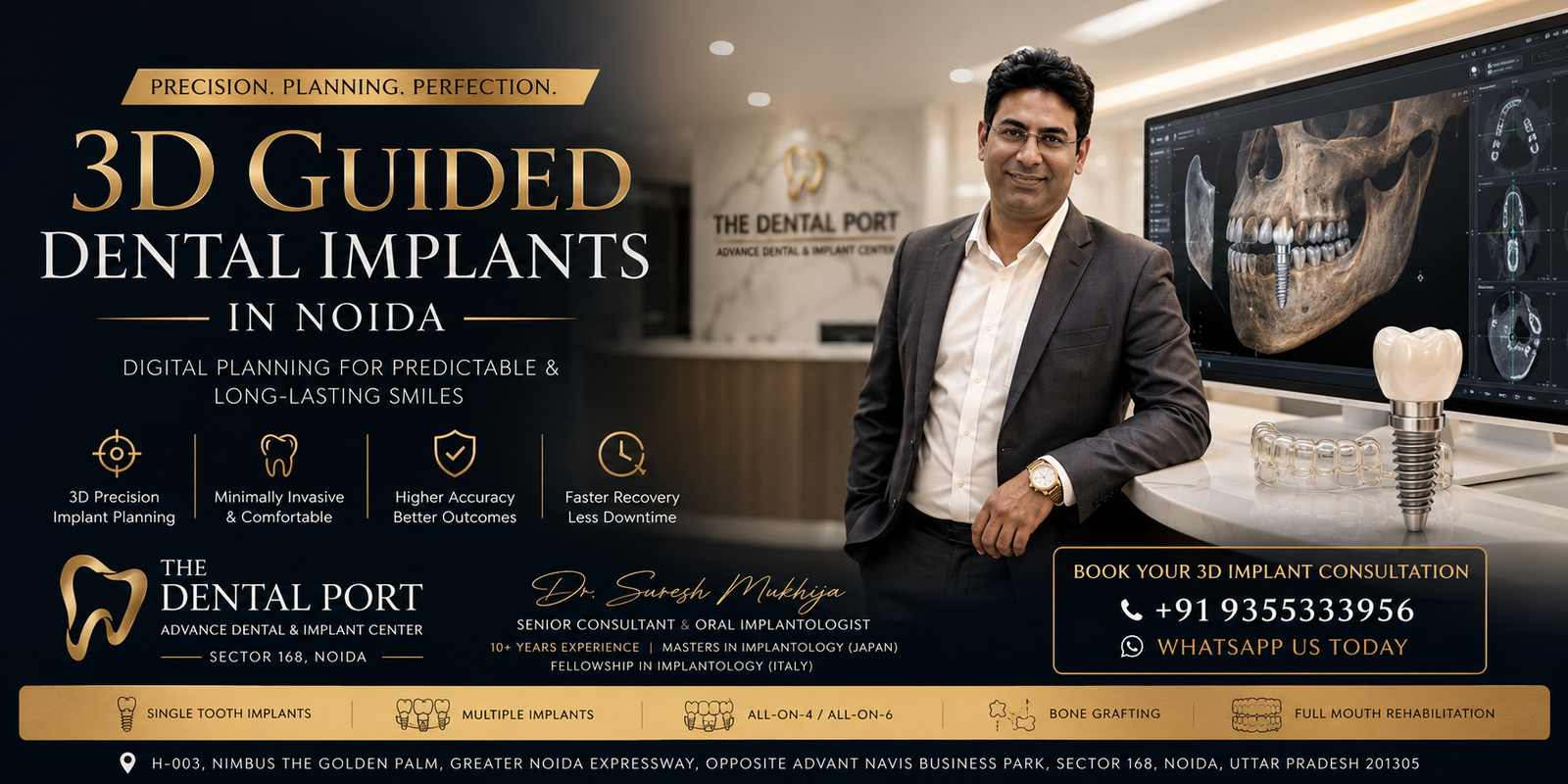
At The Dental Port – Advance Dental & Implant Center, Sector 168, Noida, implant treatment can be planned using digital diagnostic technology to evaluate the available bone, important anatomical structures and the ideal restorative position before implant placement.
The important point is this:
Guided implant surgery is not simply about using a computer. It is about planning the implant around the final tooth before surgery begins.
Quick Answer: What Are 3D Computer-Guided Dental Implants?
3D computer-guided dental implant surgery is a digitally planned implant procedure that combines 3D CBCT imaging, digital dental records and implant-planning software to determine the proposed position of the implant before surgery.
Depending on the case, a custom surgical guide may then be fabricated to help transfer the digital plan to the patient’s mouth.
Compared with conventional freehand placement, computer-assisted implant surgery has been shown in clinical research to improve the accuracy of implant positioning. However, guided surgery does not guarantee a particular accuracy, complication-free treatment or implant lifetime. Clinical results depend on anatomy, planning, guide design, surgical technique, implant system and patient factors.
If you are searching for 3D guided dental implants in Noida, the first step should be a proper clinical and digital evaluation rather than choosing treatment based only on an advertised price.
What Is 3D Computer-Guided Dental Implant Surgery?
Traditional implant placement can involve clinical examination, X-rays and the surgeon’s experience to determine implant position.
3D guided implant dentistry adds another layer of digital planning.
A CBCT scan creates a three-dimensional view of the patient’s jaw. Depending on the diagnostic workflow, this information can be combined with digital intraoral scans or other digital records.
The implantologist can then assess:
- Available bone volume
- Bone width and height
- Position of important nerves
- Relationship to the maxillary sinus
- Adjacent teeth and roots
- Proposed implant angulation
- Implant depth
- Implant diameter
- Prosthetic space
- Position of the future crown
- Whether bone augmentation may be required
The objective is to plan the implant before the surgical procedure begins.
The typical digital workflow
3D CBCT Scan + Digital Dental Records
↓
Virtual Implant Planning
↓
Restorative-Driven Implant Positioning
↓
Custom Surgical Guide, Where Indicated
↓
Clinically Controlled Implant Placement
↓
Healing + Final Crown / Prosthesis
This workflow is particularly valuable when anatomy is limited or when precise implant positioning is important for the final crown, bridge or full-mouth rehabilitation.
Why Is 3D Planning Important for Dental Implants?
A dental implant is not simply placed where there happens to be empty space.
Its position needs to work with the bone, gums, bite and final restoration.
An implant that is positioned appropriately for the future crown can support better restorative planning and help the dentist manage anatomical limitations.
Computer-assisted implant surgery has demonstrated improved accuracy compared with freehand placement in systematic reviews and meta-analyses.
However, there is an important distinction:
A surgical guide improves control of the planned position. It does not replace clinical judgment.
The dentist still needs to evaluate bone quality, soft tissue, systemic factors, occlusion, periodontal health and the patient’s overall treatment requirements.
7 Potential Benefits of 3D Guided Dental Implant Surgery
1. More Controlled Implant Positioning
One of the biggest advantages of computer-guided implant surgery is the ability to plan the implant position digitally before surgery.
The planned position can be evaluated in three dimensions rather than relying only on a 2D image.
Research consistently indicates that computer-assisted approaches can improve implant placement accuracy compared with freehand techniques.
2. Better Understanding of Bone and Anatomy
CBCT imaging allows the implantologist to evaluate the three-dimensional anatomy of the treatment area.
This can help identify:
- Limited bone width
- Reduced vertical bone height
- Anatomical limitations
- Proximity to the inferior alveolar nerve
- Proximity to the maxillary sinus
- Areas where bone grafting may be required
This information can make treatment planning more predictable.
3. Implant Position Can Be Planned Around the Future Tooth
This is one of the most important advantages that patients often overlook.
The implant should ultimately support a crown, bridge or prosthesis.
Digital planning allows the clinician to consider the final restoration and implant position together.
This restorative-driven approach is especially relevant in visible smile areas, multiple implants and full-mouth implant rehabilitation.
4. Potentially Less Invasive Surgery in Selected Cases
Some appropriately selected cases can be treated using a flapless or minimally invasive approach.
But flapless surgery is not automatically better for every patient.
If the dentist needs direct access to the bone, bone grafting, tissue management or another surgical procedure, a conventional flap may still be the safest approach.
Therefore, be cautious of advertisements promising “no cut, no stitches, zero bleeding” for every patient.
The correct surgical technique should be decided after examination and digital planning.
5. Efficient Surgical Workflow
Because much of the implant positioning can be planned before the appointment, guided workflows can make surgery more organized.
The actual procedure time varies considerably according to:
- Number of implants
- Bone availability
- Need for extraction
- Bone grafting
- Sinus procedures
- Implant system
- Surgical approach
- Patient anatomy
A single straightforward implant is very different from a full-mouth reconstruction involving multiple implants.
So rather than promising every patient a specific number of minutes, a responsible implant clinic should provide an estimated treatment timeline after evaluation.
6. Useful for Complex Implant Cases
Digital planning can be particularly helpful when there is:
- Limited bone
- Challenging anatomy
- Multiple missing teeth
- Full-mouth tooth loss
- Immediate implant planning
- Aesthetic-zone implant treatment
- Need for prosthetically driven positioning
- Planned All-on-4 or All-on-6 rehabilitation
- Need to coordinate implants with a future bridge or prosthesis
Guided surgery is a tool. The patient’s anatomy and treatment objectives determine whether it is appropriate.
7. Better Patient Communication
One of the simplest benefits of digital planning is that patients can understand their treatment more clearly.
Instead of saying:
“We will place an implant here.”
the dentist can show the proposed implant position in a 3D planning environment and explain:
- Where the implant will be placed
- How much bone is available
- Where the final crown will sit
- Whether grafting may be necessary
- What the treatment stages may involve
That can make a complicated implant treatment easier to understand.
3D Guided vs Conventional Dental Implant Surgery
| Feature | Conventional / Freehand Approach | 3D Computer-Guided Approach |
|---|---|---|
| Imaging | Depends on case and diagnostic protocol | Typically uses 3D CBCT-based planning |
| Implant planning | Primarily clinical planning | Digital 3D planning before surgery |
| Implant positioning | Relies heavily on clinical guidance | Planned position can be transferred using guided technology |
| Anatomical assessment | Based on available diagnostic records | Three-dimensional evaluation can provide additional information |
| Surgical guide | Not necessarily used | May be used where clinically appropriate |
| Flapless surgery | Possible in selected cases | Possible in selected cases |
| Accuracy | Operator and case dependent | Generally improved transfer accuracy compared with freehand in research |
| Recovery | Depends on surgical procedure | Depends on surgical procedure, not simply on whether guidance was used |
| Cost | Varies | May be higher because of digital planning and guide fabrication |
| Best use | Suitable for many routine cases | Particularly useful when controlled positioning is important |
Systematic reviews support improved positional accuracy with computer-assisted implant placement compared with freehand techniques, although accuracy is influenced by the guide, support, fixation, manufacturing process and clinical circumstances.
Does 3D Guided Implant Surgery Mean Less Pain and Swelling?
Not necessarily in every patient.
The amount of discomfort after implant surgery depends on the procedure performed.
A straightforward implant without grafting may have a very different recovery experience from:
- Multiple implant placement
- Tooth extraction plus implant placement
- Bone grafting
- Sinus augmentation
- Full-mouth implant rehabilitation
When minimally invasive or flapless surgery is clinically appropriate, tissue disruption may be reduced.
But it would be misleading to promise that every guided implant procedure will be painless, swelling-free or stitch-free.
At The Dental Port, the surgical approach should be selected according to the patient’s anatomy and treatment plan.
How Long Does a 3D Dental Implant Take?
There is no single correct time for every implant procedure.
A simple single-tooth implant may be relatively quick, while multiple implants, extraction, grafting or complex full-mouth treatment can take considerably longer.
The more useful question is:
“How long will my specific implant procedure take?”
That can be estimated after the dentist evaluates the CBCT, bone availability, planned implant position and whether additional procedures are required.
How Long Is Recovery After Guided Dental Implant Surgery?
Recovery varies from patient to patient.
For a straightforward implant placement, many patients can return to routine activities relatively quickly, but the biological process of osseointegration takes much longer than the initial surgical recovery.
The implant needs time to integrate with the surrounding bone before it can be considered ready for the definitive restoration in many treatment protocols.
Healing can be affected by:
- Bone quality
- Smoking
- Oral hygiene
- Diabetes and other medical factors
- Periodontal health
- Implant location
- Bone grafting
- Surgical complexity
- Individual healing response
Therefore, “24-hour recovery” should not be confused with complete implant healing.
How Long Do Dental Implants Last?
Dental implants can provide long-term tooth replacement, but no responsible dentist should promise that an implant will last forever.
A systematic review of contemporary dental implants found an estimated 10-year implant-level survival of approximately 96.4% in its traditional analysis, while other long-term systematic reviews have reported high survival rates over extended follow-up.
Long-term implant success depends on more than surgical accuracy.
Maintenance matters.
Patients should maintain:
- Daily brushing
- Interdental cleaning
- Regular professional dental care
- Periodic implant reviews
- Healthy gums
- Good control of relevant medical conditions
- Avoidance of smoking
Implants can develop biological and mechanical complications, so implant placement is not the end of treatment. Maintenance is part of implant care.
Who Is a Good Candidate for 3D Guided Dental Implants?
A person with one or more missing teeth may be considered for dental implants after a proper evaluation.
You may benefit from digital implant planning if you have:
Single missing tooth
An implant can replace the missing tooth without preparing adjacent healthy teeth for a conventional bridge.
Multiple missing teeth
Several implants may support individual crowns or an implant-supported bridge depending on the case.
Loose or failing teeth
Implant treatment may be considered when teeth cannot be predictably saved.
Significant tooth loss
Patients with extensive tooth loss may require an implant-supported denture or full-arch rehabilitation.
Full-mouth tooth loss
Digital planning can help coordinate multiple implants and the future prosthesis in selected full-arch cases.
What If I Don’t Have Enough Bone for an Implant?
Low bone volume does not automatically mean you cannot have dental implants.
Depending on the location and anatomy, treatment may involve:
- Bone grafting
- Guided bone regeneration
- Sinus augmentation
- Alternative implant dimensions
- Different implant positioning
- Other advanced implant protocols
The correct approach can only be decided after clinical examination and appropriate imaging.
This is exactly where 3D CBCT planning can be valuable because it allows the implantologist to assess the available anatomy before surgery.
Is 3D Guided Implant Surgery Suitable for Diabetic Patients?
Diabetes does not automatically rule out dental implants.
However, medical history and glycemic control are important parts of treatment planning.
The dentist may need to consider:
- Current diabetic control
- Healing capacity
- Gum health
- Infection risk
- Medications
- Smoking status
- Overall medical history
A personalized evaluation is more appropriate than assuming that every diabetic patient is either suitable or unsuitable.
Is 3D Guided Surgery Better for All-on-4 or Full-Mouth Implants?
It can be particularly useful in complex implant rehabilitation because several implants need to work together with the final prosthesis.
Digital planning can help evaluate:
- Implant distribution
- Bone availability
- Angulation
- Prosthetic space
- Occlusion
- Anatomical limitations
- Relationship between implants and the planned prosthesis
However, the exact number and position of implants should always be decided after individual assessment.
What Is the Cost of 3D Computer-Guided Dental Implants in Noida?
One of the most common searches is:
“What is the cost of 3D guided dental implants in Noida?”
There is no responsible one-price answer.
The total treatment cost can depend on:
- Number of implants
- Implant brand and system
- Bone condition
- Need for extraction
- Bone grafting
- Sinus augmentation
- Surgical guide / digital planning
- Abutment
- Crown material
- Zirconia or PFM restoration
- Temporary teeth
- Immediate or delayed loading
- Full-mouth versus single-tooth treatment
Why the cheapest implant quote may not be the cheapest treatment
When comparing dental implant prices in Noida, ask what is actually included.
A low advertised price may not include:
- CBCT
- Surgical planning
- Implant component
- Abutment
- Crown
- Temporary restoration
- Bone graft
- Follow-up appointments
Instead of asking only:
“How much is one implant?”
ask:
“What is the complete cost from implant placement to final tooth?”
That gives you a much more meaningful comparison.
At The Dental Port, Sector 168, Noida, the appropriate treatment plan and estimate can be discussed after clinical and digital evaluation.
Why Choose The Dental Port for Dental Implants in Noida?
At The Dental Port – Advance Dental & Implant Center, Sector 168, Noida, implant treatment is planned around the patient’s individual anatomy and restorative requirements.
The clinic’s website identifies Dr. Purnima as a cosmetic dental specialist and Dr. Suresh Mukhija as a senior consultant and oral implantologist, with advanced implant care offered at the Noida center.
For patients considering dental implants, the goal should not simply be to find the clinic advertising the lowest implant price.
Look for:
Diagnosis → Digital Planning → Surgical Expertise → Appropriate Implant System → Quality Restoration → Long-Term Maintenance
That complete pathway matters more than a headline price.
What Happens During a 3D Implant Consultation?
Your appointment may include:
Step 1: Clinical examination
The dentist evaluates the missing tooth area, gums, bite and surrounding teeth.
Step 2: Digital imaging
A CBCT scan may be recommended when three-dimensional assessment is clinically indicated.
Step 3: Digital planning
The proposed implant position can be assessed in relation to available bone and the intended restoration.
Step 4: Treatment discussion
The dentist explains whether you need:
- Implant placement
- Extraction
- Bone grafting
- Sinus augmentation
- Temporary teeth
- Single crown
- Implant bridge
- Full-mouth rehabilitation
Step 5: Personalized estimate
You receive a treatment plan based on your actual clinical requirements rather than a generic online quote.
7 Questions to Ask Before Choosing a Dental Implant Clinic in Noida
Before booking an implant treatment, ask:
1. Will my case be evaluated with 3D CBCT when indicated?
2. Who will plan and place my implant?
3. Is the treatment planned around the final crown or prosthesis?
4. Do I need bone grafting?
5. What implant brand and components are included?
6. Does the quoted price include the abutment and final crown?
7. What follow-up and maintenance will I need after treatment?
These questions can help you compare implant clinics based on quality of treatment rather than price alone.
3D Guided Dental Implants in Noida: The Bottom Line
3D computer-guided dental implant surgery represents an important development in modern implant dentistry.
Its biggest advantage is not a marketing promise of “painless implants” or a guaranteed number of minutes.
Its real value is better visualization and more controlled transfer of a digitally planned implant position.
Evidence indicates that computer-assisted implant surgery can provide greater placement accuracy than conventional freehand techniques.
But technology is only one part of successful implant treatment.
The right diagnosis, experienced clinical decision-making, appropriate implant selection, careful surgery, quality restoration and long-term maintenance all matter.
If you are missing one tooth, several teeth or all of your teeth, a personalized 3D implant evaluation can help determine whether guided implant treatment is appropriate for you.
Ready to Explore 3D Guided Dental Implants in Noida?
If you are searching for dental implants in Noida, 3D guided dental implants in Noida, computer-guided implant surgery, implant dentist near Sector 168, or full-mouth dental implants, start with a proper evaluation rather than an online price comparison.
Book a Dental Implant Consultation at The Dental Port – Advance Dental & Implant Center, Sector 168, Noida.
📍 H-003, Nimbus The Golden Palm, Greater Noida Expressway, opposite Advant Navis Business Park, Sector 168, Noida, Uttar Pradesh 201305
📞 Call / WhatsApp: +91 9355333956
🌐 The Dental Port: www.thedentalport.com
Ask about a personalized dental implant evaluation and whether 3D computer-guided planning is appropriate for your case.
Medical disclaimer: This article is for general educational information and does not replace an in-person dental examination, diagnostic imaging or individualized treatment advice. Dental implant treatment, surgical approach, healing time and prognosis vary between patients.



Pingback: Straumann vs Nobel Biocare Implants in Noida | Which Is Better?