By The Dental Port – Advance Dental & Implant Center, Noida
A tooth that had a root canal years ago suddenly starts hurting—and naturally, the first thought is:
“Wasn’t this tooth already treated?”
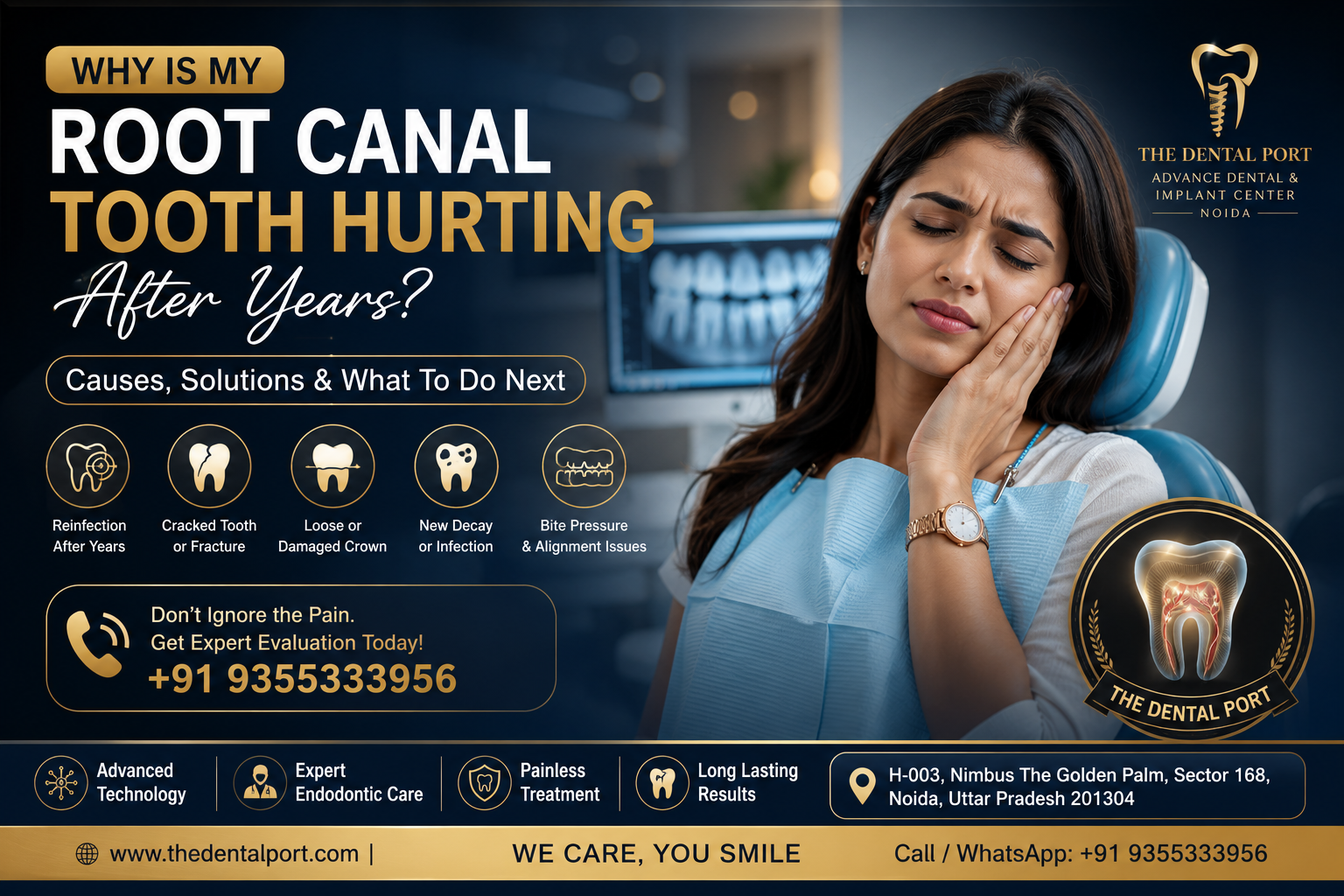
If you’re searching “Why is my root canal tooth hurting after years?”, you’re certainly not alone. Although Root Canal Treatment (RCT) has a success rate of over 90–95%, no dental procedure can guarantee lifelong success in every case. A root canal-treated tooth can remain healthy for decades, but new problems can develop over time.
The good news? Most painful root canal teeth can still be saved when diagnosed early.
At The Dental Port – Advance Dental & Implant Center, Noida, our experienced endodontic team uses Digital RVG X-rays, CBCT 3D Imaging, Dental Operating Magnification, and Laser-Assisted Root Canal Therapy to accurately identify the cause of pain and provide minimally invasive treatment.
Why Does a Root Canal Tooth Hurt After Years?
A root canal removes infected pulp, disinfects the canals, and seals them to prevent bacteria from returning.
However, teeth continue to function under constant chewing forces, and over several years, new issues may arise.
Common symptoms include:
- Pain while chewing
- Tenderness on biting
- Gum swelling
- Sensitivity around the tooth
- Bad taste in the mouth
- Recurrent dental abscess
- Loose dental crown
- Dull continuous pain
The underlying reason isn’t always a failed root canal—it could be a completely new problem.
1. Root Canal Re-Infection (Most Common Cause)
The most common reason for delayed pain is reinfection.
Despite excellent treatment, some teeth have:
- Extremely narrow canals
- Curved roots
- Hidden accessory canals
- Complex anatomy
Tiny bacteria may remain hidden or may enter later if the restoration leaks.
Symptoms
- Throbbing pain
- Swollen gums
- Pus discharge
- Bad breath
- Pain while biting
- Gum boil (Dental abscess)
Without treatment, infection may spread to the surrounding jawbone.
2. Cracked Tooth or Vertical Root Fracture
After root canal treatment, the tooth becomes less flexible because its nerve has been removed.
Without proper protection—especially a dental crown—the tooth may develop microscopic cracks.
Over time these cracks allow bacteria to enter the root.
Signs
- Sharp pain while chewing
- Pain on releasing bite pressure
- Sudden discomfort
- Intermittent pain
- Localized swelling
Some fractures are invisible on routine X-rays and require CBCT Scan for diagnosis.
3. Loose or Damaged Dental Crown
Many patients delay replacing worn-out crowns.
A loose crown creates tiny gaps where saliva and bacteria enter.
Eventually, bacteria travel into the root canal system again.
Signs include:
- Loose crown
- Food getting stuck
- Bad smell
- Gum irritation
- Crown movement
Replacing a damaged crown early often prevents reinfection.
4. New Tooth Decay Around the Crown
A root canal-treated tooth can still develop cavities.
The nerve has been removed—but the outer tooth structure remains vulnerable.
Decay beneath crowns or fillings can:
- Break the seal
- Allow bacterial leakage
- Cause secondary infection
- Weaken the remaining tooth
Good oral hygiene and regular dental checkups significantly reduce this risk.
5. Bite Problems (High Bite)
Sometimes the tooth itself is healthy.
Instead, excessive bite pressure causes inflammation of the ligament around the tooth.
Patients often describe:
- Pain only while chewing
- Mild soreness
- Feeling that one tooth is “higher”
A simple bite adjustment often provides immediate relief.
6. Missed Root Canal During Initial Treatment
Some teeth naturally have additional canals.
Examples include:
- Upper molars
- Lower molars
- Premolars
If one canal was extremely difficult to locate during the original procedure, bacteria may remain inside.
Modern Dental Microscopes and CBCT Scans can identify missed canals that conventional X-rays often miss.
7. Infection at the Root Tip (Apical Periodontitis)
Sometimes infection develops around the root despite an apparently successful treatment.
This may happen because of:
- Persistent bacteria
- Leakage
- Cracks
- Delayed healing
The infection causes bone loss around the root tip, resulting in pain and swelling.
Why Does Pain Return After 5, 10 or Even 20 Years?
Patients are often surprised when symptoms appear after many years.
This usually happens because:
- Crown leakage develops gradually.
- Tooth fractures occur over time.
- New decay forms around the restoration.
- Natural wear compromises the seal.
- Bacteria slowly multiply until symptoms appear.
The tooth may have been functioning perfectly until recently.
How Is the Problem Diagnosed?
At The Dental Port – Advance Dental & Implant Center, Noida, diagnosis focuses on identifying the exact cause before recommending treatment.
Your evaluation may include:
- Comprehensive dental examination
- Digital RVG X-rays
- CBCT 3D Scan (when required)
- Bite analysis
- Crown assessment
- Gum examination
- Percussion and mobility tests
Accurate diagnosis helps avoid unnecessary extraction.
Treatment Options
Treatment depends on the underlying cause.
Root Canal Retreatment
If reinfection is detected, the previous root filling is removed, the canals are disinfected again, and the tooth is resealed.
Modern retreatment has an excellent success rate.
Laser-Assisted Root Canal Therapy
Laser technology helps eliminate bacteria from complex canal anatomy more effectively than conventional irrigation alone.
Benefits include:
- Better disinfection
- Less post-operative discomfort
- Faster healing
- Higher treatment precision
Crown Replacement
If the crown has failed but the root canal remains healthy, replacing the crown may solve the problem.
Bite Adjustment
A minor adjustment can relieve excessive pressure and reduce inflammation.
Apicoectomy (Root-End Surgery)
If retreatment cannot eliminate the infection, a minor surgical procedure removes the infected root tip while preserving the tooth.
Tooth Extraction & Dental Implant
If the tooth cannot be saved because of a severe fracture or extensive damage, extraction followed by a Dental Implant may be the best long-term solution.
When Is It an Emergency?
Seek immediate dental care if you experience:
- Facial swelling
- Severe continuous pain
- Fever
- Difficulty opening your mouth
- Difficulty swallowing
- Pus discharge
- Rapidly increasing swelling
These signs may indicate a spreading dental infection requiring urgent treatment.
Can Root Canal Failure Be Prevented?
Absolutely.
You can significantly increase the lifespan of your treated tooth by:
- Brushing twice daily
- Flossing regularly
- Getting professional dental cleaning every six months
- Replacing damaged crowns promptly
- Avoiding chewing ice or hard objects
- Wearing a night guard if you grind your teeth
- Visiting your dentist for routine checkups
With proper care, many root canal-treated teeth last 20 years or longer.
Frequently Asked Questions (FAQs)
Is it normal for a root canal tooth to hurt after years?
No. Pain years later usually indicates reinfection, a crack, bite problems, or restoration failure and should be evaluated promptly.
Can a root canal become infected again?
Yes. Bacteria can re-enter through leaking crowns, new decay, fractures, or untreated accessory canals.
Can antibiotics cure the infection?
No. Antibiotics may temporarily reduce swelling but cannot eliminate bacteria trapped inside the tooth. Definitive dental treatment is usually required.
Is root canal retreatment painful?
Modern retreatment is performed under local anesthesia and is generally no more uncomfortable than the original root canal.
Can a root canal tooth be saved again?
In many cases, yes. Early diagnosis greatly improves the chances of saving the natural tooth.
Why Choose The Dental Port – Advance Dental & Implant Center, Noida?
When dealing with a painful root canal tooth, experience and technology make a significant difference.
At The Dental Port – Advance Dental & Implant Center, we offer:
- Expert Endodontic Care
- Single-Sitting Root Canal Treatment
- Root Canal Retreatment
- Laser-Assisted RCT
- Digital RVG & CBCT 3D Imaging
- High-Precision Diagnosis
- Microscope-Assisted Procedures
- Premium Zirconia Crowns
- Comprehensive Dental Implant Solutions
- Personalized, Patient-Centered Care
Our goal is always to preserve your natural tooth whenever possible while ensuring long-term oral health.
Don’t Ignore Pain in a Previously Treated Tooth
If your root canal tooth has started hurting after months or even years, don’t wait for the pain to become unbearable. Early diagnosis can often prevent more complex treatment and help save your natural tooth.
Whether the cause is reinfection, a cracked tooth, a failed crown, or bite-related stress, our specialists can identify the problem using advanced diagnostics and recommend the most effective treatment.
Book your consultation today with The Dental Port – Advance Dental & Implant Center, Noida.
📍 The Dental Port – Advance Dental & Implant Center
H-003, Nimbus The Golden Palm, Sector 168, Noida, Uttar Pradesh
🌐 Website: https://www.thedentalport.com
📞 Call / WhatsApp: +91 9355333956